
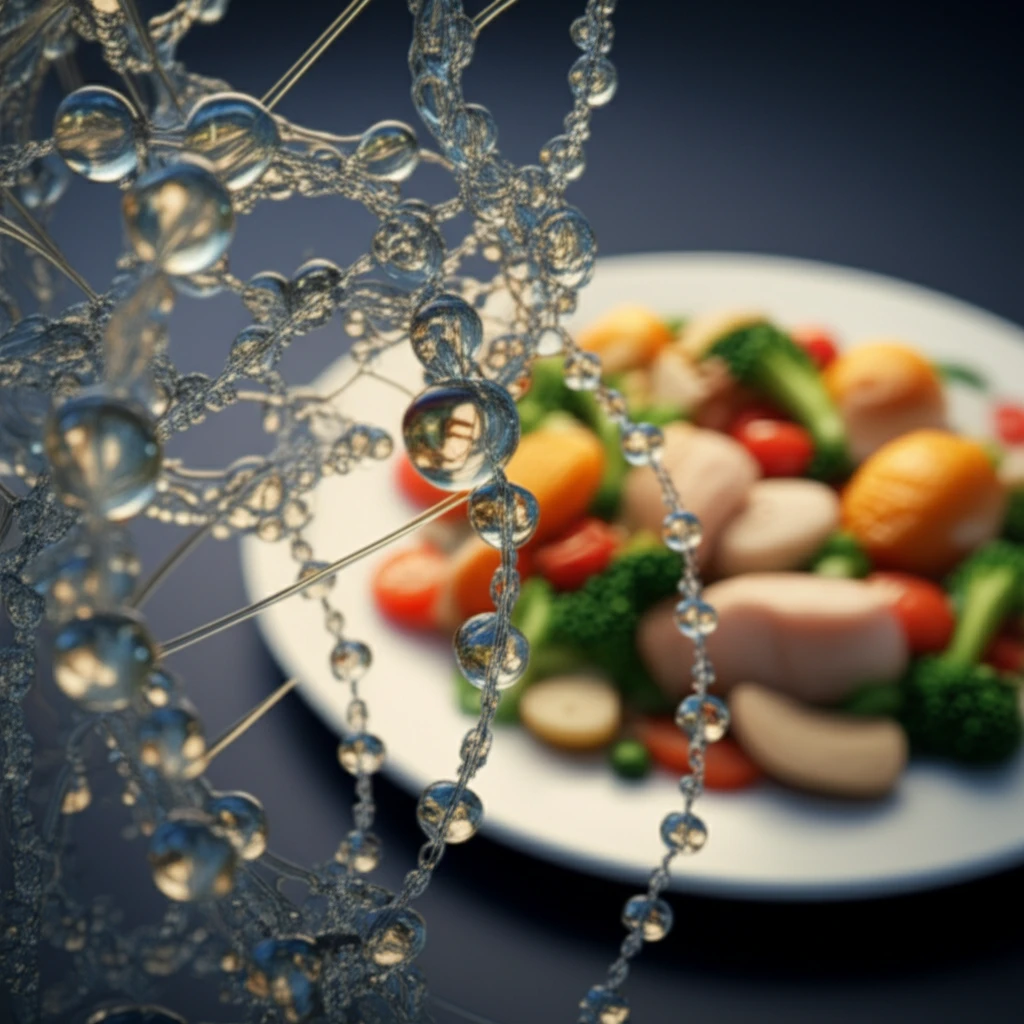
Microscopic water droplets forming a complex food structure, representing the future of food innovation.

Water-in-Water Emulsions: The Tiny Tech Revolutionizing Food Science?

"From healthier ingredients to innovative textures, discover how particle-stabilized emulsions are reshaping the future of food."


The food industry is constantly evolving, driven by consumer demand for healthier, more sustainable, and innovative products. One of the most promising areas of development is the use of water-in-water (W/W) emulsions. These unique systems, where droplets of one aqueous phase are dispersed within another, are opening up new possibilities for food scientists and manufacturers.

Unlike traditional oil-in-water or water-in-oil emulsions, W/W emulsions rely on the phase separation of incompatible biopolymers – natural substances like proteins and polysaccharides – within a predominantly aqueous environment. This allows for the creation of novel textures, improved ingredient delivery, and the reduction of unwanted components like fats.

This article delves into the fascinating world of particle-stabilized W/W emulsions, exploring their underlying principles, applications, and potential to revolutionize the food we eat.

Understanding Water-in-Water Emulsions: A Deeper Dive

Microscopic water droplets forming a complex food structure, representing the future of food innovation.

At their core, W/W emulsions are a result of thermodynamic incompatibility. When certain biopolymers are mixed in water at sufficient concentrations, they tend to separate into distinct phases, forming droplets of one phase dispersed in the other. This phenomenon is governed by factors like polymer type, concentration, temperature, pH, and ionic strength.

However, these emulsions are inherently unstable due to the low interfacial tension between the two aqueous phases. This is where particle stabilization comes in. By introducing colloidal particles – tiny solid or soft matter – to the system, we can create a robust and long-lasting emulsion.

  • Particle Types: A wide range of particles can be used, including proteins, polysaccharides, inorganic materials, and even microorganisms.
  • Mechanism of Action: Particles adsorb at the water-water interface, creating a physical barrier that prevents droplets from coalescing.
  • Pickering Stabilization: This process is similar to Pickering stabilization in traditional emulsions, where solid particles stabilize the interface between oil and water.
The effectiveness of particle stabilization depends on several factors, including particle size, shape, surface properties, and concentration. In general, larger, more hydrophobic particles tend to be more effective at stabilizing W/W emulsions.

The Future of Food is Here

Particle-stabilized water-in-water emulsions offer a powerful platform for creating next-generation food products. By carefully selecting the right biopolymers and particles, food scientists can tailor the texture, stability, and nutritional profile of these emulsions to meet specific needs.

From low-fat spreads and healthier dressings to innovative desserts and functional foods, the possibilities are endless. As research in this area continues to grow, we can expect to see even more exciting applications of W/W emulsions in the years to come.

The journey of water-in-water emulsions from a scientific curiosity to a promising food technology highlights the power of innovation in addressing the challenges and opportunities of the modern food industry. These tiny innovations hold the key to creating a future of food that is both delicious and sustainable.

About this Article -

This article was crafted using a human-AI hybrid and collaborative approach. AI assisted our team with initial drafting, research insights, identifying key questions, and image generation. Our human editors guided topic selection, defined the angle, structured the content, ensured factual accuracy and relevance, refined the tone, and conducted thorough editing to deliver helpful, high-quality information.See our About page for more information.

This article is based on research published under:

DOI-LINK: 10.1016/j.tifs.2018.11.004, Alternate LINK

Title: Particle-Based Stabilization Of Water-In-Water Emulsions Containing Mixed Biopolymers

Subject: Food Science

Journal: Trends in Food Science & Technology

Publisher: Elsevier BV

Authors: Eric Dickinson

Published: 2019-01-01

Everything You Need To Know

1

How do water-in-water emulsions differ from traditional oil-in-water or water-in-oil emulsions, and what makes them unique for food applications?

Water-in-water (W/W) emulsions differ significantly from conventional emulsions because they involve the dispersion of one aqueous phase within another, rather than oil and water. These emulsions rely on the thermodynamic incompatibility of biopolymers, such as proteins and polysaccharides, causing them to separate into distinct phases within a water-based environment. Unlike traditional emulsions, W/W emulsions utilize particle stabilization to maintain their structure, employing colloidal particles to prevent the droplets from coalescing, this is particularly important due to the low interfacial tension between the two aqueous phases.

2

Why is particle stabilization so important in water-in-water emulsions, and how does it prevent the separation of the aqueous phases?

Particle stabilization is crucial for maintaining the structure of water-in-water (W/W) emulsions. Without it, the two aqueous phases would quickly separate due to the low interfacial tension between them. Particle stabilization involves introducing colloidal particles that adsorb at the water-water interface, creating a physical barrier that prevents the droplets from coalescing. This process is similar to Pickering stabilization, where solid particles stabilize the interface between oil and water. Effective particle stabilization depends on factors like particle size, shape, surface properties and concentration.

3

What types of particles can be used to stabilize water-in-water emulsions, and how do these particles contribute to the overall stability and functionality?

Various types of particles, including proteins, polysaccharides, inorganic materials, and even microorganisms, can be used in water-in-water (W/W) emulsions for particle stabilization. The selection of particle types depends on the desired properties of the final food product. For instance, proteins and polysaccharides contribute to the nutritional profile and texture, while inorganic materials can enhance stability. The effectiveness of these particles hinges on their ability to adsorb at the water-water interface and prevent droplet coalescence. The size, shape, and surface properties of the particles also play a crucial role in the overall stability and functionality of the emulsion.

4

In what ways could water-in-water emulsions change the way food products are made, and what are the benefits for consumers and manufacturers?

Water-in-water (W/W) emulsions offer potential for revolutionizing food products by enabling the creation of healthier, tastier, and more sustainable options. These emulsions allow food scientists to tailor the texture, stability, and nutritional profile of food. For example, W/W emulsions can be used to reduce fat content while maintaining a creamy texture or to encapsulate and deliver specific nutrients more effectively. The ability to use natural biopolymers and particles in these emulsions aligns with the growing consumer demand for cleaner and more sustainable food ingredients.

5

What factors influence the stability of water-in-water emulsions, and how can these be controlled to produce consistent results?

The stability of water-in-water (W/W) emulsions is influenced by factors such as polymer type, concentration, temperature, pH, and ionic strength. These parameters affect the thermodynamic incompatibility of the biopolymers, which is fundamental to the formation of the emulsion. Particle characteristics such as size, shape, surface properties, and concentration of colloidal particles added for stabilization also play a crucial role. Fine-tuning these factors enables the creation of stable and functional W/W emulsions for various food applications.

Newsletter Subscribe

Subscribe to get the latest articles and insights directly in your inbox.