
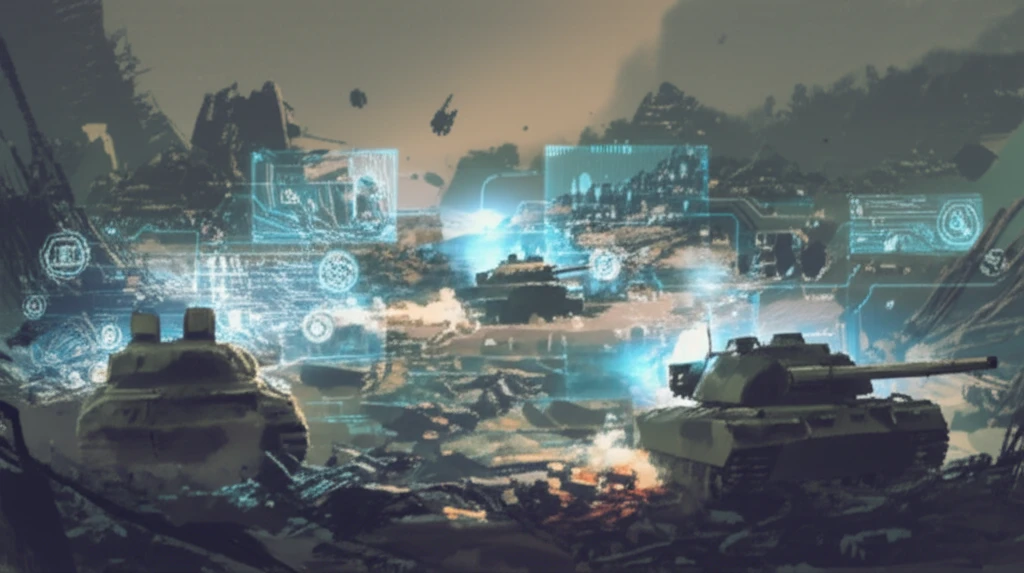
Military vehicles navigate a war-torn landscape with AI-powered holographic route projections.

Wartime Navigation: Can AI Keep Military Vehicles Safe?

"New research explores how to optimize routes for military vehicles in conflict zones, leveraging AI for enhanced safety and robustness against unpredictable threats."


Planning routes for military vehicles during wartime is far more complex than ordinary navigation. It's not just about getting from point A to point B; it's about survival. Unlike civilian transportation, military route planning must account for unpredictable enemy actions, fluctuating weather conditions, and the ever-changing state of roads. All these elements can drastically alter a mission's course, making it a high-stakes challenge for commanders.

The crucial difference lies in the element of enemy interference. Military vehicles aren't simply transporting goods; they're potential targets. This threat necessitates a shift in focus from mere efficiency to prioritizing vehicle safety above all else. The goal is to design routes that minimize exposure to attacks, ensuring that vehicles arrive at their destinations intact and ready for action.

This article explores recent advances in military vehicle route planning, focusing on a novel approach that combines scenario-based planning with k-th shortest path algorithms. This method aims to create robust routes that are not only efficient but also resilient to unforeseen dangers, offering a significant improvement over traditional planning methods.

K-Shortest Path Planning: A Safer Route?

Military vehicles navigate a war-torn landscape with AI-powered holographic route projections.

Traditional route planning often seeks the single, most efficient path. However, in a war zone, predictability can be a liability. The k-shortest path approach offers a solution by generating a set of 'k' different, viable routes from origin to destination. This provides flexibility and allows for adaptation if the primary route becomes compromised.

The beauty of this method lies in its ability to incorporate various scenarios. Each scenario represents a possible situation, complete with probabilities of occurrence and specific safe passage probabilities (SPPs) for each road segment. By considering multiple scenarios, the algorithm identifies routes that perform well across a range of conditions, rather than excelling in only one specific situation.

Here's how the k-shortest path planning model works:
  • Scenario Definition: Define a range of possible wartime scenarios, considering factors like enemy presence, road conditions, and weather.
  • Probability Assignment: Assign probabilities to each scenario, reflecting the likelihood of its occurrence.
  • SPP Calculation: Determine the safe passage probability (SPP) for each road segment in each scenario. This represents the likelihood of a vehicle successfully traversing that segment without incident.
  • K-Shortest Path Generation: Generate 'k' different routes from origin to destination for each vehicle.
  • Robustness Optimization: Select the routes that maximize the overall expected safety across all scenarios, considering both the SPPs and the scenario probabilities.
This approach ensures that the chosen routes are not only short but also resilient to potential threats. By diversifying the possible paths and considering multiple scenarios, the system significantly enhances the chances of vehicles arriving safely, even in the face of unexpected challenges.

The Future of Safe Military Navigation

The research presented offers a promising step towards safer and more reliable military vehicle navigation in conflict zones. By integrating scenario-based planning with the k-shortest path algorithm, it addresses the critical need for robustness in the face of unpredictable threats.

While the current model makes certain assumptions, such as constant travel times and pre-defined road capacities, future research can expand upon this foundation. Incorporating real-time data, dynamic updates, and adaptive learning algorithms could further enhance the system's effectiveness.

Ultimately, the goal is to create a navigation system that not only gets military vehicles to their destinations but also protects them along the way. As technology advances, AI-powered route planning will play an increasingly vital role in ensuring the safety and success of military operations.

About this Article -

This article was crafted using a human-AI hybrid and collaborative approach. AI assisted our team with initial drafting, research insights, identifying key questions, and image generation. Our human editors guided topic selection, defined the angle, structured the content, ensured factual accuracy and relevance, refined the tone, and conducted thorough editing to deliver helpful, high-quality information.See our About page for more information.

This article is based on research published under:

DOI-LINK: 10.1051/matecconf/20168102005, Alternate LINK

Title: Maneuvering Route Safety Planning For Military Vehicles During Wartime

Subject: General Medicine

Journal: MATEC Web of Conferences

Publisher: EDP Sciences

Authors: Tan Zhao, Jincai Huang, Guangquan Cheng, Chao Chen, Jianmai Shi

Published: 2016-01-01

Everything You Need To Know

1

What is the k-shortest path algorithm?

The k-shortest path algorithm is a method of route planning that generates multiple viable routes, rather than just one. This approach is particularly useful in wartime scenarios because it provides flexibility and allows for adaptation if the primary route becomes compromised due to enemy actions, changing weather, or road conditions. Instead of relying on a single path, the algorithm offers a set of 'k' different routes from the origin to the destination, which increases the chances of a safe arrival.

2

What is the significance of scenario-based planning?

Scenario-based planning is a critical component because it allows the system to consider a range of possible wartime situations. These scenarios take into account factors such as enemy presence, road conditions, and weather. Each scenario is assigned a probability of occurrence. By analyzing multiple scenarios, the algorithm identifies routes that perform well across a range of potential challenges. It is crucial because it addresses the inherent unpredictability of conflict zones.

3

What is the Safe Passage Probability (SPP) and why is it important?

The Safe Passage Probability (SPP) is a measure of the likelihood of a vehicle successfully traversing a specific road segment without incident. It is calculated for each road segment within each defined scenario. The SPP is essential for the algorithm to assess the safety of various routes. Routes with higher SPPs are prioritized during the selection process because they are more likely to keep the vehicles safe from attacks. This approach prioritizes safety.

4

How does the combination of scenario-based planning and the k-shortest path algorithm improve military vehicle navigation?

The integration of scenario-based planning with the k-shortest path algorithm enhances the safety and reliability of military vehicle navigation. The k-shortest path provides multiple route options, while the scenario-based planning assesses the safety of each route under various conditions. By combining these methods, the system can generate routes that are not only efficient but also resilient to potential threats. This leads to a significant increase in the probability of vehicles reaching their destinations safely.

5

How does military vehicle route planning differ from civilian navigation?

Military vehicle route planning differs significantly from civilian navigation due to the increased risk of enemy interference. Military vehicles are potential targets, necessitating a shift in focus from mere efficiency to prioritizing vehicle safety. Civilian navigation focuses on the shortest or fastest route, whereas military planning must account for unpredictable enemy actions, fluctuating weather, and changing road conditions. The goal is to minimize exposure to attacks and ensure that vehicles arrive at their destinations intact and ready for action. This requires a far more complex and robust approach.

Newsletter Subscribe

Subscribe to get the latest articles and insights directly in your inbox.