
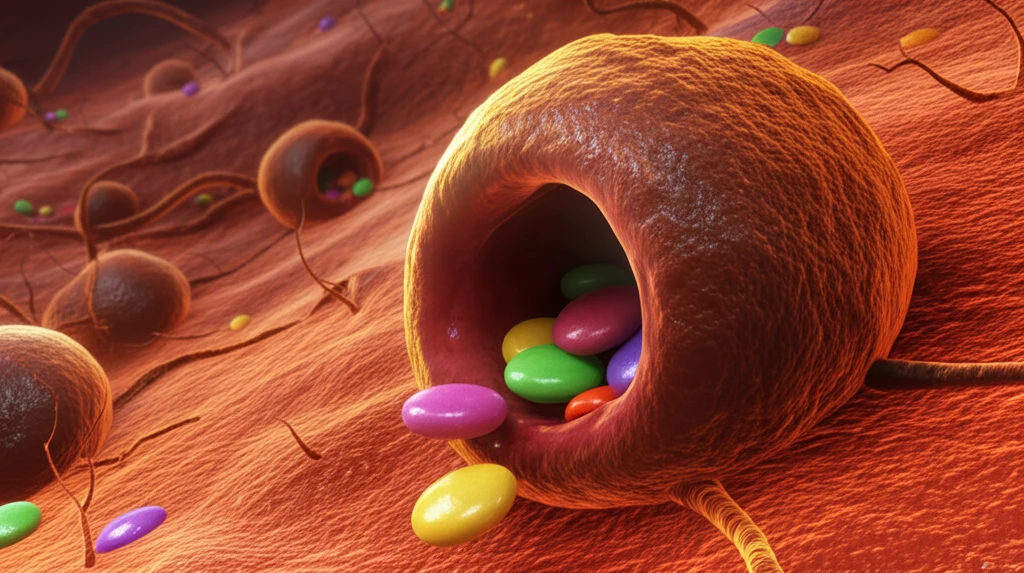
Cancer cells consuming glucose, Warburg Effect

Warburg Effect: How Cancer Cells Cheat & What It Means for Your Health

"Uncover the Warburg effect, its role in gynecologic cancers, and the latest research offering hope for targeted treatments."


Your body's cells normally create energy through a process called oxidative phosphorylation, which requires oxygen. However, in the 1920s, a scientist named Otto Warburg discovered that cancer cells have a different way of producing energy, even when oxygen is available. This is known as the "Warburg effect."

Instead of fully utilizing oxygen in the mitochondria, cancer cells tend to favor glycolysis, a process where glucose is broken down into lactate. This happens regardless of whether there's enough oxygen or not. While glycolysis is faster at producing energy, it's also far less efficient, forcing cancer cells to consume much more glucose than normal cells.

The Warburg effect is now a well-known marker of cancer and is used in techniques like PET scans to visualize tumors. While it might seem like a weakness, this energy strategy helps tumors survive and grow, especially when they lack a good blood supply. Moreover, by producing lactate, cancer cells create an acidic environment that supports their invasion and spread.

Key Players in the Warburg Effect: Understanding the Mechanisms

Cancer cells consuming glucose, Warburg Effect

Several key molecules and enzymes drive the Warburg effect, making them potential targets for cancer therapy.

Pyruvate Kinase M (PKM): This enzyme has two forms, PKM1 and PKM2. Most normal cells use PKM1, while cancer cells primarily use PKM2. PKM2 helps accelerate tumor growth, even under low-oxygen conditions.

  • Glucose Transporters (GLUTs): These proteins help bring glucose into cells. Cancer cells often increase the expression of GLUT1 and GLUT3 to take in more glucose.
  • Lactate Dehydrogenase A (LDHA): This enzyme converts pyruvate into lactate, which is then exported out of the cell. Increased LDHA expression is common in cancer cells.
  • Hypoxia-Inducible Factor-1 (HIF1): HIF1 is a transcription factor that promotes glycolysis and suppresses the use of oxygen in cancer cells. It's activated when oxygen levels are low, helping tumors adapt and survive.
  • p53: Often called a tumor suppressor, p53 helps control energy metabolism by reducing glycolysis and increasing mitochondrial respiration. Mutations in the TP53 gene are common in cancer.
Interestingly, recent studies have identified a "reverse Warburg effect" where cancer cells cause adjacent stromal cells to undergo glycolysis, providing energy for the cancer cells. This complex interaction further demonstrates how cancer cells manipulate their environment to survive.

The Future of Cancer Treatment: Targeting the Warburg Effect

The Warburg effect represents a key mechanism driving cancer growth, and it is a promising target for new cancer treatments. As research evolves and new drugs emerge, targeting cancer metabolism could transform how we manage and treat cancer in the future.

About this Article -

This article was crafted using a human-AI hybrid and collaborative approach. AI assisted our team with initial drafting, research insights, identifying key questions, and image generation. Our human editors guided topic selection, defined the angle, structured the content, ensured factual accuracy and relevance, refined the tone, and conducted thorough editing to deliver helpful, high-quality information.See our About page for more information.

This article is based on research published under:

DOI-LINK: 10.1111/jog.13867, Alternate LINK

Title: Warburg Effect In Gynecologic Cancers

Subject: Obstetrics and Gynecology

Journal: Journal of Obstetrics and Gynaecology Research

Publisher: Wiley

Authors: Yusuke Kobayashi, Kouji Banno, Haruko Kunitomi, Takayuki Takahashi, Takashi Takeda, Kanako Nakamura, Kosuke Tsuji, Eiichiro Tominaga, Daisuke Aoki

Published: 2018-12-03

Everything You Need To Know

1

What is the Warburg effect, and how does it relate to cancer?

The Warburg effect is a metabolic shift observed in cancer cells, where they favor glycolysis, the breakdown of glucose into lactate, even when sufficient oxygen is present. This differs from normal cells, which primarily use oxidative phosphorylation for energy production. This effect is crucial because it allows cancer cells to rapidly produce energy, supporting their proliferation and survival, particularly in environments with limited oxygen supply. The Warburg effect is used in techniques like PET scans to visualize tumors.

2

What are the key molecules and enzymes involved in the Warburg effect?

Several key players drive the Warburg effect. These include Pyruvate Kinase M (PKM), with cancer cells mainly using PKM2 to accelerate growth. Glucose Transporters (GLUTs) are also involved, with cancer cells often increasing the expression of GLUT1 and GLUT3 to uptake more glucose. Lactate Dehydrogenase A (LDHA) converts pyruvate into lactate, and Hypoxia-Inducible Factor-1 (HIF1) promotes glycolysis. Finally, p53, a tumor suppressor, helps control energy metabolism. These molecules and enzymes offer potential targets for cancer therapy.

3

How does the Warburg effect impact the tumor microenvironment?

The Warburg effect significantly alters the tumor microenvironment. The production of lactate by cancer cells creates an acidic environment, which supports tumor invasion and spread. Furthermore, the "reverse Warburg effect" involves cancer cells inducing glycolysis in adjacent stromal cells, providing additional energy for the cancer cells. These interactions highlight the complex ways cancer cells manipulate their surroundings to facilitate their survival and growth.

4

What is the significance of PKM2 in the context of the Warburg effect?

PKM2, a form of the enzyme Pyruvate Kinase M, plays a crucial role in the Warburg effect. While normal cells predominantly use PKM1, cancer cells favor PKM2. This isoform helps accelerate tumor growth, even under low-oxygen conditions. Targeting PKM2 represents a potential therapeutic strategy because inhibiting this enzyme could disrupt the cancer cells' ability to generate energy through glycolysis, potentially slowing or stopping tumor progression.

5

How could understanding the Warburg effect lead to new cancer treatments?

The Warburg effect provides several potential targets for new cancer treatments. By understanding the mechanisms that drive the Warburg effect, researchers can develop drugs that specifically target the key molecules and enzymes involved. For example, inhibiting PKM2, blocking GLUTs, or targeting LDHA could disrupt cancer cell metabolism and hinder tumor growth. Since HIF1 is activated when oxygen levels are low, treatments could focus on HIF1 to suppress the use of oxygen in cancer cells. Such targeted therapies could potentially be more effective and less toxic than traditional treatments. These therapies could transform how cancer is managed and treated.

Newsletter Subscribe

Subscribe to get the latest articles and insights directly in your inbox.