
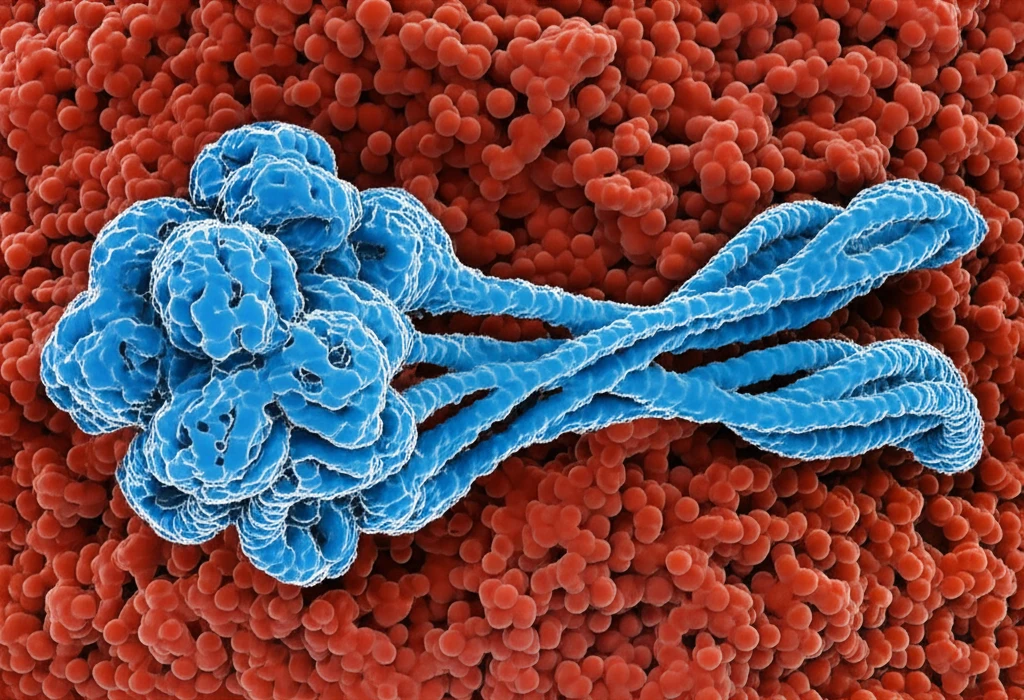
VWF Unveiled: Comparing Recombinant vs. Plasma-Derived Forms for Enhanced Blood Clotting Therapies

"Atomic Force Microscopy reveals structural secrets, paving the way for improved von Willebrand factor treatments."
Von Willebrand factor (VWF) is a crucial protein in our blood, acting like a molecular glue that helps initiate blood clotting. Think of it as the first responder at the scene of an injury, attracting platelets to form a plug and stop the bleeding. Inherited deficiencies or defects in VWF lead to von Willebrand disease (VWD), a common bleeding disorder with symptoms ranging from mild to severe.
VWF comes in different forms, primarily sourced from blood plasma (pdVWF) or manufactured through recombinant technology (rVWF). Both aim to restore proper clotting function in VWD patients, but they aren't identical. A key difference lies in their structure, particularly the presence of ultra-large multimers, which are the most active forms of VWF. Understanding these structural nuances is vital for optimizing treatment strategies.
This article delves into the microscopic world of VWF, comparing the structural characteristics of pdVWF and rVWF using atomic force microscopy (AFM). We'll explore how these forms differ in size, shape, and behavior under stress, shedding light on potential implications for their effectiveness in treating bleeding disorders.
Peeking Under the Microscope: AFM Reveals VWF Structure
Atomic force microscopy (AFM) is a powerful tool that allows scientists to visualize molecules at the nanoscale. Imagine using a tiny finger to 'feel' the surface of a molecule, creating an image based on the texture and shape. In this study, researchers used AFM to compare the structures of pdVWF and rVWF, focusing on their lengths, the diameter of their globular domains (core units), and their behavior when exposed to shear stress (the force of blood flow).
- Length Distribution: Most VWF molecules, regardless of their origin (pdVWF or rVWF), fell within the 100-300 nm length range.
- Ultra-Large Multimers: Recombinant VWF (rVWF) had a slightly higher proportion of very long molecules (>300 nm) compared to pdVWF, suggesting a greater presence of ultra-large multimers.
- Globular Domain Size: The diameters of the globular core structures were similar for both types of VWF, ranging from 12 to 30 nm.
- Response to Shear Stress: Both pdVWF and rVWF undergo a dramatic conformational change when exposed to shear stress, extending their structure. This extension is crucial for VWF to function properly in initiating blood clotting.
Implications for VWF Therapies
This microscopic comparison of pdVWF and rVWF provides valuable insights for the development and optimization of VWF therapies. The structural similarities between the two forms are reassuring, suggesting that rVWF can effectively mimic the function of its plasma-derived counterpart.
The finding that rVWF may contain a higher proportion of ultra-large multimers is particularly interesting. These larger multimers are known to be more active in promoting blood clotting, potentially leading to improved therapeutic efficacy. However, further research is needed to fully understand the clinical implications of this difference.
Ultimately, a deeper understanding of VWF structure and function will pave the way for more targeted and effective treatments for von Willebrand disease, improving the lives of individuals affected by this common bleeding disorder.