
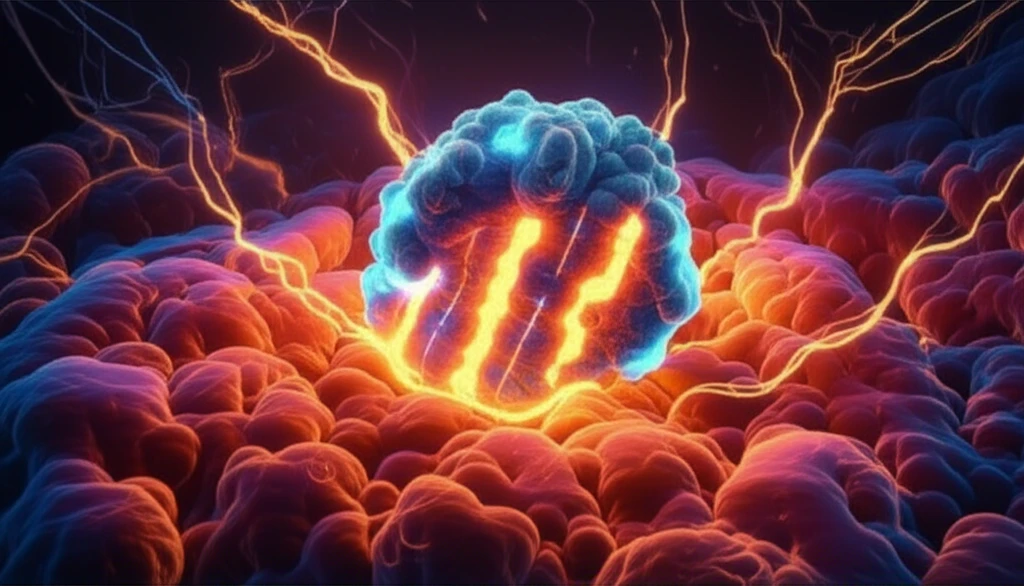
Illustration of a voltage sensor protein in a cell membrane.

Voltage Sensors: How Cells Detect and Respond to Electrical Signals

"Decoding the mechanisms behind voltage-sensitive proteins and their crucial roles in health and disease."


Our bodies are electric. From the beating of our hearts to the firing of neurons in our brains, electrical signals play a vital role in countless biological processes. This electrical activity is largely governed by specialized proteins embedded in cell membranes called voltage-sensitive proteins (VSPMs). These remarkable molecules act as sensors, detecting changes in electrical potential across the cell membrane and triggering a cascade of events that ultimately control cell behavior.

Understanding how VSPMs work is not just an academic exercise. These proteins are implicated in a wide range of diseases, including epilepsy, heart arrhythmias, and certain types of cancer. By unraveling the intricate mechanisms of voltage sensing, scientists hope to develop new therapies that can target these proteins and restore normal cell function.

This article delves into the exciting research exploring the structure, function, and dynamics of voltage sensors. We'll examine the cutting-edge techniques used to study these proteins and discuss the implications of these findings for future medical treatments. Prepare to be amazed by the elegant complexity of these molecular machines and their profound impact on our health.

Unlocking the Secrets of Voltage-Sensing Proteins: What are the critical components?

Illustration of a voltage sensor protein in a cell membrane.

Voltage-sensitive proteins are able to transform electric energy into conformational rearrangements, enabling a cell to respond appropriately to its environment. These are key for an array of key physiological processes. Voltage sensors exist within diverse protein structures. This structural diversity makes understanding their function a complex challenge. New research aims to understand which parts of these proteins are crucial for their voltage-sensing ability.

One approach to identifying voltage-sensing regions involves systematically testing different parts of the protein. Researchers can now pinpoint key amino acid residues responsible for voltage sensitivity. By calculating the 'gating charge transferred per distance unit' for each residue, scientists can predict which residues are most likely to be involved in voltage sensing. The residues with the largest gating charge transfer are good starting points for scientists to investigate in depth.

  • The S4 Helix: Often contains positively charged residues that move in response to changes in membrane potential.
  • S2 and S3 Helices: Provide negative countercharges that interact with the S4 helix, stabilizing its position and facilitating its movement.
  • Linkers: Connecting different parts of the protein and helping coordinate the conformational changes.
The recent study by Carvalho-de-Souza and Bezanilla sheds light on the crucial interactions between the voltage-sensor domain (VSD) and the pore domain (PD) in Shaker potassium channels. Their work demonstrates a non-canonical coupling between these two domains. By identifying key residues in the VSD-to-PD interface, researchers can better understand how voltage sensing is translated into the opening and closing of the channel pore.

The Future of Voltage Sensor Research: What's Next?

The study of voltage sensors is a rapidly evolving field. As technology advances, scientists are developing more sophisticated tools to probe the structure and function of these proteins. Techniques such as cryo-electron microscopy and advanced molecular dynamics simulations are providing unprecedented insights into the inner workings of voltage sensors.

One of the most promising areas of research is the development of new drugs that target voltage sensors. By selectively modulating the activity of these proteins, scientists hope to treat a wide range of diseases. For example, drugs that block certain voltage-gated ion channels are already used to prevent seizures in people with epilepsy.

Ultimately, a deeper understanding of voltage sensors could revolutionize medicine. By harnessing the power of these molecular machines, we may be able to develop new therapies for a wide range of diseases and improve human health.

About this Article -

This article was crafted using a human-AI hybrid and collaborative approach. AI assisted our team with initial drafting, research insights, identifying key questions, and image generation. Our human editors guided topic selection, defined the angle, structured the content, ensured factual accuracy and relevance, refined the tone, and conducted thorough editing to deliver helpful, high-quality information.See our About page for more information.

Everything You Need To Know

1

What exactly are voltage-sensitive proteins, and why are they so important?

Voltage-sensitive proteins (VSPMs) are specialized proteins embedded in cell membranes that detect changes in electrical potential across the cell membrane. This is crucial because they trigger a cascade of events that control cell behavior, from the beating of our hearts to the firing of neurons. The implications are vast, as these proteins are implicated in numerous diseases, making them critical targets for future medical treatments.

2

What are the key components of voltage-sensitive proteins, and what roles do they play?

The S4 helix often contains positively charged residues that move in response to changes in membrane potential. The S2 and S3 helices provide negative countercharges that interact with the S4 helix, stabilizing its position and facilitating its movement. Linkers connect different parts of the protein and help coordinate the conformational changes. Understanding these components is vital because they are essential for the voltage-sensing ability of VSPMs, which allows cells to respond appropriately to their environment. Deficiencies or malfunctions in any of these components could lead to various diseases, highlighting their importance.

3

What advanced techniques are used to study voltage sensors, and why are they important?

Researchers use techniques such as cryo-electron microscopy and advanced molecular dynamics simulations. These are cutting-edge tools that provide unprecedented insights into the inner workings of voltage sensors. These techniques are important because they enable scientists to study the structure and function of VSPMs in detail, leading to a better understanding of their mechanisms and their role in disease. The implications are improved drug design and development, targeting specific protein structures.

4

What was the significance of the study on Shaker potassium channels?

The recent study highlighted a non-canonical coupling between the voltage-sensor domain (VSD) and the pore domain (PD) in Shaker potassium channels. Identifying key residues in the VSD-to-PD interface is crucial for understanding how voltage sensing is translated into the opening and closing of the channel pore. This is significant because it reveals the intricate mechanisms of voltage sensing and its direct impact on cellular function. Understanding these interactions can lead to targeted therapies.

5

Is the study of voltage sensors a static or a dynamic field of research, and what are the implications?

Yes, the study of voltage sensors is a rapidly evolving field. Advanced technologies and research are constantly improving our understanding. Scientists are developing more sophisticated tools to study the structure and function of these proteins. This constant evolution is important as it allows for a deeper understanding of the proteins' mechanisms. The implications are improved drug design, therapeutic targets and breakthroughs in understanding and treating diseases such as epilepsy, heart arrhythmias, and cancer.

Newsletter Subscribe

Subscribe to get the latest articles and insights directly in your inbox.