
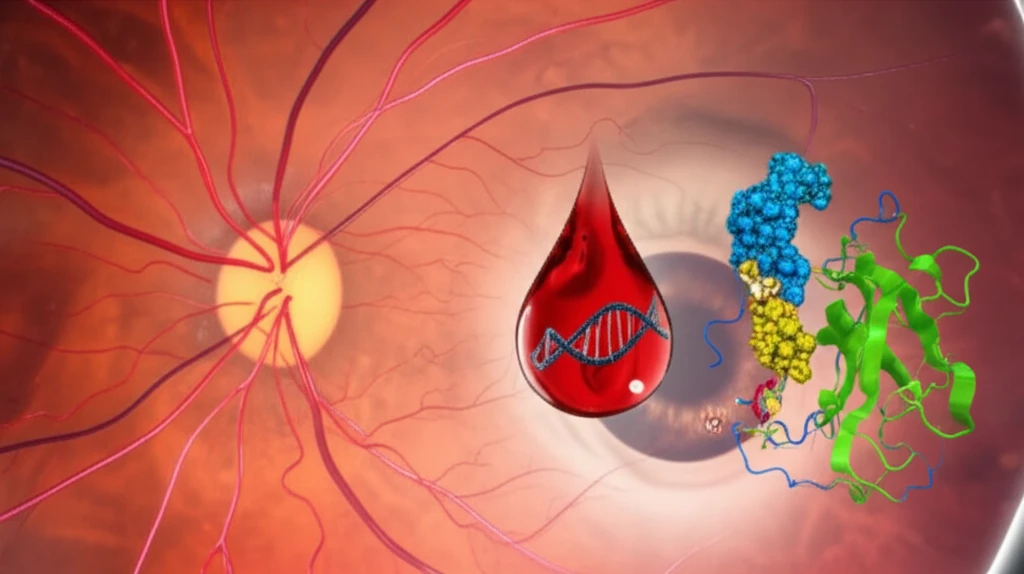
Vision Savers: Unveiling the Biomarker That Could Revolutionize Diabetic Retinopathy Treatment

"Groundbreaking research reveals a potential serum biomarker, microRNA-211, offering new hope in the fight against diabetic retinopathy, a leading cause of blindness."
Diabetic retinopathy (DR), a severe complication of diabetes, poses a significant threat to global vision health. It is the leading cause of preventable blindness worldwide. The condition progressively damages the blood vessels in the retina, potentially leading to severe vision loss. This article sheds light on a recent study focusing on microRNAs (miRNAs) and their role in DR. It specifically highlights microRNA-211 (miR-211) as a potential biomarker for the condition.
Recent advancements have increasingly highlighted the potential of miRNAs in the physiological and pathological processes of diabetes, including its microvascular and macrovascular complications. This innovative research aims to identify a specific circulating miRNA that can serve as a novel biomarker for DR. The ultimate goal is to create highly sensitive and specific tools for early detection and treatment of the disease.
This exploration focuses on a multi-stage clinical and experimental research approach. It combines clinical data and experimental research to evaluate the effectiveness of miR-211. The findings are significant because they can dramatically improve the diagnosis, treatment, and prognosis of DR patients.
Deciphering Diabetic Retinopathy: How miR-211 Emerged as a Key Player
The study began with a comprehensive analysis using miRNA microarray analysis, Venn diagram analysis, and real-time quantitative reverse transcription polymerase chain reaction (qRT-PCR). Researchers also used receiver operating characteristic (ROC) curve analysis. These methods helped identify and validate miR-211 as a potential biomarker. The prediction of Sirtuin 1 (SIRT1) as a target gene of miR-211 was done with TargetScan 7.2.
- Clinical Study: Used clinical data of patients with DR to identify the presence of miR-211 as a potential biomarker.
- Experimental Research: Utilized in-vivo and in-vitro experiments to confirm the role and function of miR-211.
- Dual-Luciferase Reporter Assay: This assay was used to confirm the targeting of SIRT1 by miR-211.
- Cell Apoptosis Assay: Investigated how the modification of miR-211 levels impacted cellular processes like apoptosis.
- Cell Viability Assay: Determined the effect of modulating miR-211 on cell survival and proliferation.
Looking Ahead: The Promise of miR-211 in Diabetic Retinopathy Management
The identification of miR-211 as a potential biomarker marks a significant step towards improving the diagnosis and treatment of diabetic retinopathy. The high sensitivity and specificity of miR-211 suggest that this biomarker could be instrumental in early detection and more effective management of DR. With further research, miR-211 has the potential to revolutionize how we approach diabetic retinopathy, offering new hope to millions at risk of losing their vision.