
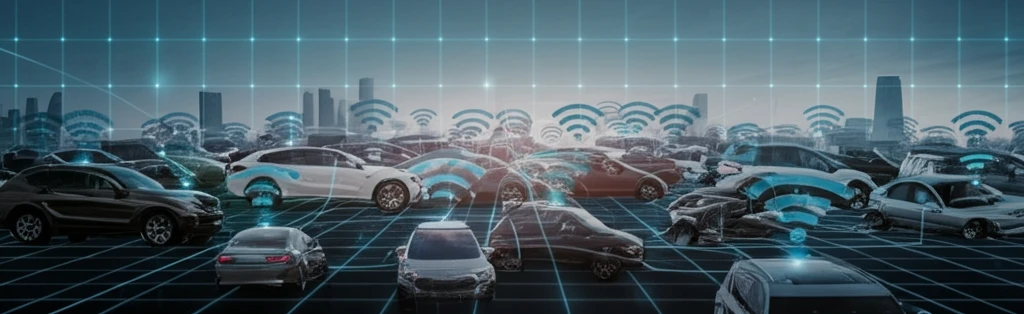
VANET Packet Loss: What It Means for the Future of Smart Cars

"Understanding the complexities of packet loss in vehicular networks is key to unlocking the full potential of connected and autonomous vehicles."
Imagine a world where your car anticipates traffic jams, warns you of icy roads ahead, and seamlessly coordinates with other vehicles to optimize traffic flow. This is the promise of Vehicular Ad-hoc Networks, or VANETs, which are essentially mobile, self-organizing networks on wheels. These networks are a cornerstone of Intelligent Transportation Systems (ITS), holding the potential to revolutionize how we drive and manage traffic. However, this exciting vision faces a significant hurdle: packet loss.
In VANETs, vehicles act as nodes, communicating with each other and roadside infrastructure to share vital information. But unlike a wired network with stable connections, VANETs operate in a highly dynamic environment. The constant movement of vehicles, the ever-changing landscape, and interference from other wireless devices create a perfect storm for dropped data packets. This packet loss can lead to delayed warnings, inaccurate traffic updates, and, in critical situations, potential safety hazards.
Think of it like trying to have a conversation in a crowded, noisy room – messages get lost, and you might miss crucial details. Understanding the causes and characteristics of packet loss in VANETs is therefore essential. By tackling this challenge, we can pave the way for more reliable and efficient communication, bringing the dream of truly smart and connected vehicles closer to reality.
Quantifying the Cost of Lost Packets
A central concern in the research is the effect of VANET packet loss on deep-learning-based object detection accuracy and vehicular perception range. To evaluate this, researchers mapped various VANET packet loss ratios (PLRs) to different levels of point cloud sparsity in test data, directly linking communication losses to perception quality. This impact of PLR under a dynamic urban environment was analyzed specifically for deep-learning-based 3D object detection performance.
Sensor Sharing as the Standard Blueprint
The accepted approach is for vehicles to exchange sensor data through VANETs to feed deep-learning-based safety alert systems. However, VANETs suffer from short link durations and rapidly changing topology, and the wireless medium adopted by VANETs provides no acknowledgement for sent packets. These constraints expose the real-time perception accuracy of received sensor data to packet loss, weakening the safety framework they are meant to support.
From Vehicular Networks to the Autonomous Era
Vehicular networks were originally explored with the goal of efficiently distributing large amounts of sensing data in dynamic mobile environments. Foundational work established vehicular ad hoc networks and delay tolerant vehicular networks, alongside management and traffic control mechanisms. Multimedia VANETs later extended these foundations into several application domains, including video transmission, setting the stage for packet loss to become a critical concern for smart vehicles.
The Complexities of Packet Loss in VANETs
Several factors contribute to the high packet loss rates experienced in VANETs. The dynamic nature of these networks means that the connections between vehicles are constantly changing. Vehicles move in and out of range, creating and breaking links frequently. This fleeting connectivity makes it difficult to maintain stable communication channels.
- Dynamic network topology due to vehicle movement.
- Short communication link durations.
- Frequent link switching.
- External wireless interference.
Deep Learning Meets Packet Loss
Recent research directly evaluates the effect of packet loss on the perception accuracy of deep-learning-based systems in VANETs. By mapping VANET PLRs to different levels of point cloud sparsity in test data, the work quantifies how lost packets degrade the real-time perception of shared sensor data. The findings demonstrate that packet loss has a measurable downstream impact on the deep-learning models interpreting received sensor information.
When Retransmission Is Not the Answer
A key failure point is that VANET's wireless medium provides no acknowledgement for sent packets, while short link durations and rapidly changing topology make reliable packet retransmission inherently difficult. As a result, packet loss directly compromises the real-time perception accuracy of received sensor data used by deep-learning-based safety alerts. Security attacks add further pressure, with packet loss compared across VANET and FANET under such attacks at various node counts.
VANET vs. FANET and Multipath Alternatives
Comparative work has examined packet loss differences between VANET and FANET under the impact of security attacks, including comparisons at specific node counts such as node 40. On the routing side, the proposed Effective Packet Loss Rate based Multipath Routing Technique (EPLR-MRT) targets video transmission in multimedia VANETs as an alternative to single-path routing. These comparisons show that packet loss mitigation depends on both the network type and the routing strategy selected.
Toward Reliable VANETs: Optimizing Data Transmission
Overcoming the challenges of packet loss is crucial for realizing the full potential of VANETs. By understanding the factors that contribute to packet loss and developing strategies to mitigate their impact, we can create more reliable and efficient communication networks for connected and autonomous vehicles. This will pave the way for safer roads, smoother traffic flow, and a more intelligent transportation ecosystem.
Perception and Communication Are Now Inseparable
Expert analysis converges on the view that communication quality and machine perception can no longer be treated as separate problems in smart vehicles. Because lost packets translate into sparse point clouds, deep-learning detectors perceive a degraded environment even when nothing is physically wrong. This synthesis argues that VANET reliability effectively sets the ceiling on the quality of real-time intelligence for autonomous driving.
Toward Global Packet-Loss Control
Future work identified in the research centers on reducing the packet loss ratio through global adjustment across the VANET framework. Researchers also note that while training deep neural networks from high-volume historical data is necessary, on-road data is essential to ensure the quality of real-time intelligence. The next frontier is efficiently distributing large amounts of sensing data in dynamic mobile environments without degrading perception fidelity.
Systemic Limits of the Wireless Medium
Broader systemic challenges stem from a wireless medium that provides no acknowledgement for sent packets, combined with short link durations and rapidly changing topology. These conditions complicate packet retransmission and traffic information retrieval across the network. Security attacks further alter packet loss behavior, meaning packet loss must be addressed across the entire network stack rather than in isolation.
Safety Alerts Hang on Every Packet
For smart cars, the real-world impact is that deep-learning-based safety alerts depend on the accurate perception of sensor data exchanged over VANETs. When packet loss degrades that perception, drivers and automated systems can react to a world the vehicle no longer sees correctly. This makes packet loss not merely a network statistic but a direct factor in vehicular safety and trust in autonomous technology.