
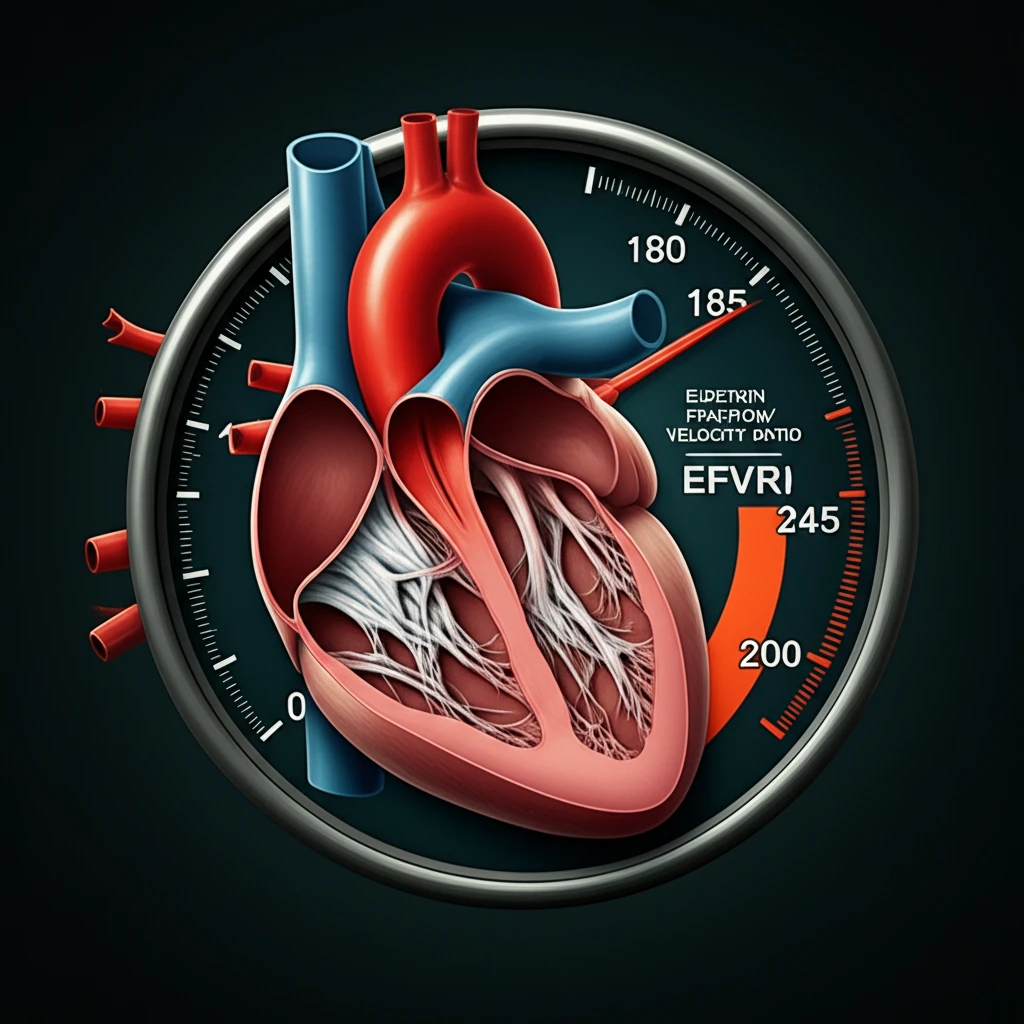
Heart with aortic stenosis, showing the narrowed valve and EFVR.

Valve to Valve Communication: How a Simple Ratio Could Save Your Heart

"Discover how the Ejection Fraction/Velocity Ratio (EFVR) is changing the way doctors assess aortic stenosis and predict heart health outcomes."


Aortic stenosis (AS) is a common and potentially life-threatening heart condition characterized by the narrowing of the aortic valve, which obstructs blood flow from the heart to the rest of the body. Traditional methods of assessing AS severity rely on measurements like peak transaortic velocity and aortic valve area (AVA). However, these measurements have limitations and may not always provide a complete picture of the condition's impact on an individual's heart health.

Imagine your heart working harder and harder to pump blood through a smaller and smaller opening. That's the reality for people with aortic stenosis. While regular check-ups and standard tests are helpful, doctors are always looking for better ways to predict who is most at risk and when the best time for intervention might be. Now, new research is shedding light on a simple ratio that could make a big difference.

The Ejection Fraction/Velocity Ratio, or EFVR, is emerging as a valuable tool in assessing aortic stenosis. This ratio combines two key pieces of information about your heart: how much blood it pumps out with each beat (ejection fraction) and the speed of the blood flowing through the narrowed valve (velocity). By putting these two measurements together, doctors may gain a more accurate understanding of the severity of the stenosis and its potential impact on your heart. This article explores the potential of EFVR to improve the prediction and management of aortic stenosis, offering new hope for better heart health outcomes.

What is EFVR and Why Does it Matter for Aortic Stenosis Patients?

Heart with aortic stenosis, showing the narrowed valve and EFVR.

The ejection fraction/velocity ratio (EFVR) is a simple, yet powerful, calculation that combines two essential measures of heart function. It's calculated by dividing the left ventricular ejection fraction (LVEF) by 4 times the square of the peak jet velocity. In simpler terms:

EFVR = LVEF / (4 x V^2), where LVEF is how well your heart pumps and V is the speed of blood through the narrowed valve.

  • Ejection Fraction (LVEF): This tells you how much blood your heart pumps out with each beat. A normal LVEF means your heart is pumping efficiently.
  • Peak Jet Velocity: This measures how fast blood is moving through the narrowed aortic valve. Higher velocity usually means the valve is more narrowed.
By combining these two measures, EFVR gives doctors a more complete picture of how the aortic stenosis is affecting your heart. A lower EFVR might indicate that the heart is working harder than it should, even if other tests look normal. This can help identify people who are at higher risk and might benefit from earlier intervention.

The Future of Aortic Stenosis Care is Here

The EFVR offers a promising new way to assess risk in people with aortic stenosis. By incorporating EFVR into routine evaluations, doctors may be able to identify high-risk individuals earlier and make more informed decisions about when to intervene. Further studies are needed to fully understand the potential of EFVR, but this simple ratio represents a significant step forward in the fight against heart disease. If you have aortic stenosis, talk to your doctor about whether EFVR might be right for you.

About this Article -

This article was crafted using a human-AI hybrid and collaborative approach. AI assisted our team with initial drafting, research insights, identifying key questions, and image generation. Our human editors guided topic selection, defined the angle, structured the content, ensured factual accuracy and relevance, refined the tone, and conducted thorough editing to deliver helpful, high-quality information.See our About page for more information.

This article is based on research published under:

DOI-LINK: 10.1111/echo.14182, Alternate LINK

Title: Value Of Ejection Fraction/Velocity Ratio In The Prognostic Stratification Of Patients With Asymptomatic Aortic Valve Stenosis

Subject: Cardiology and Cardiovascular Medicine

Journal: Echocardiography

Publisher: Wiley

Authors: Francesco Antonini-Canterin, Concetta Di Nora, Eugenio Cervesato, Concetta Zito, Scipione Carerj, Andreea Ravasel, Iulian Cosei, Andreea Catarina Popescu, Bogdan Alexandru Popescu

Published: 2018-10-30

Everything You Need To Know

1

What is Aortic Stenosis, and why is it important to understand it?

Aortic Stenosis (AS) is a serious heart condition where the aortic valve narrows, restricting blood flow from the heart to the body. This obstruction forces the heart to work harder, potentially leading to significant health issues. Understanding AS is crucial because early detection and management can improve patient outcomes. Traditional methods, like measuring peak transaortic velocity and aortic valve area, have limitations. Therefore, new methods like the Ejection Fraction/Velocity Ratio (EFVR) are being explored to provide a more complete understanding of the condition's impact on heart health.

2

How does the Ejection Fraction/Velocity Ratio (EFVR) help in assessing Aortic Stenosis?

The Ejection Fraction/Velocity Ratio (EFVR) combines two crucial measurements: the Left Ventricular Ejection Fraction (LVEF) and the peak jet velocity through the aortic valve. The LVEF indicates how efficiently the heart pumps blood, while peak jet velocity reflects the speed of blood flow through the narrowed valve. The EFVR is calculated as: EFVR = LVEF / (4 x V^2), where V is the peak jet velocity. By integrating these two, EFVR gives a more comprehensive picture of AS severity. A lower EFVR can indicate a heart working harder, potentially identifying those who need earlier intervention.

3

What are the limitations of traditional methods in evaluating Aortic Stenosis?

Traditional methods such as peak transaortic velocity and aortic valve area (AVA) have limitations. These measurements do not always provide a complete picture of the impact of the condition. They might not fully capture how the narrowed valve affects the heart's overall function and its ability to pump blood efficiently. That's why newer metrics like the Ejection Fraction/Velocity Ratio (EFVR) are being investigated.

4

Can you explain the components of the EFVR calculation?

The EFVR calculation involves two main components: the Left Ventricular Ejection Fraction (LVEF) and peak jet velocity. The LVEF measures the percentage of blood the left ventricle pumps out with each beat, reflecting the heart's pumping efficiency. Peak jet velocity measures the speed of blood flow through the narrowed aortic valve; a higher velocity suggests a narrower valve. EFVR is derived using the formula: EFVR = LVEF / (4 x V^2), where V represents peak jet velocity. By combining these, the EFVR offers a more holistic assessment of the heart's condition in the presence of aortic stenosis.

5

How could the EFVR potentially change the future of Aortic Stenosis care?

The EFVR holds the potential to transform the management of Aortic Stenosis by improving risk assessment. By integrating EFVR into routine evaluations, doctors could identify high-risk individuals earlier. This would allow them to make more informed decisions about when intervention is necessary. Early identification is crucial, as it allows for timely treatment. This could lead to better heart health outcomes. Although further research is required, EFVR presents a significant step forward in the fight against heart disease.

Newsletter Subscribe

Subscribe to get the latest articles and insights directly in your inbox.