
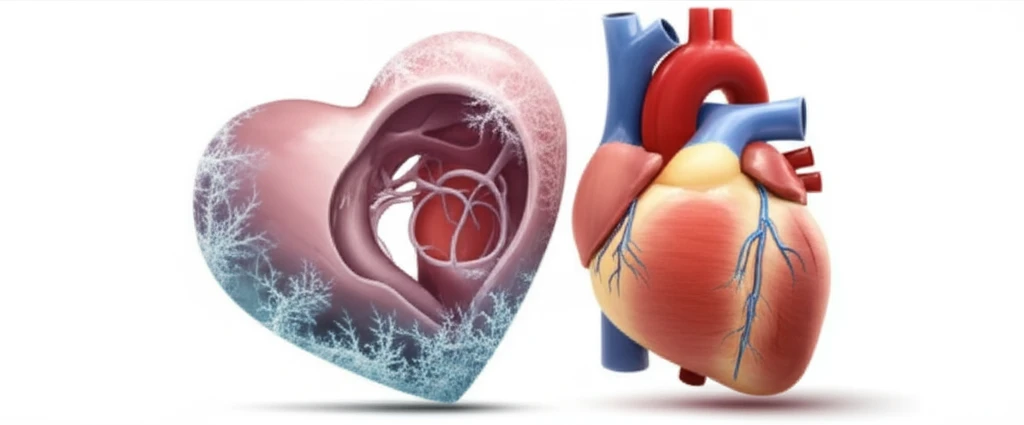
Heart with mitral valve and cryoablation patterns next to a healthy heart.

Valve Surgery and AFib: Is Adding Cryoablation Worth It?

"A new study questions whether adding cryoablation to mitral valve surgery improves quality of life for AFib patients."


Atrial fibrillation (AFib) and mitral valve disease often occur together, leading many patients to undergo mitral valve surgery (MVS). Because AFib significantly reduces quality of life, surgeons often combine MVS with a procedure called cryoablation, aiming to restore a normal heart rhythm. But does adding cryoablation actually improve patients' well-being?

Cryoablation involves using extreme cold to create scar tissue on the heart, blocking the abnormal electrical signals that cause AFib. While it's become a routine addition to MVS, solid evidence of its benefits on quality of life has been lacking. This prompted researchers to investigate whether cryoablation truly enhances patients' lives after mitral valve surgery.

A new study published in Europace sheds light on this important question. Researchers conducted a double-blind, randomized trial—the gold standard for medical research—to compare the outcomes of MVS alone versus MVS combined with cryoablation. Here's what they discovered about the impact on patients' quality of life.

The SWEDMAF Study: A Deep Dive into Quality of Life

Heart with mitral valve and cryoablation patterns next to a healthy heart.

The SWEDish Multicentre Atrial Fibrillation study (SWEDMAF) was designed to evaluate the effectiveness of adding epicardial left atrial cryoablation to mitral valve surgery. Sixty-five patients with permanent AFib, all undergoing MVS, participated in the study. They were randomly assigned to receive either MVS alone or MVS with cryoablation.

Researchers used the Short Form 36 (SF-36) quality of life survey to assess patients' physical and mental well-being at 6 and 12 months after surgery. The SF-36 measures eight key areas of health, including physical functioning, bodily pain, general health, vitality, social functioning, and mental health. Here are the key components measured:

  • Physical Functioning: Ability to perform physical activities.
  • Role Physical: Limitations due to physical health problems.
  • Bodily Pain: Extent of pain experienced.
  • General Health: Overall perception of health.
  • Vitality: Energy level and fatigue.
  • Social Functioning: Impact of health on social activities.
  • Role Emotional: Limitations due to emotional problems.
  • Mental Health: Psychological well-being.
The results might surprise you. The study found that adding cryoablation to MVS did not significantly improve patients' quality of life compared to MVS alone. In fact, both groups reported similar levels of well-being at the 12-month follow-up. All patients, regardless of the procedure they received, experienced the same improvements in quality of life after surgery as an age-matched Swedish general population. This suggests the primary driver of improved well-being was the mitral valve surgery itself, not the addition of cryoablation.

Implications for Patients and Future Research

This study raises important questions about the routine addition of cryoablation to mitral valve surgery for patients with permanent AFib. While cryoablation can help restore a normal heart rhythm, this study suggests it doesn't necessarily translate into a better quality of life for patients. This finding calls for a more cautious approach, emphasizing the need to carefully weigh the potential benefits and risks of cryoablation for each individual patient. Further research is needed to identify which patients, if any, might benefit most from this combined procedure and to explore alternative strategies for improving quality of life in AFib patients undergoing mitral valve surgery.

About this Article -

This article was crafted using a human-AI hybrid and collaborative approach. AI assisted our team with initial drafting, research insights, identifying key questions, and image generation. Our human editors guided topic selection, defined the angle, structured the content, ensured factual accuracy and relevance, refined the tone, and conducted thorough editing to deliver helpful, high-quality information.See our About page for more information.

This article is based on research published under:

DOI-LINK: 10.1093/europace/eux253, Alternate LINK

Title: Quality Of Life Is Not Improved After Mitral Valve Surgery Combined With Epicardial Left Atrial Cryoablation As Compared With Mitral Valve Surgery Alone: A Substudy Of The Double Blind Randomized Swedish Multicentre Atrial Fibrillation Study (Swedmaf)

Subject: Physiology (medical)

Journal: EP Europace

Publisher: Oxford University Press (OUP)

Authors: Louise Bagge, Johan Probst, Steen M Jensen, Per Blomström, Stefan Thelin, Anders Holmgren, Carina Blomström-Lundqvist

Published: 2017-08-19

Everything You Need To Know

1

What is mitral valve surgery and why is it performed?

Mitral valve surgery, or MVS, is a surgical procedure performed to repair or replace a diseased mitral valve in the heart. This surgery is often necessary when the mitral valve doesn't open or close properly, leading to symptoms like shortness of breath and fatigue. Because Atrial Fibrillation and mitral valve disease often occur together, many patients undergo MVS. The procedure is significant because it addresses a structural problem in the heart that can significantly impact overall health and quality of life. If left untreated, mitral valve issues can lead to heart failure and other serious complications, highlighting the importance of timely intervention.

2

Can you explain what cryoablation is and how it's used in treating heart conditions?

Cryoablation is a procedure that uses extreme cold to create scar tissue on the heart. This scar tissue blocks the abnormal electrical signals that cause atrial fibrillation (AFib), with the goal of restoring a normal heart rhythm. It is often performed in conjunction with other heart surgeries, such as mitral valve surgery (MVS), in patients who have both mitral valve disease and AFib. The aim is to improve the patient's quality of life by addressing both heart conditions simultaneously. However, recent studies suggest that the benefits of adding cryoablation to MVS may not always translate into a significant improvement in quality of life.

3

What is the Short Form 36 (SF-36) and what does it measure?

The Short Form 36, or SF-36, is a widely used questionnaire to measure a person's overall quality of life and well-being. It assesses eight key areas of health: physical functioning, role physical (limitations due to physical health problems), bodily pain, general health, vitality (energy level and fatigue), social functioning, role emotional (limitations due to emotional problems), and mental health. By evaluating these different aspects, the SF-36 provides a comprehensive picture of how health impacts a person's daily life and is used to assess the effectiveness of medical treatments and interventions.

4

What is atrial fibrillation (AFib) and why is it a concern?

Atrial fibrillation, or AFib, is an irregular and often rapid heart rhythm that can lead to blood clots, stroke, heart failure, and other heart-related complications. In AFib, the upper chambers of the heart (atria) beat chaotically and out of sync with the lower chambers (ventricles). This can cause symptoms like palpitations, shortness of breath, and fatigue. AFib is significant because it increases the risk of serious cardiovascular events and can significantly impact a person's quality of life. Treatments for AFib include medications, lifestyle changes, and procedures like cryoablation or surgery to restore a normal heart rhythm.

5

What was the SWEDMAF study and what did it investigate?

The SWEDish Multicentre Atrial Fibrillation study, or SWEDMAF, was designed to evaluate the effectiveness of adding epicardial left atrial cryoablation to mitral valve surgery. Researchers randomly assigned patients with permanent AFib, all undergoing MVS, to receive either MVS alone or MVS with cryoablation. They then used the SF-36 to measure eight key areas of health, including physical functioning, bodily pain, general health, vitality, social functioning, and mental health, at 6 and 12 months after surgery. The SWEDMAF study's importance is that it used a rigorous, double-blind, randomized trial to assess whether adding cryoablation to mitral valve surgery improves patients' quality of life.

Newsletter Subscribe

Subscribe to get the latest articles and insights directly in your inbox.