
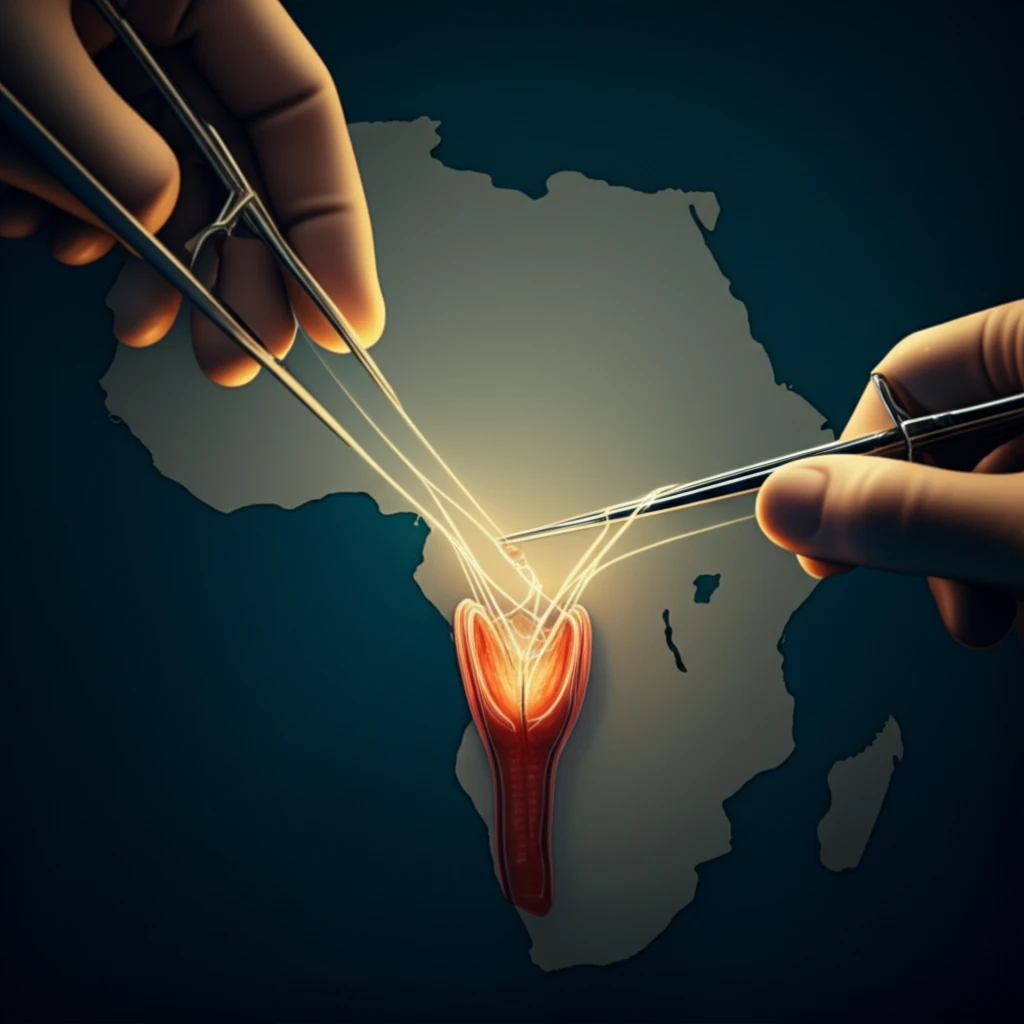
Surgical repair of urethral stricture using preputial graft technique

Urethral Stricture Repair: A Simpler Grafting Technique for Better Outcomes

"Discover how preputial mucosal grafts offer an easier and effective alternative to buccal mucosa grafts for urethral stricture repair, especially in resource-limited settings."


Urethral stricture disease represents a significant health challenge, particularly in sub-Saharan Africa, where it stands as a leading cause of urological morbidity. While developed nations often cite prostate disease as the primary urological concern, the African continent faces a different reality. This divergence is largely attributed to a complex interplay of factors, including the high prevalence of sexually transmitted infections (STIs), rising instances of urethral trauma, and the strain on already over-stretched urological services.

The presence of long-term indwelling urethral catheters, frequently used in the management of prostate disease for extended periods (sometimes up to two years), further compounds the problem. This prolonged catheterization significantly elevates the risk of developing urethral strictures, creating a vicious cycle of urological complications. The predominant cause of these strictures is often attributed to sexually transmitted infections, particularly those involving gonococcus or chlamydia.

These infections frequently lead to the development of long and severe strictures characterized by spongiofibrosis, a condition where scar tissue replaces healthy tissue. This is especially common in the anterior urethra, the region where the periurethral glands are located. Unfortunately, these types of strictures often prove resistant to conventional treatments such as urethral dilatation, optical urethrotomy, or primary anastomosis. As a result, the majority of strictures in Africa are most effectively managed through open substitution urethroplasty, a surgical procedure that involves replacing the damaged section of the urethra with healthy tissue.

Why Preputial Mucosal Grafts Offer a Viable Solution

Surgical repair of urethral stricture using preputial graft technique

The gold standard for substitution urethroplasty has traditionally been the use of buccal mucosa grafts (BMG), which involves harvesting tissue from the lining of the mouth. While effective, this procedure presents considerable challenges in resource-limited settings. These challenges include the need for specialized equipment, longer operating times, and the requirement for general anesthesia and intubation.

In response to these challenges, medical professionals have explored alternative grafting techniques. One such alternative is the use of a dorsal onlay free preputial graft, which utilizes the inner lining of the foreskin. This technique has emerged as a promising solution, particularly in centers with limited resources.

  • Simplified Procedure: The preputial graft technique is technically less demanding compared to buccal mucosa grafts.
  • Reduced Operating Time: Harvesting preputial tissue generally requires less time than harvesting buccal mucosa.
  • Lower Anesthesia Requirements: The procedure can often be performed under local or regional anesthesia, reducing the risks associated with general anesthesia.
  • Good Clinical Outcomes: Studies have demonstrated that preputial grafts can achieve comparable success rates to buccal mucosa grafts in treating urethral strictures.
The preputial mucosa, like the buccal mucosa, is a wet mucosa composed of non-keratinized stratified squamous epithelium, making it an ideal substitute for urethral tissue. The use of preputial mucosal grafts (PMG) for urethroplasty was initially described by Barbagli and has been shown to produce favorable outcomes. The study that PMG is easier than BMG and is easier to perform and gives good results.

A Promising Avenue for Improved Urological Care

The high incidence and severity of urethral strictures in Africa necessitate the adoption of innovative approaches to mitigate morbidity. The utilization of PMG represents a valuable strategy for reducing the burden of urethral stricture disease, particularly in resource-constrained environments. As healthcare systems strive to enhance accessibility and optimize patient outcomes, simplified yet effective techniques like preputial grafting hold significant promise for improving urological care in Africa and beyond.

About this Article -

This article was crafted using a human-AI hybrid and collaborative approach. AI assisted our team with initial drafting, research insights, identifying key questions, and image generation. Our human editors guided topic selection, defined the angle, structured the content, ensured factual accuracy and relevance, refined the tone, and conducted thorough editing to deliver helpful, high-quality information.See our About page for more information.

This article is based on research published under:

DOI-LINK: 10.1177/0049475517724924, Alternate LINK

Title: Preputial Mucosal Graft For Urethral Repair

Subject: Infectious Diseases

Journal: Tropical Doctor

Publisher: SAGE Publications

Authors: Kasonde Bowa, Eliakim Manda

Published: 2017-08-24

Everything You Need To Know

1

What is a urethral stricture and why is it a significant health issue in certain regions?

A urethral stricture is a narrowing of the urethra, the tube that carries urine from the bladder out of the body. It's a significant health issue, especially in sub-Saharan Africa, where it's a leading cause of urological problems. Factors such as sexually transmitted infections (STIs), urethral trauma, and limited access to urological services contribute to its prevalence. These strictures often result from infections like gonococcus or chlamydia leading to spongiofibrosis, a condition where scar tissue replaces healthy tissue within the urethra. This makes urination difficult or even impossible.

2

What are the common causes of urethral strictures, and how do they differ from those in developed nations?

In sub-Saharan Africa, urethral strictures are frequently caused by sexually transmitted infections (STIs) like gonococcus and chlamydia, as well as urethral trauma. The use of long-term indwelling urethral catheters also increases the risk. In contrast, developed nations often see prostate disease as the primary urological concern. This divergence highlights the impact of factors like infection rates, healthcare access, and the usage of medical devices. The long and severe strictures caused by STIs lead to spongiofibrosis that often needs open substitution urethroplasty to treat the patient.

3

What are the advantages of using preputial mucosal grafts (PMG) compared to buccal mucosa grafts (BMG) for urethral stricture repair?

Preputial mucosal grafts (PMG) offer several advantages over buccal mucosa grafts (BMG). The PMG technique is simpler, requiring less surgical expertise, and reduces operating time. It also lowers anesthesia requirements, often allowing the procedure to be performed under local or regional anesthesia, which is safer than general anesthesia. Studies show that PMGs can achieve comparable success rates to BMGs in treating urethral strictures, making them a viable alternative, especially in resource-limited settings. The PMG utilizes the inner lining of the foreskin, and the tissue is similar to the buccal mucosa.

4

How does the preputial mucosal graft technique work, and what makes it a suitable substitute for urethral tissue?

The preputial mucosal graft technique involves harvesting the inner lining of the foreskin (preputial mucosa) and using it to replace the damaged section of the urethra. The preputial mucosa, like the buccal mucosa, is a wet mucosa composed of non-keratinized stratified squamous epithelium. This type of tissue makes it an ideal substitute for urethral tissue. The PMG is technically less demanding, reducing operating time, and requires less anesthesia, making it a beneficial procedure.

5

Why is the adoption of preputial mucosal grafts considered a promising approach for improving urological care in resource-constrained environments?

The adoption of preputial mucosal grafts (PMG) is promising because it addresses the challenges of treating urethral strictures in resource-constrained settings. The high incidence and severity of urethral strictures in Africa necessitate innovative approaches to mitigate morbidity. The PMG technique is simpler, reduces operating time, and lowers anesthesia requirements compared to traditional methods like buccal mucosa grafts (BMG). These factors make PMG a more accessible and efficient solution for improving patient outcomes and enhancing urological care, especially in areas with limited access to specialized equipment and healthcare resources. The utilization of PMG represents a valuable strategy for reducing the burden of urethral stricture disease.

Newsletter Subscribe

Subscribe to get the latest articles and insights directly in your inbox.