
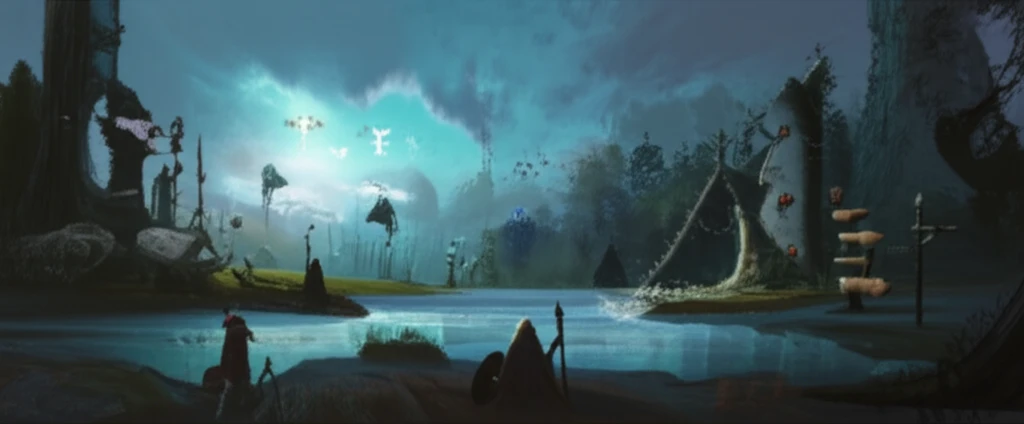
Viking Age Finland Landscape with Sami and Finnic cultural elements.

Unveiling Viking Age Finland: A Journey Through Sami and Finnic Lands

"Explore the intricate history of Viking Age Finland, where Sami and Finnic cultures intertwined, challenging traditional narratives and reshaping our understanding of the era."


The Viking Age in Finland, often perceived through the lens of Scandinavian influence, presents a far more complex and interwoven narrative. Recent research, notably from the University of Helsinki's 'Viking Age in Finland' (VAF) project, sheds light on the dynamic interactions between the Sami and Finnic populations, challenging conventional understandings of this era.

This article delves into the key findings of the VAF project, focusing on the book 'Fibula, Fabula, Fact.' This explores Finland's Viking Age with an interdisciplinary approach, weaving together archaeological discoveries, linguistic analyses, and folkloric traditions. While archaeology has traditionally dominated Viking Age research, this project elevates the roles of language and folklore, revealing fresh insights into the cultural and ethnic landscape of the time.

Prepare to embark on a journey that navigates the nuances of ethnic terminology, explores the expanded reach of Sami habitation, and examines the evolving roles of Finnic groups. We will uncover how linguistic and folkloric evidence provides a richer, more textured understanding of Viking Age Finland, inviting a re-evaluation of established historical perspectives.

Deciphering Ethnic Identities: Who Were the Finnic Peoples?

Viking Age Finland Landscape with Sami and Finnic cultural elements.

One of the initial challenges in understanding Viking Age Finland lies in the often-confusing terminology used to describe the various ethnic groups inhabiting the region. The term 'Finnic' is frequently used as a broad descriptor for Finno-Ugrian groups around the Baltic Sea, sometimes interchangeably with 'Baltic Finnic'. This can lead to misunderstandings, especially when compared to the term 'Finnish,' which specifically refers to the inhabitants of present-day Finland.

Adding to the complexity, older archaeological literature sometimes used 'Finnish' to encompass all Baltic Finnish groups. It’s crucial to differentiate these terms, especially considering the term 'Baltic' itself often includes all inhabitants of the modern Baltic states – including Estonians and Livs, who are ethnically Finnic. This project attempts to clarify some of the language surrounding these groups, but continues to leave room for interpretation.

  • Finnic: A broad term for Finno-Ugrian ethnic groups around the Baltic Sea.
  • Finnish: Specifically refers to the inhabitants of present-day Finland.
  • Baltic Finnish: Often used synonymously with Finnic, but can also refer to groups living in the Baltic region.
  • Baltic: Can refer to the inhabitants of the present-day Baltic states, including Finnic Estonians and Livs, as well as the Baltic people.
Navigating these terms carefully is essential for accurately interpreting research and avoiding generalizations about the ethnic composition of Viking Age Finland. The project strives for clarity, but it acknowledges the inherent challenges in reconstructing ethnic identities from historical records.

Future Directions: Embracing Collaboration and New Perspectives

The research presented by the VAF project marks a significant step forward in understanding Viking Age Finland. By integrating diverse disciplines and challenging traditional interpretations, it paves the way for future research and collaboration. The inclusion of previously overlooked regions, such as Estonia, and a continued emphasis on interdisciplinary approaches promise to yield even more nuanced and comprehensive understandings of this fascinating period. As we await new discoveries and interpretations, it is clear that the study of Viking Age Finland is a dynamic and evolving field, full of potential for future insights.

About this Article -

This article was crafted using a human-AI hybrid and collaborative approach. AI assisted our team with initial drafting, research insights, identifying key questions, and image generation. Our human editors guided topic selection, defined the angle, structured the content, ensured factual accuracy and relevance, refined the tone, and conducted thorough editing to deliver helpful, high-quality information.See our About page for more information.

Everything You Need To Know

1

What is the current understanding of the Viking Age in Finland?

The Viking Age in Finland is understood as a period where the cultural interactions between the Sami and Finnic populations were quite dynamic. It's not just about Scandinavian influence. Projects like the 'Viking Age in Finland' (VAF) initiative highlight these interactions through archaeological findings, linguistic studies, and folklore.

2

Why is the 'Fibula, Fabula, Fact' project important for Viking Age research in Finland?

The 'Fibula, Fabula, Fact' project is significant because it uses an interdisciplinary approach to explore Finland's Viking Age. This means it combines archaeology with linguistic analysis and folkloric traditions, offering new perspectives on the cultural and ethnic landscape of the time. This approach challenges traditional research methods that primarily rely on archaeological evidence alone.

3

Could you clarify the terms 'Finnic,' 'Finnish,' and 'Baltic Finnish'?

The term 'Finnic' is a broad descriptor for Finno-Ugrian ethnic groups living around the Baltic Sea. It's important not to confuse this with 'Finnish,' which specifically refers to the inhabitants of modern-day Finland. Also, 'Baltic Finnish' is sometimes used interchangeably with 'Finnic,' but can also refer to groups within the Baltic region. Understanding these differences is essential for accurate historical interpretation.

4

Did the Sami people only inhabit the northern regions of Finland during the Viking Age?

The Sami people inhabited a wider area than traditionally thought during the Viking Age in Finland. Linguistic and folkloric evidence suggests their presence and influence extended further than previously recognized. Recognizing this expanded habitation helps in re-evaluating the cultural dynamics and interactions of the time.

5

What should future research on the Viking Age in Finland focus on?

Future research should focus on interdisciplinary collaboration and include previously overlooked regions, such as Estonia. By continuing to integrate diverse fields like archaeology, linguistics, and folklore, researchers can develop a more nuanced and comprehensive understanding of Viking Age Finland and its surrounding areas. This collaborative approach promises to uncover new insights and challenge existing interpretations.

Newsletter Subscribe

Subscribe to get the latest articles and insights directly in your inbox.