
Unveiling the Universe's Hidden Cities: How Galaxy Cluster Mapping is Changing Cosmology

"Explore how astronomers are mapping galaxy clusters using photometric redshifts to unlock the secrets of the Universe and refine our understanding of its vast structure."
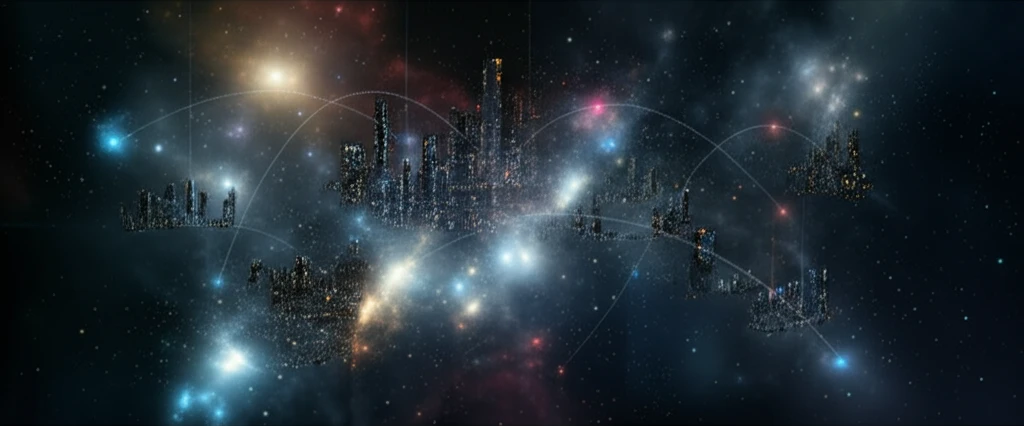
Imagine the Universe as a sprawling metropolis, with galaxies forming bustling cities and clusters of galaxies acting as major metropolises. Understanding the distribution and properties of these 'galactic cities' is crucial for unraveling the mysteries of the cosmos, from the nature of dark matter to the expansion rate of the Universe.
For years, astronomers have been developing methods to locate these galactic clusters, often hidden in the vast expanse of the night sky. One particularly promising technique involves using photometric redshifts—estimates of a galaxy's distance based on its color—to map these clusters across large areas of the sky. This approach allows scientists to efficiently survey vast cosmic territories and catalog these significant cosmic structures.
A recent study published in Astronomy & Astrophysics details how this method was applied to the Canada France Hawaii Telescope Legacy Survey (CFHTLS) Wide fields, significantly expanding the catalog of known galaxy cluster candidates. By identifying these clusters and analyzing their properties, researchers are refining our understanding of the Universe's fundamental parameters.
By the Numbers: What Cluster Surveys Reveal
The Phoenix Cluster contains 42 catalogued galaxies, and its central galaxy Phoenix A hosts an active galactic nucleus exhibiting both quasar-like and type 2 Seyfert characteristics. Measurements of cluster contents show how heavily these systems are dominated by invisible components: the hot gas between galaxies typically holds about five times the total mass of all the cluster's galaxies themselves, while roughly 80 percent of a cluster's mass is supplied by dark matter. Those figures underscore why cluster mapping is so central to cosmology: what telescopes see is only a small fraction of what clusters contain.
Measuring the Unmeasurable
One standard method for measuring cluster masses reconstructs the projected gravitational potential with a quadratic estimator and then applies a matched filter to extract the cluster mass, an approach well suited to statistical analyses that bin clusters according to other mass proxies. Even basic quantities such as a galaxy's size depend on the method used to define it, and each method can yield different results, while cluster-scale systems are dominated by a surrounding dark matter halo. Alternatives to the standard dark-matter framework have also been pressed to explain cluster observations: a Machian MOND variant boosts the acceleration scale by roughly 10 a0 at cluster cores, approaching standard MOND in the outer regions.
From Nebulae to the Largest Structures
The Milky Way's nearest major companion, Andromeda, was originally catalogued as a nebula before being recognized as the galaxy Messier 31 (NGC 224). Globular clusters are thought to have formed soon after the universe began nearly 13.8 billion years ago, at the same time as, or perhaps even before, the first galaxies, and they have since remained largely unchanged apart from the aging of their stars. On the largest scales, a branching string of galaxy clusters stretching roughly 1.3 billion light-years—more than 13,000 times the length of the Milky Way—holds an estimated 200 quadrillion solar masses.
The Power of Photometric Redshifts in Galaxy Cluster Searches
Traditional methods of measuring galaxy distances, such as spectroscopic redshifts, are accurate but time-consuming. To efficiently survey large areas, astronomers use photometric redshifts, which estimate distances based on a galaxy's color. By analyzing the light in different filters, scientists can infer the redshift and thus the distance of these galaxies, enabling the creation of three-dimensional maps of the cosmos.
- Adaptive Kernel Technique: This technique helps create galaxy density maps, highlighting structures.
- SExtractor Software: Used to identify structures in the density maps at different significance levels.
- Minimal Spanning Tree Algorithm: Used to analyze substructures within the identified clusters.
Fresh Findings on the Cosmic Frontier
Recent work led by Prof. Dr. Kroupa investigated how stellar populations and matter are distributed in galaxy clusters, with stellar remnants emerging as a way to solve the mystery of the 'missing mass' in these systems. Cluster studies also illuminate the cosmos's scaffolding: the glowing lights of galaxies in the direction of the constellations Perseus and Pisces trace invisible dark matter highways running through colossal structures. When two of these giants collide, they send powerful shock waves through one another and release energy on a scale not seen since the Big Bang, leaving behind radio relics that researchers are now working to unravel.
When Reality Outruns the Models
Clusters of galaxies—conglomerates of tens to hundreds of galaxies and the largest structures in the universe—are not static; they are dynamically changing and aging over time, which complicates treating them as fixed laboratories for cosmological measurements. Discoveries have also humbled expectations, as when astronomers found a galaxy cluster first detected by Hubble that they thought could not exist, weighing in at over 500 trillion times the mass of the sun. Such findings underscore how often observed clusters outrun theoretical predictions.
A Tale of Two Clusters
Comparing galaxy clusters such as Eridanus and Fornax shows how differently similar-looking systems can behave. In the Eridanus cluster, gravitational forces are actively distorting galaxies, especially dwarf galaxies, while new galaxy groups are still falling into the main cluster and beginning to interact. These ongoing effects make Eridanus a dynamic laboratory for observing live galactic evolution in a way that more settled clusters do not offer.
Implications and Future Directions
This extensive catalog of galaxy cluster candidates provides valuable insights into the large-scale structure of the Universe. By studying the distribution, mass, and redshift of these clusters, scientists can refine cosmological parameters, such as the density of dark matter and the equation of state of dark energy. The detected clusters behave as expected if located at intersections of filaments, supporting current structure formation theories. Future research will focus on characterizing these clusters in greater detail, confirming their nature through multi-wavelength observations, and using them to further constrain our cosmological models.
Jets, Lenses, and Collisions
Each galaxy cluster centers on one especially large galaxy containing a huge black hole; in the Perseus cluster, two vast bubbles in the hot intergalactic gas are aligned with jets of energy emanating from the middle of the central galaxy. Clusters also act as gravitational lenses, permitting astronomers to map the dark matter distribution on a range of scales and to reveal high- and intermediate-redshift background galaxies that would otherwise be unreachable. These threads come together in collisions, as when two clusters on a collision course are simulated merging to create Abell 754, with tiny dots representing galaxies, each containing billions of stars, surrounded by gas.
The Next Decade of Cluster Science
Looking into the core of the Centaurus Cluster, including the central galaxy NGC 4696, astronomers discovered for the first time a bulk flow of hot gas traveling roughly 130 to 310 kilometers per second in the line of sight from Earth, a finding tied to the long-standing mystery of why galaxy clusters stay so hot. Hundreds of 'baby' galaxy clusters found in recent surveys may answer a central question: how much does a galaxy's upbringing dictate its fate, or is its future ruled mainly by innate properties like size and mass? Because clusters tend to hold onto the gas in their systems, unlike galaxies where gas is driven out through supernova explosions, they act as closed systems whose chemical composition records the history of nucleosynthesis in the universe.
Simulating the Slowest Show on Earth
Because the universe moves too slowly to watch directly, researchers create faster-moving computer simulations to find out how clusters of galaxies form. One famous effort is TNG50 from IllustrisTNG, an upgrade of the famous Illustris Simulation. These simulations place cluster mapping within the broader story of cosmic structure formation, even as reproducing cluster-scale physics across billions of years remains a considerable computational and physical challenge.
From Labs and Algorithms to the Voids
In the laboratory, 196 lasers have helped scientists recreate the conditions inside gigantic galaxy clusters, producing hot and cold spots that provide solid evidence that magnetic fields influence how the clusters' hot gas cools—though further experiments are needed to understand exactly what is happening. On the analysis side, a GRU-based machine-learning framework that exploits the sequential nature of cluster profiles offers a powerful tool for mass calibration, probing the complex, non-linear connection between baryonic gas and dark matter. Studying the rare, loner galaxies that call voids home should also shed light on how all galaxies evolved over the universe's eons.