
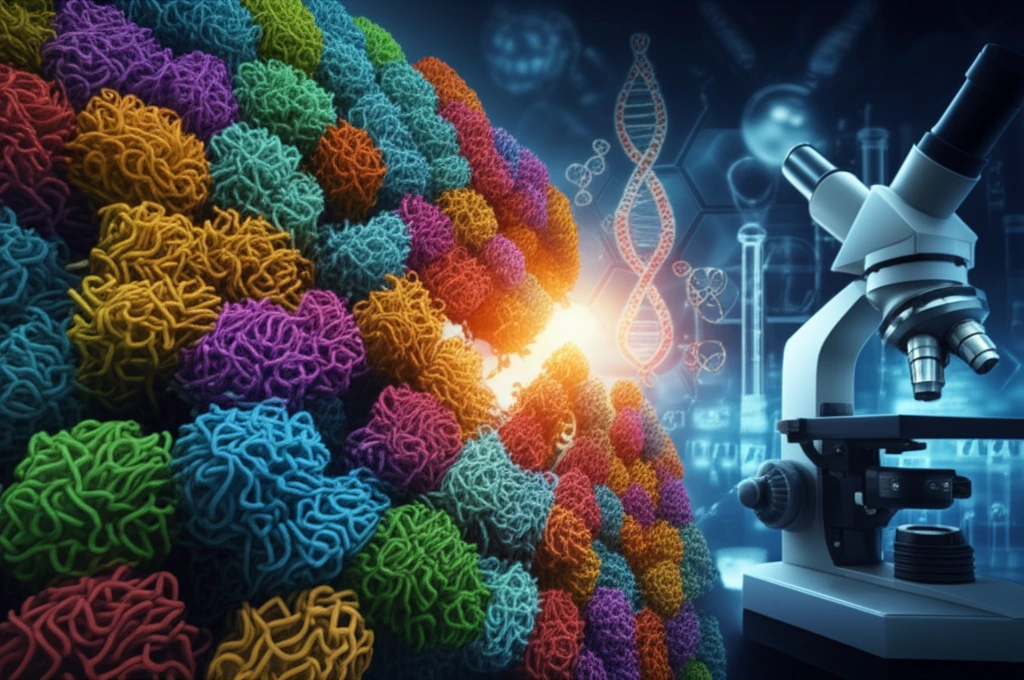
Microscopic view of bacterial cell wall with interconnected glycopolymers.

Unveiling the Power of Bacterial Glycopolymers: What You Need to Know

"A correction highlights the intricate world of bacterial cell wall glycopolymers and their potential applications in understanding microbial behavior."


In the ever-evolving field of microbiology, understanding the structures and functions of bacterial cell walls is paramount. These walls, particularly their glycopolymer components, play crucial roles in bacterial survival, interaction with their environment, and even pathogenicity. Recent research has focused on characterizing these complex molecules from various bacterial species, aiming to unlock their potential applications in medicine, biotechnology, and other fields.

A team of scientists initially published a paper detailing their research on rhamnose-containing cell wall glycopolymers extracted from two species of bacteria: Rathayibacter toxicus VKM Ac-1600 and Rathayibacter tanaceti VKM Ac-2596. The original article, which appeared in Biochemistry (Moscow), volume 83, page 717 in 2018, has now been updated with an erratum to reflect changes in the acknowledgments section.

This article highlights the importance of bacterial glycopolymers and emphasizes the necessity for accuracy and transparency in scientific publications. It aims to simplify the core message of the research and its correction, focusing on its implications for future studies.

Decoding the Erratum: What Changed and Why It Matters?

Microscopic view of bacterial cell wall with interconnected glycopolymers.

The primary change introduced by the erratum involves the acknowledgment of funding sources. The original paper acknowledged support from the Russian Science Foundation and the Russian Foundation for Basic Research. The corrected version provides a more detailed breakdown of the specific projects supported by each foundation.

Specifically, the erratum clarifies that the Russian Science Foundation (project No. 14-50-00126) supported structural studies, optical and NMR spectroscopy experiments, and interpretation of spectra. Meanwhile, the Russian Foundation for Basic Research (project No. 13-04-00447) supported work related to obtaining biomass of actinobacteria under study, microbiological control, obtaining cell walls, and isolation of glycopolymer preparations and their primary chemical analysis.

  • Accuracy in Acknowledgments: Highlighting the specific contributions of funding sources ensures transparency and proper attribution.
  • Impact on Research Integrity: Corrections, even seemingly minor ones, reinforce the commitment to accuracy in scientific publishing.
  • Detailed Methodological Insights: The clarified acknowledgments offer insights into the specific techniques and resources used in the research.
While this correction might seem minor, it underscores the importance of precise record-keeping and transparent reporting in scientific research. Accurate acknowledgment of funding sources is crucial for maintaining ethical standards and fostering trust within the scientific community.

The Bigger Picture: Glycopolymers and the Future of Microbial Research

The study of bacterial glycopolymers extends far beyond mere academic interest. These complex molecules are increasingly recognized for their potential applications in various fields. Understanding their structure and function can pave the way for developing novel antibacterial agents, improved diagnostic tools, and even innovative biomaterials.

For example, researchers are exploring the use of glycopolymers as targeted drug delivery systems. Their unique ability to interact with specific cells or tissues could allow for more effective and less toxic therapies. Additionally, glycopolymers are being investigated as potential vaccine candidates, offering a promising avenue for preventing bacterial infections.

As research in this area continues to advance, we can expect to see even more exciting applications of bacterial glycopolymers emerge. By unraveling the mysteries of these complex molecules, scientists are opening up new possibilities for combating disease, improving human health, and harnessing the power of the microbial world.

About this Article -

This article was crafted using a human-AI hybrid and collaborative approach. AI assisted our team with initial drafting, research insights, identifying key questions, and image generation. Our human editors guided topic selection, defined the angle, structured the content, ensured factual accuracy and relevance, refined the tone, and conducted thorough editing to deliver helpful, high-quality information.See our About page for more information.

This article is based on research published under:

DOI-LINK: 10.1134/s0006297918070106, Alternate LINK

Title: Erratum To: “Rhamnose-Containing Cell Wall Glycopolymers From Rathayibacter Toxicus Vkm Ac-1600 And “Rathayibacter Tanaceti” Vkm Ac-2596”

Subject: Biochemistry

Journal: Biochemistry (Moscow)

Publisher: Pleiades Publishing Ltd

Authors: A. S. Shashkov, E. M. Tul’Skaya, A. S. Dmitrenok, G. M. Streshinskaya, N. V. Potekhina, S. N. Senchenkova, N. F. Piskunkova, L. V. Dorofeeva, L. I. Evtushenko

Published: 2018-07-01

Everything You Need To Know

1

What are bacterial cell wall glycopolymers, and why are they important?

Bacterial cell wall glycopolymers are complex sugar-based molecules that form a critical part of the bacterial cell wall. They are made of repeating sugar units, and their specific structure varies depending on the bacterial species. In the context of microbiology, these glycopolymers are important because they play a significant role in bacterial survival, interaction with the environment, and the development of diseases. Understanding these structures can lead to discoveries in medicine and biotechnology.

2

What is the significance of the correction or erratum in the research?

The significance of the correction lies in its impact on research integrity and transparency. The erratum clarifies the funding sources that supported the research. Specifically, the correction details which projects the Russian Science Foundation and the Russian Foundation for Basic Research funded. This level of detail ensures proper attribution and reinforces ethical standards within the scientific community. The correction enables other scientists to understand the methodological details, allowing them to build upon and reproduce the work.

3

Why is the study of bacterial glycopolymers important for the future?

The study of bacterial glycopolymers is essential due to their potential in various fields. These molecules are increasingly recognized for their applications in medicine and biotechnology. The understanding of their structure and function can lead to developing novel antibacterial agents, enhancing diagnostic tools, and innovating biomaterials. The complex sugar molecules are critical for bacterial survival, and therefore, offer a gateway to various applications.

4

What is an erratum, and what changes were made in this case?

An erratum is a correction made to a previously published scientific paper. In this case, the erratum addresses the acknowledgments section, providing a more detailed breakdown of funding sources and their contributions to the research. The changes introduced by the erratum include clarifying the specific projects supported by the Russian Science Foundation and the Russian Foundation for Basic Research. These corrections, though seemingly minor, ensure accuracy in scientific publishing, which maintains the integrity of research.

5

Which specific bacterial species were studied, and why is it important?

*Rathayibacter toxicus* VKM Ac-1600 and *Rathayibacter tanaceti* VKM Ac-2596 are two bacterial species from which the rhamnose-containing cell wall glycopolymers were extracted. The study of these specific species is important because it contributes to understanding the diversity of bacterial glycopolymers and their structures. This specific research contributes to the broader goal of understanding microbial behavior and its potential applications.

Newsletter Subscribe

Subscribe to get the latest articles and insights directly in your inbox.