
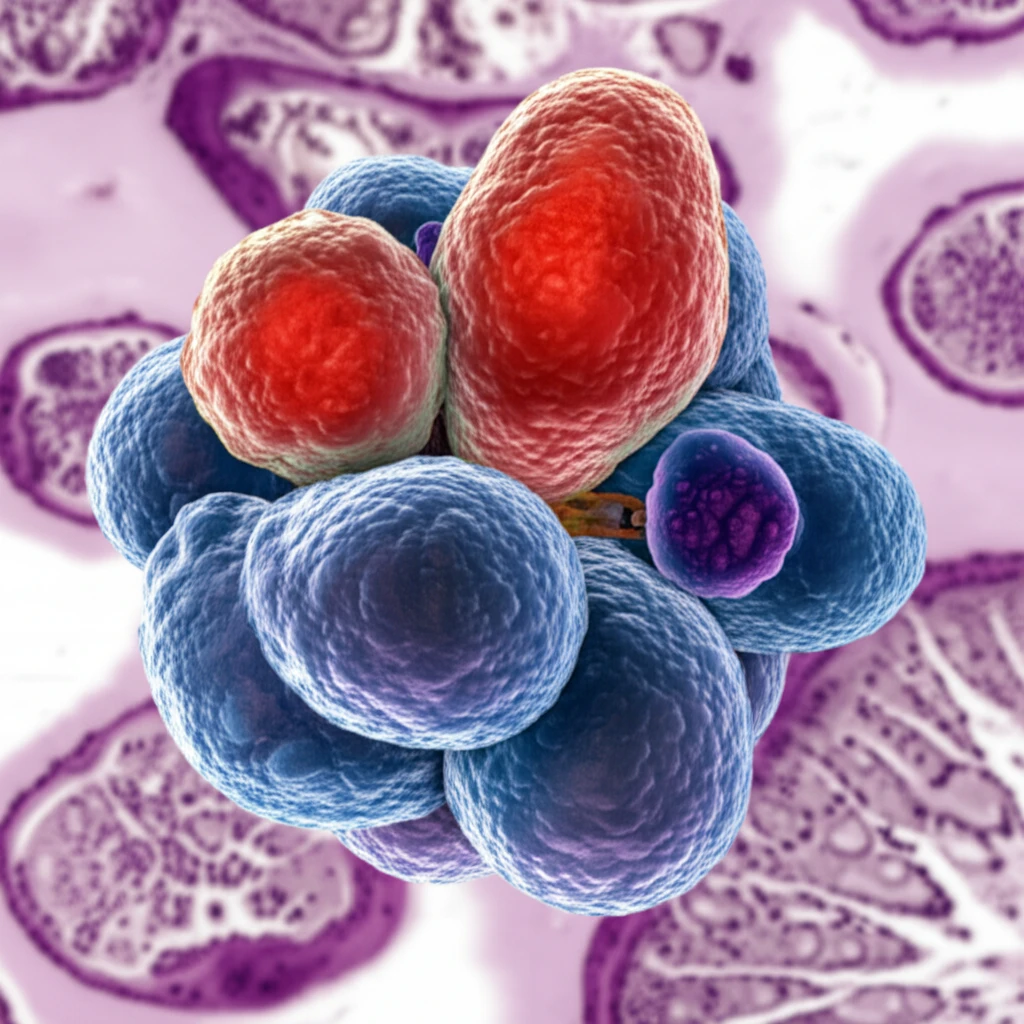
Illustration depicting the cellular structure of epithelial-myoepithelial carcinoma

Unveiling the Mystery: Understanding Epithelial-Myoepithelial Carcinoma

"A Deep Dive into a Rare Salivary Gland Tumor: Causes, Symptoms, and Treatment Options"


Imagine a health concern so rare that few people have even heard of it. Epithelial-myoepithelial carcinoma (EMC) is one such condition, a low-grade malignancy primarily affecting the salivary glands. While it might not be a household name, understanding EMC is crucial for anyone seeking knowledge about rare medical conditions or those directly impacted by it.

This article aims to demystify EMC, providing a comprehensive overview of this unique condition. We will delve into its characteristics, explore how it's diagnosed, and examine the various treatment strategies available. This information is designed to be accessible and informative, empowering readers with a deeper understanding of this rare but significant health issue.

EMC's rarity means that information can be scarce, and those affected often have many questions. This article seeks to answer those questions, offering clarity and insight into EMC's nature and the paths available for management and care.

What is Epithelial-Myoepithelial Carcinoma?

Illustration depicting the cellular structure of epithelial-myoepithelial carcinoma

EMC is a type of tumor that arises in the salivary glands, the glands responsible for producing saliva. It is classified as a low-grade malignancy, implying it tends to grow slowly and is less likely to spread aggressively compared to high-grade cancers. This characteristic is crucial in understanding the prognosis and treatment approaches for EMC.

EMC is not a common condition. Research indicates that it accounts for a small percentage of all salivary gland tumors. The parotid gland, located near the ear, is the most common site for EMC to develop. EMC typically affects individuals in their later years, and there is a slight predilection for females.

  • Origin and Development: EMC originates from the intercalated ducts of the salivary glands. These ducts are responsible for transporting saliva.
  • Growth Pattern: The tumors often present as slow-growing masses.
  • Histological Features: Microscopically, EMC is characterized by a distinctive two-cell population: inner ductal cells and outer myoepithelial cells.
  • Rarity: EMC is a rare tumor.
The slow-growing nature of EMC can sometimes lead to delayed diagnosis. Patients might notice a painless swelling that gradually increases in size. While EMC is considered low-grade, it is still essential to seek prompt medical attention if any unusual lumps or swellings are detected in the salivary gland regions.

Living with and Managing Epithelial-Myoepithelial Carcinoma

EMC, though rare, is a manageable condition. Early detection, accurate diagnosis, and appropriate treatment are crucial for optimal outcomes. While the journey can be challenging, there are resources and support systems available to help those affected. This article serves as a starting point for understanding EMC, encouraging informed decisions, and promoting a proactive approach to health and well-being.

About this Article -

This article was crafted using a human-AI hybrid and collaborative approach. AI assisted our team with initial drafting, research insights, identifying key questions, and image generation. Our human editors guided topic selection, defined the angle, structured the content, ensured factual accuracy and relevance, refined the tone, and conducted thorough editing to deliver helpful, high-quality information.See our About page for more information.

This article is based on research published under:

DOI-LINK: 10.5125/jkaoms.2011.37.6.505, Alternate LINK

Title: Epithelial-Myoepithelial Carcinoma On The Superficial Lobe Of The Parotid Gland: A Case Report

Subject: Oral Surgery

Journal: Journal of the Korean Association of Oral and Maxillofacial Surgeons

Publisher: The Korean Association of Oral and Maxillofacial Surgeons

Authors: Sun-Mi Jin, Hyun-Ho Ryu, Seok-Hwan Ryu, Dong-Yoon Shin, Hie-Sung Hwang, Chul-Hoon Kim, Bok-Joo Kim

Published: 2011-01-01

Everything You Need To Know

1

What exactly is Epithelial-Myoepithelial Carcinoma (EMC), and where does it typically occur?

Epithelial-Myoepithelial Carcinoma (EMC) is a rare, low-grade malignant tumor that originates in the salivary glands, which are responsible for producing saliva. While it's uncommon, when it does occur, it's most frequently found in the parotid gland, located near the ear. The "low-grade" classification means it tends to grow slowly and is less likely to spread aggressively compared to high-grade cancers. EMC develops from the intercalated ducts of the salivary glands, which are essential for transporting saliva. Its rarity underscores the importance of specialized knowledge in diagnosis and treatment.

2

How is Epithelial-Myoepithelial Carcinoma (EMC) diagnosed, considering it's a rare type of tumor?

Given the rarity of Epithelial-Myoepithelial Carcinoma (EMC), diagnosis typically involves a combination of clinical evaluation, imaging studies, and histopathological examination. Patients often present with a slow-growing, painless swelling in the salivary gland region, prompting further investigation. Imaging techniques like CT scans or MRI can help visualize the tumor's size and location. However, a definitive diagnosis requires a biopsy and microscopic examination of the tissue. Histologically, EMC is characterized by a distinctive two-cell population: inner ductal cells and outer myoepithelial cells. This specific cellular arrangement is crucial for distinguishing EMC from other salivary gland tumors. This also requires experts in the field to accurately determine.

3

What are the primary treatment options for Epithelial-Myoepithelial Carcinoma (EMC), and how effective are they?

The primary treatment for Epithelial-Myoepithelial Carcinoma (EMC) typically involves surgical removal of the tumor. The extent of surgery depends on the tumor's size, location, and involvement of surrounding structures. In some cases, radiation therapy may be recommended after surgery, especially if there's a high risk of recurrence or if the tumor cannot be completely removed. Because EMC is slow-growing, early detection and complete surgical resection often lead to favorable outcomes. However, long-term follow-up is essential to monitor for any signs of recurrence. Further research is needed to explore the potential benefits of targeted therapies or chemotherapy in cases where surgery and radiation are insufficient. The effectiveness of treatments is also related to the stage at which EMC is identified.

4

What factors contribute to the development of Epithelial-Myoepithelial Carcinoma (EMC), and are there any known risk factors?

The exact causes of Epithelial-Myoepithelial Carcinoma (EMC) are not yet fully understood. Like many rare cancers, research into its specific etiology is ongoing. While there are no definitively established risk factors, EMC typically affects individuals in their later years, and there is a slight predilection for females. Some studies have explored potential genetic or environmental factors that might contribute to its development, but more research is needed to draw firm conclusions. Understanding the molecular mechanisms driving EMC development could lead to the identification of potential therapeutic targets. Further, a comprehensive study on a larger population is required.

5

What should individuals do if they suspect they have Epithelial-Myoepithelial Carcinoma (EMC)?

If an individual suspects they have Epithelial-Myoepithelial Carcinoma (EMC), they should seek prompt medical attention from a qualified healthcare professional. Given that EMC presents as a slow-growing mass, any unusual lumps or swellings detected in the salivary gland regions warrant investigation. The evaluation process typically begins with a physical examination and imaging studies. If EMC is suspected, a biopsy will be performed to confirm the diagnosis. Early detection and accurate diagnosis are crucial for optimizing treatment outcomes. Due to the rarity of EMC, it is also advisable to seek consultation with specialists experienced in treating salivary gland tumors to ensure comprehensive and appropriate management. Moreover, patients should be informed about potential participation in clinical trials that are focused on Epithelial-Myoepithelial Carcinoma.

Newsletter Subscribe

Subscribe to get the latest articles and insights directly in your inbox.