
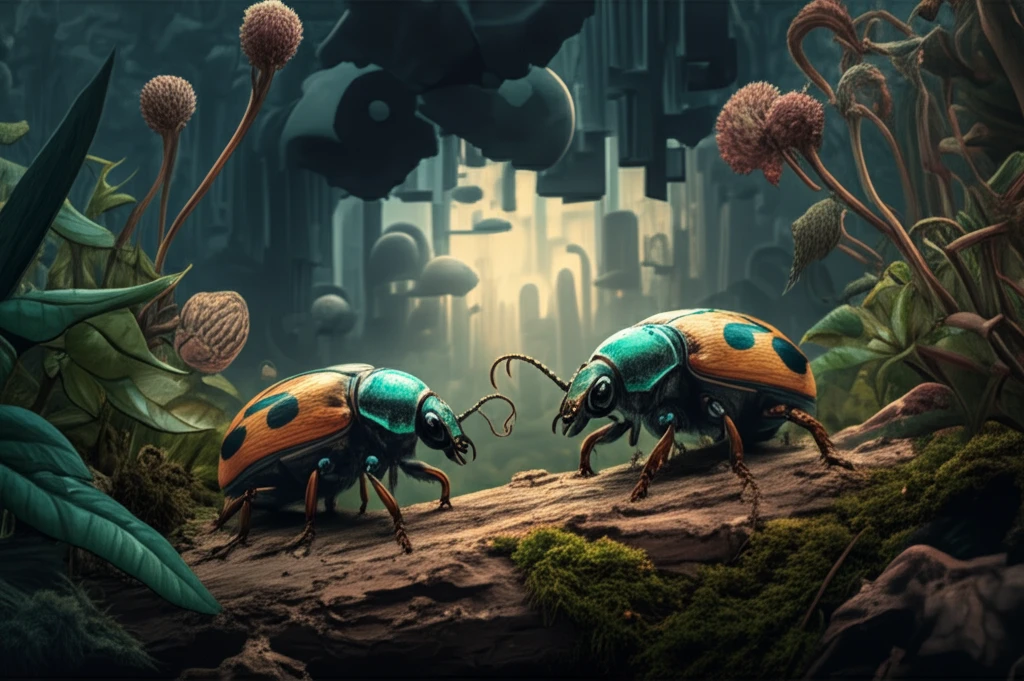
Unveiling Hong Kong's Hidden Biodiversity: Two New Beetle Species Discovered

"Unexpected Discoveries in the Urban Jungle: Uncovering new Laena beetle species in Hong Kong reveals the area's hidden ecological richness."
For entomologists, the world is full of surprises, especially when exploring regions thought to be well-documented. A recent discovery has shed light on the hidden biodiversity of Hong Kong, revealing two new species of beetles from the genus Laena. This genus, part of the Tenebrionidae family (commonly known as darkling beetles), is incredibly diverse, especially in China. However, its presence in Hong Kong was previously unconfirmed.
The Laena genus is particularly rich in species across China, with approximately 100 known species inhabiting various provinces, excluding Taiwan. These beetles, typically flightless, tend to have limited distribution ranges, thriving in the soil of mature forests, particularly in Sichuan and Yunnan. While a single species, Laena ovipennis, was once mistakenly attributed to Hong Kong, it was later found to originate from the Zhejiang province near Shanghai. This new finding marks the first official record of the Laena genus in Hong Kong.
This groundbreaking discovery was made possible by recent collecting efforts in Hong Kong, leading to the identification of Laena hongkongica sp. n. and Laena walkeri sp. n.. These species present a unique characteristic within the genus – significant body length variation, an unusual trait that sets them apart from their counterparts. This article delves into the fascinating details of these newly discovered species, their unique features, and the implications for understanding biodiversity in urban environments.
Rediscoveries, Infestations, and Pop Culture Names
Beetle discoveries continue to reshape regional species counts: a beetle hotspot on the South Devon coast rewrote its record book for the second time in six years when researchers found an oil beetle last seen in 1906 and long thought extinct, taking the area's species count from four to five. In the United States, a University of Idaho entomologist confirmed that an exotic beetle native to the Mediterranean basin has arrived in Idaho's Treasure Valley, where it has infested homes with large numbers of larvae that are difficult to control. Dung beetles illustrate the everyday impact of the group by keeping ecosystems clean through their diet. Even naming can reflect the insects' cultural reach, as an ENMU professor and his colleague named three new species in an Australian genus after Pokémon's Legendary birds.
Integrating Morphology and DNA Barcoding
Modern beetle taxonomy increasingly relies on an integrative approach that pairs meticulous morphological examination with DNA barcoding, which uses an organism's genetic sequence to identify its species. Researchers report that this dual-method strategy has not only uncovered many new species but also corrected numerous inaccuracies left over from earlier taxonomic assessments. The technique has limits, however: some species can look very different from one another despite sharing the same DNA markers, so morphology remains essential. Such findings also highlight how much remains unknown about beetle biology itself, from a millimeter-sized featherwing flyer discovered using a flight mode never seen in other insects to the revelation that dung beetle thoracic horns emerge from the same gene network as wings.
From 1819 Field Notes to Fossilized Feces
Formal beetle discovery has deep roots: as far back as August 1819, naturalist Thomas Say documented the Great Plains darkling beetle. Paleontological work pushes the timeline much further, with an international team including a Palacký University expert finding a beetle in amber fossils in Hungary that dates to the Age of Dinosaurs. An even older specimen, Triamyxa coprolithica, was discovered whole and unusually intact inside fossilized feces and is described as the first insect to be scientifically identified from coprolites, dating to roughly 230 million years ago.
Meet the New Species: Laena hongkongica and Laena walkeri
Laena hongkongica is distinguished by its unique femoral spines. The anterior femora lack spines, while the middle and posterior femora each possess spines. This characteristic is unique among Chinese Laena species. Other distinctive features include the pronotum shape, featuring nearly acute posterior corners, and the specific dorsal punctuation and setation patterns. The body length ranges from 4.5 to 9.0 mm.
- Laena hongkongica: Unique femoral spine pattern (middle and posterior femora only).
- Laena walkeri: All femora without teeth; resembles Laena guangxica.
- Both species show unusual body length variation within the Laena genus.
- Collected in leaf litter from wooded areas above 100m altitude.
A Global Wave of New Species
Recent beetle research spans both deep time and living species, including a 90-million-year-old ancient beetle whose discovery was aided by fossil material first found at Botswana's Orapa Diamond Mine in 1980, which sparked years of study. On a living scale, researchers described Parastethorus pinicola, a new ladybird beetle roughly one millimeter long discovered on a Japanese black pine at Kyushu University's Hakozaki Satellite. Another new long-horned beetle species drew attention for using ovoviviparity, a reproductive mode in which females hatch eggs inside the body, something rarely seen outside mammals. Other newly documented beetles were so distinct that researchers collaborated on naming them for a paper in The Canadian Entomologist, christening the species after the Pokémon franchise's Legendary birds.
Failures and Surprises That Pay Off
Not every beetle research line goes as planned, and some apparent dead ends lead somewhere better: a failed attempt to mimic a beetle's structural color reportedly redirected researchers toward a biodegradable, plant-based alternative to plastic packaging. Another result challenges a foundational assumption about how nature innovates, since researchers found that thoracic horns in dung beetles arise from the same gene network as wings. Reported in a 2019 study, the discovery led biologists to revise their understanding of how new traits can evolve. Together, these cases show how setbacks in beetle research can still produce real-world value and conceptual breakthroughs.
Comparing Beetles in the Wild and Online
Comparative content about beetles spans entertainment, utility, and public education. Casual video platforms host beetle vs toy beetle "battles" that pair live insect encounters with toy comparisons, while general comparison sites let users evaluate products and subjects side by side using detailed specifications and data visualizations. On social platforms, curated idea boards collect practical guidance on how to identify Asian beetles, helping non-experts distinguish similar-looking species. These varied formats show that beetle comparisons range from identification aids to pure entertainment.
Implications and Future Research
The discovery of Laena hongkongica and Laena walkeri highlights the importance of continued biodiversity research, even in urbanized areas. These findings challenge preconceived notions about species distribution and emphasize the need for conservation efforts to protect vulnerable habitats. Further research could explore the genetic relationships between these new species and other members of the Laena genus, providing a deeper understanding of their evolutionary history. Additionally, investigating the ecological roles of these beetles within the Hong Kong ecosystem could reveal valuable insights into the intricate web of life in this unique environment.
Discovery With Scientific and Economic Weight
Expert commentary on beetle discoveries tends to stress both their scientific and practical significance. Researchers at Ateneo de Manila University noted that two newly described Philippine Byrrhinus species were the first additional species of the genus found in the country in 28 years, raising the known tally from five to seven. A separate find carried a large economic dimension: a Canberran's quick identification of a khapra beetle led biosecurity officials to close multiple Good Guys stores for several days to contain the invasive species, and the response earned a biosecurity award credited with saving Australia an estimated $1.5 billion.
Uncharted Habitats and Unnamed Collections
Future beetle work points toward unexplored habitats and long-overlooked specimens: a new snow-loving beetle found at 2,000 meters on the northern slopes of the Swiss Alps has been described as a leftover from the ice age. Even museum backlog can hide discoveries, as a beetle first collected in soil and leaf litter in Nairobi in 1965, held by the Natural History Museum since 1978 alongside its collection of over 22 million beetles, remained nameless until recently receiving a name honoring Greta Thunberg. Conservation questions are also on the horizon, since researchers report that dazzling new mimic jewel weevils found in the Philippines may already be under threat despite the effectiveness of their iridescent defenses.
How Beetles Rewrite the Rules of Evolution
Beetles are now informing some of the biggest open questions in evolutionary biology. Research reported in the journal Science found that thoracic horns in dung beetles emerge from the same gene network as wings, evidence that came from an unexpected source, the small dung beetle. The finding better illuminates how new traits can evolve and challenges the assumption that genuinely new body parts must depend on entirely novel genetic machinery. Such work shows how a single charismatic insect can reshape biologists' understanding of innovation in nature.
Tough Shells and Ancient Colors
Beetles continue to inspire engineering and evolutionary science. The diabolical ironclad beetle, clad in super-tough body armor, can survive forces up to 39,000 times its own weight, including being run over by a car. Its resilience has made it a compelling subject for materials and engineering research. Separately, scientists recently uncovered spectacularly preserved blue-green colors in the scales of 13,000-year-old fossilized weevil beetles, providing new insight into how and when insects evolved colors and whether their roles have remained constant through time.