
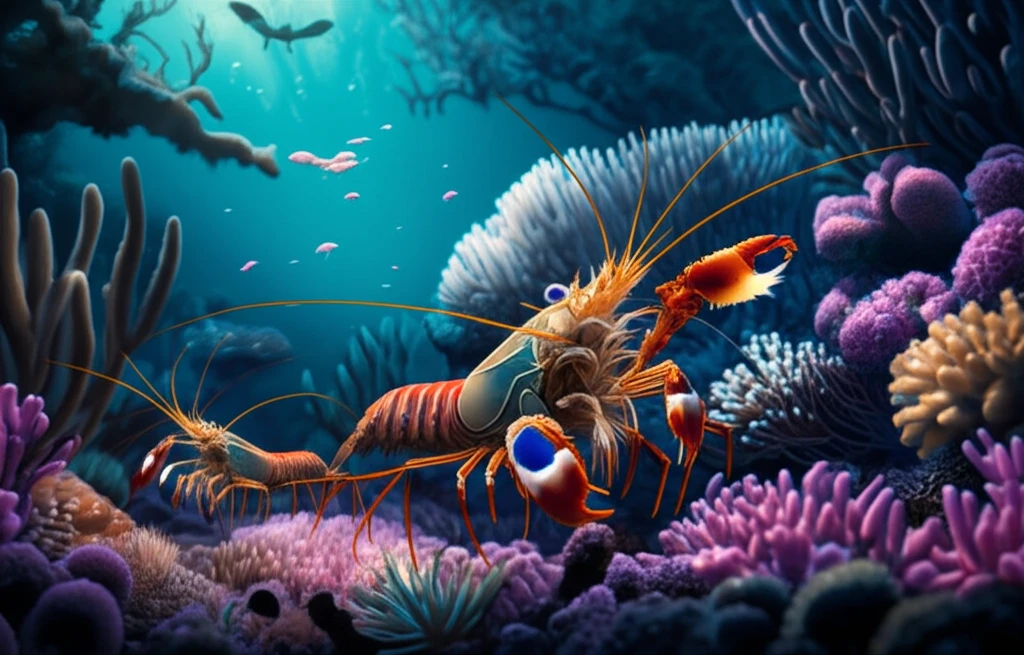
Shrimp Secrets: Uncovering New Species in the Persian Gulf

"Dive into the world of marine biology and discover the fascinating story of newly identified snapping shrimp species, their unique characteristics, and the importance of biodiversity in the Persian Gulf."
The ocean's depths hold countless secrets, and among them are the hidden lives of marine creatures, great and small. In a recent study published in the Journal of the Marine Biological Association of the United Kingdom, researchers unveiled a fascinating discovery: three new species of snapping shrimp, genus Alpheus, dwelling in the Persian Gulf. This discovery highlights the incredible biodiversity still waiting to be uncovered and underscores the importance of ongoing marine research.
Snapping shrimp, also known as pistol shrimp, are a captivating group of crustaceans renowned for their unique ability to create a powerful snapping sound with their oversized claw. This sound, generated by rapidly closing the claw, produces a cavitation bubble that collapses with enough force to stun or even kill prey. These tiny but mighty creatures play a vital role in marine ecosystems, contributing to the complex web of life beneath the waves.
This article delves into the details of this exciting discovery, exploring the characteristics of these new shrimp species, their habitat in the Persian Gulf, and the broader implications for understanding marine biodiversity and conservation. Whether you're a seasoned marine biologist or simply curious about the natural world, prepare to be amazed by the hidden lives of these snapping shrimp.
Current Statistics & Impact
Research since 2019 has examined how oil spills affect Persian Gulf snapping shrimp, specifically measuring polycyclic aromatic hydrocarbons (PAHs) in sediments and their impact on the fecundity of Alpheus estuariensis. Taxonomic work using samples from Iraq has clarified the status of Alpheus lobidens, previously confused with the A. edwardsii species complex. While bigclaw snapping shrimp (Alpheus heterochaelis) populations are regarded as stable, their abundance and density have not been extensively studied. The genus Alpheus contains numerous sibling species complexes distinguished by color and color pattern, complicating biodiversity assessments.
Standard Approach, Accepted Methods & Their Limitations
Standard methods for studying snapping shrimp include single-frame video analysis of snapping behavior during intraspecific encounters, as demonstrated in Alpheus heterochaelis. Researchers employ integrated approaches combining geometric morphometrics with molecular phylogenetic reconstructions to test hypotheses about convergent adaptation for microhabitat use. Morphometric studies typically involve collecting small sample sizes — such as 30 randomly selected specimens — from local gatherers to characterize populations. These approaches face limitations in capturing the full complexity of weapon scaling, sex differences, and seasonal variation in claw morphology.
Historical Perspective, Milestones, Foundational Discoveries
The study of snapping shrimp has a long history in carcinology, with early taxonomic work establishing the genus Alpheus as the most species-rich in the Alpheidae family. Foundational discoveries include the remarkable snapping mechanism — a cavitation-producing claw closure that generates intense sound and light — and the phenomenon of claw reversal, where lost snapping claws regenerate as smaller claws while the original minor claw transforms into a new snapper. Historical collections from the Persian Gulf region have been limited, leaving gaps in our understanding of regional diversity that modern research is only beginning to address.
What Makes These Snapping Shrimp Unique?
The researchers, Amir Dehghani, Alireza Sari, and Reza Naderloo, meticulously examined shrimp specimens collected from the Abu-Musa Island region of the Persian Gulf. Their detailed analysis revealed distinct morphological characteristics that set these shrimp apart from previously known species. These differences include variations in claw shape, body size, and color patterns.
- Alpheus ankeri sp. nov.: This species features a unique color pattern and a relatively large female allotype, measuring 9.1 mm in carapace length (CL).
- A. abumusa sp. nov.: The female allotype of this species has a CL of 8.8 mm, with subtle differences in claw morphology. The male holotype is recorded with a CL of 8.9 mm.
- A. mohammadpouri sp. nov.: Characterized by a distinct set of features, this species includes a female allotype with a CL of 9.4 mm and a male holotype with a CL of 8.3 mm.
Latest Research and Reviews
Recent research has resolved long-standing taxonomic confusion, with four new snapping shrimp species confirmed in Chiba, providing a more accurate foundation for marine biodiversity understanding. The complete mitochondrial genome of Alpheus brevicristatus has been sequenced and analyzed, adding to genomic resources for this speciose genus. Soundscape studies along the southeast China coast demonstrate that snapping shrimp sounds serve as important biological input for habitat-specific underwater soundscape characterization. Additionally, the first zoeal stages of Alpheus carlae and A. intrinsecus from Brazil have been described from laboratory-hatched specimens, advancing larval identification.
Counter Arguments and Failures
Not all snapping behavior may serve aggressive or predatory functions; the cocked claw display in Alpheus heterochaelis may conserve energy normally expended by snapping, suggesting alternative signaling strategies. Fossil evidence from the Miocene Pirabas Formation in Brazil reveals isolated snapping claw fragments, but preservation biases and fragmentary remains limit paleoecological inferences about ancient alpheid communities. In urban estuaries like San Francisco Bay, snapping shrimp acoustic behavior reflects dramatically changing water conditions across multiple scales, complicating long-term monitoring and baseline establishment.
Comparative Analysis
Snapping shrimp exhibit the remarkable ability to reverse claws: when the snapping claw is lost, it regenerates as a smaller claw while the original minor appendage grows into a new snapping claw. The genus Alpheus is defined by asymmetrical claws, with one significantly larger claw producing loud snapping sounds used for both communication and hunting. Strikingly, juvenile pistol shrimp can snap their claws up to 20 times faster than adults, reaching speeds comparable to speeding bullets and exceeding even mantis shrimp strike velocities. This ontogenetic difference in performance highlights developmental plasticity in the snapping mechanism.
Why This Discovery Matters
The identification of these three new snapping shrimp species is more than just an academic exercise. It underscores the critical importance of biodiversity in the Persian Gulf, a region facing increasing environmental pressures from pollution, habitat destruction, and climate change. Understanding the full extent of marine life in this area is essential for developing effective conservation strategies. Each species, no matter how small, plays a role in the intricate web of the ecosystem.
Synthesis & Expert Commentary
As a biological sound source widely distributed in temperate and tropical coastal waters, snapping shrimp produce strong acoustic pulses that serve as honest signals indicating habitat-specific soundscapes. Their ubiquitous snapping creates a pervasive background noise that shapes the acoustic environment for countless marine organisms, from fish to invertebrates. This soundscape role positions snapping shrimp as ecosystem engineers whose acoustic output influences predator-prey dynamics, larval settlement, and community structure across coastal habitats.
Future Outlook & Next Frontiers
Future research will likely leverage advancing genomic tools to resolve cryptic species complexes across the Persian Gulf and beyond, while long-term acoustic monitoring networks could track population responses to environmental change. Integrating larval descriptions with molecular barcoding promises to connect life-history stages that have historically been studied in isolation. Emerging technologies in high-speed imaging and 3D morphometrics may reveal new details of the snapping mechanism's biomechanics and its evolutionary diversification.
Broader Context & Systemic Challenges
Snapping shrimp research sits at the intersection of taxonomy, behavioral ecology, bioacoustics, and conservation biology, requiring interdisciplinary approaches that are often difficult to fund and coordinate. The Persian Gulf's unique environmental conditions — extreme temperatures, high salinity, and anthropogenic pressures from oil extraction — create both urgency and logistical challenges for biodiversity documentation. Taxonomic impediments, including the scarcity of regional expertise and type material, continue to slow species discovery in this biologically rich but underexplored region.
The Human Element & Real-World Impact
High-speed photography has captured the complete feeding sequence of bigclaw snapping shrimp (Alpheus heterochaelis) with various prey items, revealing the precision of their predatory strikes. Oil pollution poses direct threats: even at low concentrations, dissolved and dispersed oil affects early life stages, with PAHs from stranded oil pellets documented in the equatorial Atlantic. These findings underscore that snapping shrimp, despite their formidable weaponry, are vulnerable to anthropogenic stressors that degrade coastal habitats and disrupt life cycles.