
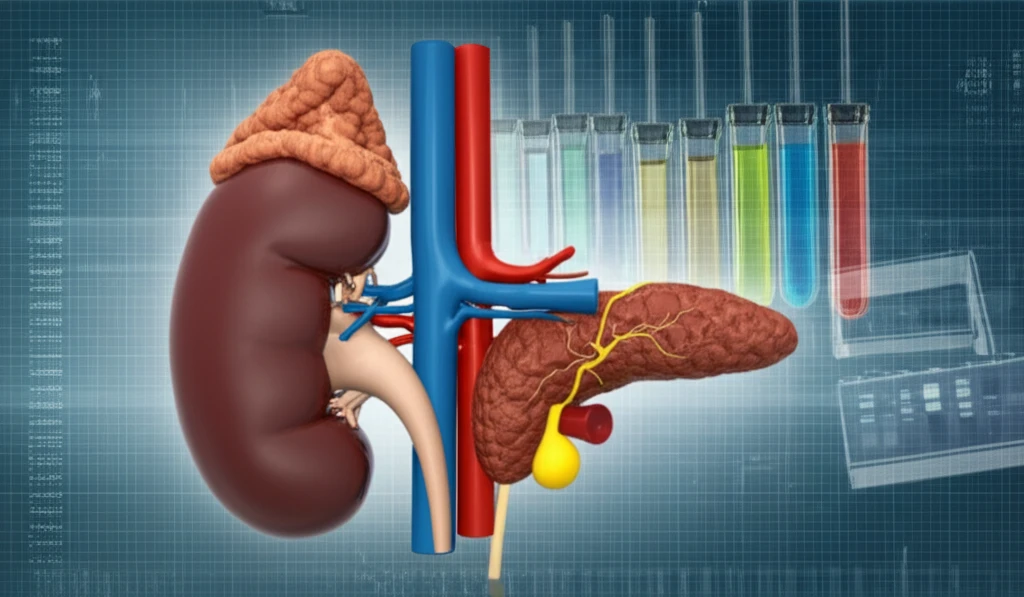
Surreal illustration of kidney, pancreas, and lab tests representing diagnostic complexity.

Unusual Urine Patterns: What Kidney-Pancreas Transplants Can Reveal

"Decoding Abnormal Urine Immunofixation After Kidney-Pancreas Transplants: A Deep Dive into Pancreatic Enzymes and MGRS"


In the intricate landscape of medical diagnostics, unexpected patterns can emerge, offering unique insights into underlying physiological processes. A recent study highlighted just such a case, focusing on three patients with a shared medical history of type 1 diabetes mellitus and combined kidney-pancreas transplants. These patients presented with an unusual pattern in their urine immunofixation tests, initially ordered to investigate potential monoclonal gammopathy of renal significance (MGRS).

Monoclonal gammopathy of renal significance, or MGRS, is a condition where abnormal plasma cells produce a monoclonal protein that can cause kidney damage. Diagnosing it can be complex, often requiring a combination of laboratory tests and clinical assessments. The standard approach involves analyzing urine and serum for the presence of these abnormal proteins using techniques like immunofixation and electrophoresis.

However, the cases presented in this study defied typical expectations. While protein electrophoresis revealed abnormal fractions in the patients' urine, the corresponding immunofixation assays failed to detect the expected monoclonal proteins. This discrepancy prompted a deeper investigation into the potential causes, ultimately shedding light on the unexpected role of pancreatic enzymes in influencing urine composition post-transplant.

The Curious Case of Pancreatic Enzymes Post-Transplant

Surreal illustration of kidney, pancreas, and lab tests representing diagnostic complexity.

Following a combined kidney-pancreas transplant, the exocrine compartment of the transplanted pancreas is often drained into the patient's bladder. This surgical configuration, designed to manage endocrine dysfunction associated with type 1 diabetes, leads to an elevated presence of pancreatic enzymes in the urine. The study revealed significantly increased levels of amylase and lipase, key enzymes produced by the pancreas, in the urine samples of the three patients.

The presence of these enzymes provides a plausible explanation for the unusual urine patterns observed. It is hypothesized that pancreatic enzymes and their cleavage products interfere with the standard immunofixation assays, leading to the detection of abnormal fractions in protein electrophoresis but a failure to identify specific monoclonal proteins. This enzymatic interference introduces a confounding factor in the diagnostic process, complicating the assessment for MGRS.

  • Enzyme Interference: Pancreatic enzymes, present in high concentrations, can break down proteins in the urine, leading to the formation of unusual protein fragments.
  • Assay Limitations: Standard immunofixation assays may not be designed to identify these enzyme-derived fragments, resulting in a mismatch between electrophoresis and immunofixation results.
  • Diagnostic Challenges: This phenomenon poses diagnostic challenges, requiring clinicians to consider the possibility of enzymatic interference when interpreting urine studies in kidney-pancreas transplant recipients.
Given the potential for enzymatic interference to confound MGRS diagnosis in this patient population, additional laboratory studies may be warranted. Immunoglobulin isotype restriction analysis on kidney biopsy samples, performed using immunostaining, immunoelectron microscopy, or laser dissection mass spectrometry-based proteomics, can provide more definitive evidence of monoclonal protein deposition in the kidneys. These techniques can help differentiate true MGRS cases from false positives arising from enzymatic activity, ensuring appropriate management and treatment strategies.

Navigating Diagnostic Complexity in Transplant Recipients

The cases highlight the importance of considering the unique physiological changes that occur following organ transplantation. In kidney-pancreas transplant recipients, the presence of elevated pancreatic enzymes in the urine can create diagnostic challenges when evaluating potential kidney-related disorders like MGRS. By recognizing the potential for enzymatic interference and employing advanced diagnostic techniques, clinicians can better navigate these complexities and provide accurate, timely diagnoses. Further research is needed to refine diagnostic algorithms and optimize patient care in this specialized population.

About this Article -

This article was crafted using a human-AI hybrid and collaborative approach. AI assisted our team with initial drafting, research insights, identifying key questions, and image generation. Our human editors guided topic selection, defined the angle, structured the content, ensured factual accuracy and relevance, refined the tone, and conducted thorough editing to deliver helpful, high-quality information.See our About page for more information.

Everything You Need To Know

1

What is monoclonal gammopathy of renal significance (MGRS), and why is it important to diagnose it correctly?

Monoclonal gammopathy of renal significance (MGRS) is a condition characterized by the production of abnormal monoclonal proteins by plasma cells, leading to kidney damage. Diagnosing MGRS typically involves analyzing urine and serum for these proteins using methods like immunofixation and electrophoresis. Accurate diagnosis is crucial to distinguish it from other conditions causing similar symptoms and to ensure appropriate treatment, preventing further kidney damage. However, post-transplant complications, like elevated pancreatic enzymes in urine, can complicate this process. Further complicating diagnosis, the presence of cryoglobulins or paraproteins can lead to false positive or negative results. Therefore, clinicians often need to employ advanced techniques such as kidney biopsy analysis to confirm the presence of monoclonal protein deposits in the kidneys, ensuring accurate diagnosis and management.

2

Why are pancreatic enzymes found in the urine after a kidney-pancreas transplant, and what is the significance of this?

Following a combined kidney-pancreas transplant, the exocrine part of the transplanted pancreas is often connected to the bladder. This surgical configuration results in elevated levels of pancreatic enzymes, such as amylase and lipase, in the urine. This is significant because these enzymes can interfere with standard urine tests, particularly immunofixation assays, leading to misleading results when evaluating kidney function and potential kidney diseases. This interference needs to be considered to avoid misdiagnosis, especially when investigating conditions like monoclonal gammopathy of renal significance (MGRS).

3

How do pancreatic enzymes interfere with urine tests, and why is this a diagnostic challenge?

Pancreatic enzymes, especially amylase and lipase, present in high concentrations in the urine of kidney-pancreas transplant recipients, can break down proteins into unusual fragments. These fragments can then interfere with immunofixation assays, leading to abnormal fractions in protein electrophoresis but failing to identify specific monoclonal proteins. This discrepancy creates a diagnostic challenge because the standard tests may not accurately reflect the presence or absence of MGRS, potentially delaying or misdirecting treatment. Clinicians need to be aware of this interference and consider alternative diagnostic approaches, such as kidney biopsy, to confirm MGRS.

4

What additional laboratory studies can be performed to diagnose monoclonal gammopathy of renal significance (MGRS) accurately in kidney-pancreas transplant recipients?

To accurately diagnose monoclonal gammopathy of renal significance (MGRS) in kidney-pancreas transplant recipients, clinicians might consider additional laboratory studies beyond standard urine and serum analysis. Immunoglobulin isotype restriction analysis on kidney biopsy samples, using immunostaining, immunoelectron microscopy, or laser dissection mass spectrometry-based proteomics, can provide more definitive evidence of monoclonal protein deposition in the kidneys. These techniques help differentiate true MGRS cases from false positives resulting from enzymatic activity, ensuring correct diagnosis and management. These advanced techniques become essential in cases where standard tests are confounded by the presence of pancreatic enzymes.

5

Why is it important to consider the possibility of enzymatic interference when evaluating kidney-related disorders in kidney-pancreas transplant recipients?

Elevated pancreatic enzymes in the urine of kidney-pancreas transplant recipients can create diagnostic challenges when evaluating potential kidney-related disorders like monoclonal gammopathy of renal significance (MGRS). The enzymes' presence can interfere with standard urine tests, leading to false positive or negative results. Recognizing this potential for enzymatic interference is crucial for accurate and timely diagnoses. This highlights the need for clinicians to interpret urine studies cautiously, considering the patient's transplant history and the potential for enzymatic activity to confound the results. Employing advanced diagnostic techniques, such as kidney biopsy analysis, helps navigate these complexities and provide appropriate patient care.

Newsletter Subscribe

Subscribe to get the latest articles and insights directly in your inbox.