
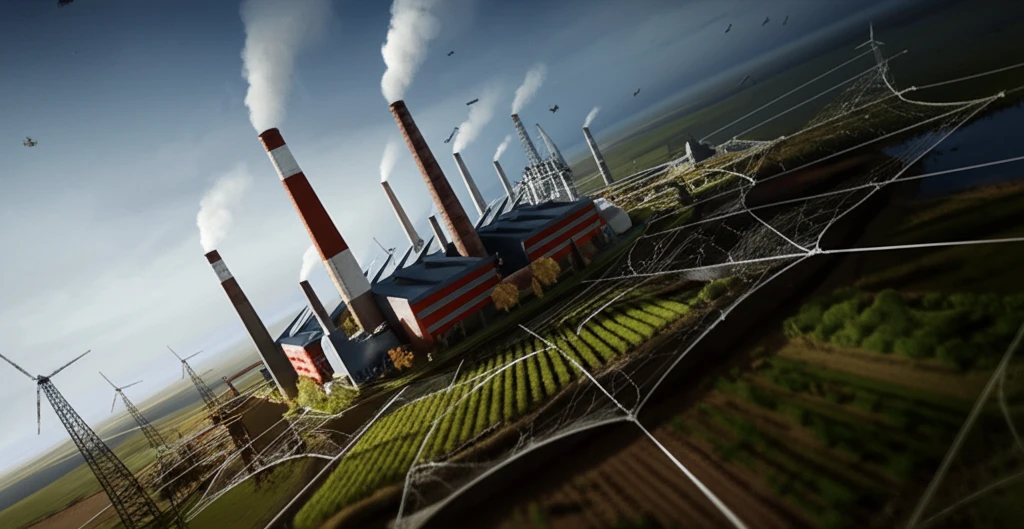
Interconnected spiderweb of factories and farms symbolizing the Dutch economy.

Untangling the Web: How Industry Connections Impact Your Wallet

"A new study reveals the hidden relationships between Dutch industries, uncovering potential vulnerabilities and surprising insights into the flow of money through the economy."


We live in an interconnected world. From global supply chains to local businesses, industries are woven together in a complex web of relationships. Understanding these connections is crucial for predicting economic trends, mitigating potential risks, and making informed decisions about your own financial well-being.

Imagine a domino effect. A disruption in one industry, like a shortage of raw materials, can trigger a cascade of consequences across the entire network. Businesses that rely on the affected industry may struggle, leading to job losses and price increases for consumers. But how can we identify these vulnerabilities and prepare for potential disruptions?

A recent study by researchers in the Netherlands has shed light on the intricate connections within the Dutch inter-industry production network. By analyzing data on 187 commodity groups, the study uncovers surprising insights into the flow of money and resources, revealing which industries are most vulnerable to shocks and how these shocks can propagate through the economy.

The Dutch Industry Web: A Closer Look

Interconnected spiderweb of factories and farms symbolizing the Dutch economy.

The study, conducted by researchers from IMT School for Advanced Studies Lucca, Lorentz Institute for Theoretical Physics, Statistics Netherlands, and Korteweg - de Vries Institute for Mathematics, delves into the complex relationships between industries in the Netherlands. Using data reconstructed from National Accounts registers, surveys, and known empirical data, the researchers mapped the flow of goods and services between 862 industries across 187 commodity groups.

Think of it as a giant map, with each industry representing a node and each connection representing the flow of goods and services. By analyzing the patterns of these connections, the researchers were able to identify key vulnerabilities and potential risks within the network.

  • Triadic Motifs: The study focused on identifying "triadic motifs," which are small, interconnected groups of three industries. These motifs can reveal how shocks propagate through the network.
  • Null Models: To distinguish significant patterns from random fluctuations, the researchers used "null models" to filter out node heterogeneity and link reciprocity.
  • Commodity-Specific Analysis: Unlike previous studies that focused on aggregate data, this research disaggregated the network to the level of individual commodities, providing a more granular understanding of industry relationships.
One of the key findings of the study is that while the aggregate network is characterized by a multitude of triadic motifs, most single-product layers feature no significant motif. Roughly 85% of the layers feature only two motifs or less. This suggests that the complexity of the overall economy masks a simpler structure at the level of individual commodities. In essence, when you zoom in on specific products, the web of connections becomes much less tangled.

What Does This Mean for You?

The findings of this study have important implications for businesses, policymakers, and consumers alike. By understanding the intricate connections between industries, businesses can better assess their own vulnerabilities and develop strategies to mitigate potential risks. Policymakers can use this information to identify key sectors that require support and to design policies that promote economic resilience. And as consumers, we can all benefit from a greater awareness of how disruptions in one industry can impact the prices we pay and the jobs we hold. Whether it's the price of your daily bread or the stability of your local economy, everything is connected.

About this Article -

This article was crafted using a human-AI hybrid and collaborative approach. AI assisted our team with initial drafting, research insights, identifying key questions, and image generation. Our human editors guided topic selection, defined the angle, structured the content, ensured factual accuracy and relevance, refined the tone, and conducted thorough editing to deliver helpful, high-quality information.See our About page for more information.

This article is based on research published under:

DOI-LINK: 10.1038/s41598-024-53655-3,

Title: Commodity-Specific Triads In The Dutch Inter-Industry Production Network

Subject: physics.soc-ph cs.it econ.gn math.it q-fin.ec stat.ap

Authors: Marzio Di Vece, Frank P. Pijpers, Diego Garlaschelli

Published: 20-05-2023

Everything You Need To Know

1

What are "triadic motifs" and why are they important in understanding industry connections?

The study focuses on "triadic motifs," which are small, interconnected groups of three industries. These motifs are important because they reveal how shocks, or disruptions, propagate through the network. By analyzing these triadic motifs, researchers can understand how a problem in one industry can affect two others, showing the ripple effects across the economy. For example, a shortage in raw materials (one industry) might impact both the manufacturer and the distributor (two other industries), illustrating the interconnectedness and potential vulnerabilities within the "Dutch inter-industry production network."

2

How did the researchers analyze the Dutch inter-industry production network?

The researchers analyzed the Dutch inter-industry production network by reconstructing data from National Accounts registers, surveys, and known empirical data. They mapped the flow of goods and services between 862 industries across 187 commodity groups. They created a 'giant map,' with each industry as a node and each connection representing the flow of goods and services. This allowed them to identify key vulnerabilities and potential risks within the network. The study used various methods including identifying "triadic motifs" and using "null models" to filter out noise and focus on significant patterns. This commodity-specific analysis gave a more granular understanding of industry relationships.

3

What role do "null models" play in the study of industry connections?

Researchers used "null models" to differentiate between meaningful patterns and random fluctuations within the "Dutch inter-industry production network." These models help filter out node heterogeneity and link reciprocity. In simpler terms, "null models" create a baseline to compare the actual network data against. This helps researchers determine if the observed connections and patterns are statistically significant or simply due to chance. This is important for ensuring the study's findings accurately reflect the real relationships between industries and are not skewed by random occurrences.

4

How does commodity-specific analysis improve our understanding of industry relationships compared to using aggregate data?

Commodity-specific analysis provides a more detailed and nuanced understanding of industry relationships compared to using aggregate data. Unlike previous studies that focused on broad data, this research disaggregated the network to the level of individual commodities. This means the researchers examined the connections and flows for specific products, offering a granular view of how different industries interact. For instance, instead of looking at the overall food industry, they examined the connections related to specific commodities like wheat or sugar. This approach reveals that the complexity of the overall economy masks a simpler structure at the level of individual commodities, as most single-product layers feature very few significant "triadic motifs."

5

How can the findings of this study on the Dutch inter-industry production network benefit businesses, policymakers, and consumers?

The study's findings have implications for businesses, policymakers, and consumers. Businesses can assess their vulnerabilities and develop strategies to mitigate risks by understanding the connections between industries. For example, a business relying on raw materials from a vulnerable industry could diversify its suppliers. Policymakers can identify key sectors needing support and design policies that promote economic resilience, like investing in industries critical to several others. As consumers, greater awareness helps us understand how disruptions in one industry can affect prices and job stability. This knowledge helps us make informed financial decisions and supports a more stable and resilient economy.

Newsletter Subscribe

Subscribe to get the latest articles and insights directly in your inbox.