
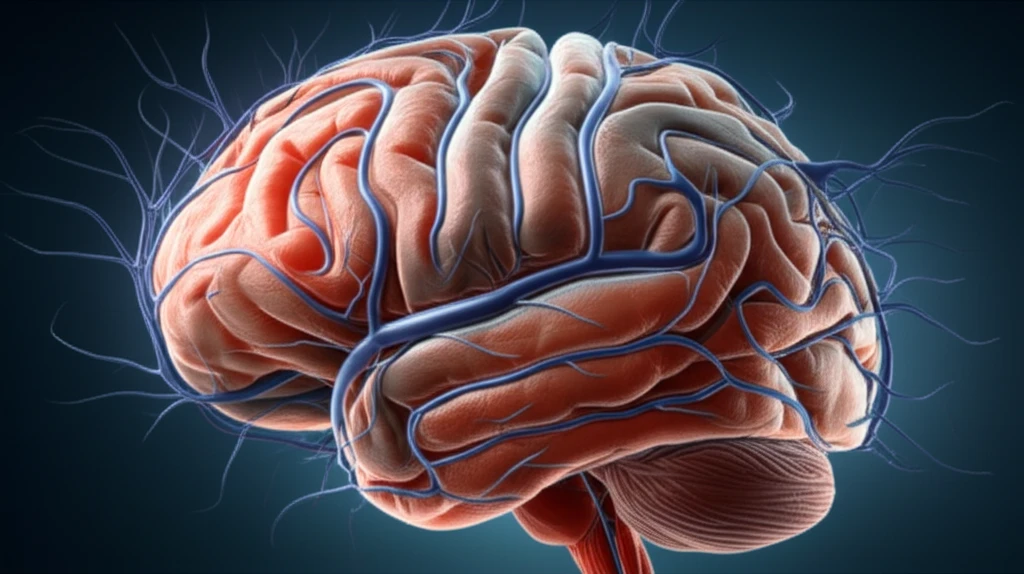
Illustration of brain AVM with healthy and tangled vessels, symbolizing the ARUBA trial's findings.

Unruptured Brain AVMs: Is Medical Management Safer Than Intervention?

"A landmark study, ARUBA, reveals surprising insights into the risks and benefits of different treatment approaches for brain arteriovenous malformations."


Brain arteriovenous malformations (AVMs) are complex tangles of abnormal blood vessels in the brain. Unlike normal blood vessels, AVMs lack a crucial network of capillaries, leading to high-pressure blood flow directly from arteries to veins. This unusual structure makes them vulnerable to rupture and bleeding, a serious condition known as a hemorrhagic stroke.

For years, the standard approach for unruptured brain AVMs was interventional therapy (IT). This includes methods like surgery, embolization (blocking off vessels), or stereotactic radiosurgery to eliminate the AVM and prevent future bleeds. However, a groundbreaking study called ARUBA (A Randomized Trial of Unruptured Brain Arteriovenous Malformations) challenged this long-held belief.

The ARUBA trial compared medical management (MM) alone versus medical management combined with interventional therapy for patients with unruptured brain AVMs. The results, published in Neurology, revealed a surprising twist: medical management alone might be a safer initial strategy.

ARUBA Trial: Unveiling the Unexpected Outcomes

Illustration of brain AVM with healthy and tangled vessels, symbolizing the ARUBA trial's findings.

The ARUBA trial was a multinational study involving adults with unruptured brain AVMs. Participants were randomly assigned to either medical management (MM) or medical management plus interventional therapy (IT). Medical management included strategies to manage symptoms, such as medication for headaches or seizures.

After a median follow-up of approximately 33 months, the study found that patients in the medical management arm were significantly less likely to experience death or stroke leading to disability (defined as a modified Rankin Scale [mRS] score of 2 or higher).

  • Lower Risk: MM group had a lower risk of primary outcomes (death or stroke with disability).
  • Significant Difference: The hazard ratio (HR) for primary outcomes in the MM group was 0.25 (95% CI: 0.11-0.57, p = 0.001) compared to the IT group.
  • As-Treated Analysis: An as-treated analysis, considering the actual treatment received, showed even more pronounced benefits for MM (HR 0.10, 95% CI: 0.04-0.28, p < 0.001).
The study also examined the Spetzler-Martin grade (S-MG), a scoring system used to assess the risk associated with brain AVMs based on size, location, and venous drainage. While S-MG didn't significantly affect outcomes in the MM group, higher S-MG scores were associated with more frequent functional impairment in the IT group.

The Takeaway: Rethinking AVM Treatment Strategies

The ARUBA trial's findings have significantly influenced the management of unruptured brain AVMs. While interventional therapy remains an option, the study suggests that medical management should be considered as a primary approach, especially given its lower risk of death and disability. The decision to intervene should be carefully weighed, considering the individual patient's characteristics and the AVM's specific features. Ongoing research continues to refine our understanding and optimize treatment strategies for this complex condition.

About this Article -

This article was crafted using a human-AI hybrid and collaborative approach. AI assisted our team with initial drafting, research insights, identifying key questions, and image generation. Our human editors guided topic selection, defined the angle, structured the content, ensured factual accuracy and relevance, refined the tone, and conducted thorough editing to deliver helpful, high-quality information.See our About page for more information.

Everything You Need To Know

1

What exactly are brain arteriovenous malformations (AVMs)?

Brain arteriovenous malformations (AVMs) are abnormal tangles of blood vessels in the brain. These AVMs lack the typical capillary network found in normal blood vessels. This absence causes high-pressure blood to flow directly from arteries to veins. As a result, these formations are susceptible to rupture and bleeding, leading to a hemorrhagic stroke. The ARUBA trial specifically studied unruptured AVMs, challenging previous assumptions about their treatment.

2

What was the main comparison being made in the ARUBA trial?

The ARUBA trial compared medical management alone versus medical management combined with interventional therapy for patients with unruptured brain AVMs. Medical management included strategies such as medication to manage symptoms like headaches or seizures. Interventional therapy includes treatments like surgery, embolization (blocking off vessels), or stereotactic radiosurgery. The study found that medical management alone might be a safer initial strategy, yielding unexpected outcomes that have reshaped treatment approaches.

3

What were the main results from the ARUBA trial?

The ARUBA trial revealed that patients receiving medical management alone had a significantly lower risk of death or stroke leading to disability compared to those receiving medical management plus interventional therapy. Specifically, the hazard ratio (HR) for primary outcomes in the medical management group was 0.25 (95% CI: 0.11-0.57, p = 0.001) compared to the interventional therapy group, indicating a substantial benefit. An as-treated analysis further reinforced these benefits, showing even more pronounced advantages for medical management.

4

What is the Spetzler-Martin grade, and how was it relevant in the ARUBA trial?

The Spetzler-Martin grade (S-MG) is a scoring system used to assess the risk associated with brain AVMs. It considers factors like the size, location, and venous drainage of the AVM. In the ARUBA trial, while S-MG didn't significantly affect outcomes in the medical management group, higher S-MG scores were associated with more frequent functional impairment in the interventional therapy group. This suggests that the risks of interventional therapy may increase with higher-grade AVMs.

5

Based on the ARUBA trial, what are the current recommendations for treating unruptured brain AVMs?

The ARUBA trial suggests that medical management should be considered as a primary approach for unruptured brain AVMs, given its lower risk of death and disability. However, interventional therapy remains an option, and the decision to intervene should be carefully weighed, considering the individual patient's characteristics and the AVM's specific features. Ongoing research continues to refine our understanding and optimize treatment strategies for this complex condition. Factors such as the patient's age, overall health, and specific AVM characteristics are crucial in determining the best course of action.

Newsletter Subscribe

Subscribe to get the latest articles and insights directly in your inbox.