
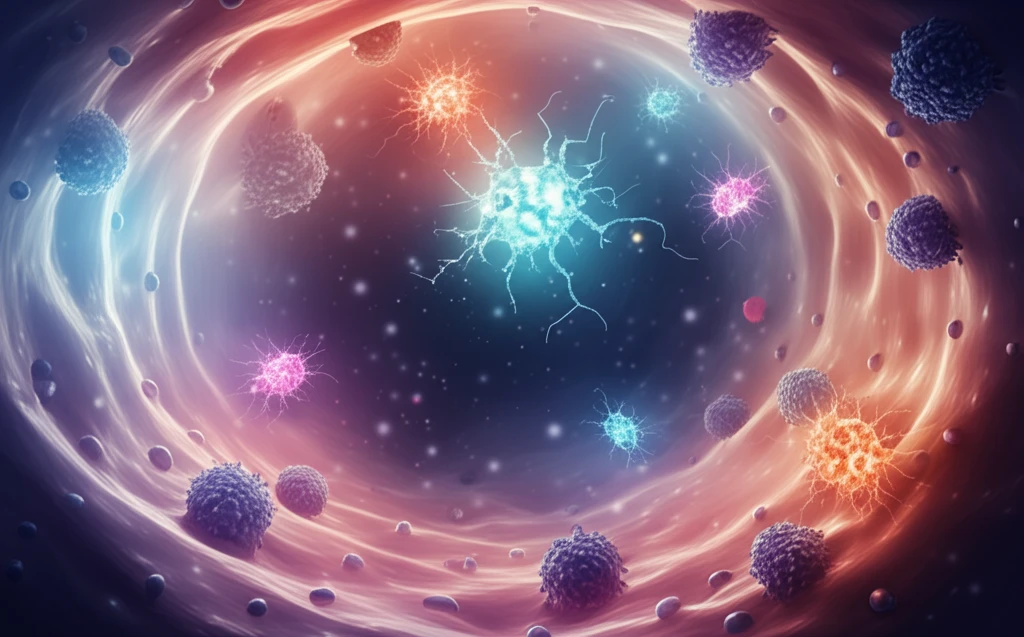
Stylized illustration of Ficolin-3 molecules interacting with pathogens within the immune system.

Unlocking Your Immune System's Hidden Potential: The Power of Ficolin-3

"Explore how Ficolin-3, a key player in the lectin pathway, can fortify your defenses and impact overall health."


Our immune system is a complex network, constantly working to protect us from a barrage of threats. While we often hear about antibodies and T-cells, there are many other players in this intricate defense system. One such player, gaining increasing attention in the scientific community, is Ficolin-3.

Ficolin-3 is a recognition molecule that's part of the lectin pathway, a critical arm of the complement system. Think of the complement system as a cascade of reactions, each step activating the next, to ultimately eliminate pathogens. The lectin pathway is triggered when specific molecules recognize patterns on the surface of invaders or damaged cells.

This article will explore the role of Ficolin-3, its genetic variations, its impact on various diseases, and what the future might hold for harnessing its potential. We will break down the science in an easy to digest way.

Ficolin-3: Your Body's First Line of Defense

Stylized illustration of Ficolin-3 molecules interacting with pathogens within the immune system.

Ficolin-3 acts like a security guard, patrolling the body for signs of trouble. It belongs to a family of pattern-recognition molecules that initiate the lectin pathway when they encounter pathogens or damaged cells. This sets off a chain reaction, activating other components of the complement system to eliminate the threat.

Think of it like this: Imagine your body's cells as houses in a neighborhood. Ficolin-3 is the neighborhood watch, constantly on the lookout for suspicious activity. When it spots something out of place – say, a bacterium with a unique pattern on its surface – it alerts the other security forces (the complement system) to take action.

Here's a breakdown of how Ficolin-3 works:
  • Recognition: Ficolin-3 identifies specific patterns on pathogens or damaged cells.
  • Activation: This recognition triggers the lectin pathway of the complement system.
  • Elimination: The complement system eliminates the threat through various mechanisms, such as directly attacking the pathogen or marking it for destruction by other immune cells.
The lectin pathway, once activated by Ficolin-3, leads to a series of events that ultimately result in the formation of cleavage products. These products perform several crucial functions: opsonization (making pathogens easier to engulf), generation of inflammation (recruiting more immune cells to the site of infection), and cell lysis (directly destroying infected cells). Furthermore, regulatory molecules exist to prevent the complement system from causing collateral damage to healthy tissues.

The Future of Ficolin-3 Research: Personalized Immunity?

While we've made great strides in understanding Ficolin-3, many questions remain. The exact clinical consequences of Ficolin-3 deficiency are still under investigation, and scientists are working to determine if it acts as a primary immune deficiency or simply a disease modifier. The good news is that ongoing research promises to shed light on these mysteries.

About this Article -

This article was crafted using a human-AI hybrid and collaborative approach. AI assisted our team with initial drafting, research insights, identifying key questions, and image generation. Our human editors guided topic selection, defined the angle, structured the content, ensured factual accuracy and relevance, refined the tone, and conducted thorough editing to deliver helpful, high-quality information.See our About page for more information.

This article is based on research published under:

DOI-LINK: 10.1007/978-1-4614-9209-2_8-1, Alternate LINK

Title: Ficolin-3

Journal: Encyclopedia of Medical Immunology

Publisher: Springer New York

Authors: Ninette Genster, Peter Garred

Published: 2016-01-01

Everything You Need To Know

1

What is Ficolin-3 and what role does it play in the body's defense mechanisms?

Ficolin-3 is a recognition molecule that functions as a security guard, patrolling the body for signs of trouble. More specifically, it belongs to a family of pattern-recognition molecules that initiate the lectin pathway, which is a critical arm of the complement system, when they encounter pathogens or damaged cells. This activation sets off a chain reaction, activating other components of the complement system to eliminate the threat. In essence, Ficolin-3 identifies specific patterns on pathogens or damaged cells, triggering the lectin pathway and leading to the elimination of the threat through mechanisms like opsonization, inflammation, and cell lysis.

2

How does the lectin pathway get activated, and what events follow its activation by Ficolin-3?

The lectin pathway is triggered when Ficolin-3 recognizes specific patterns on the surface of invaders or damaged cells. Once activated by Ficolin-3, it initiates a series of events resulting in the formation of cleavage products. These products perform crucial functions such as opsonization (making pathogens easier to engulf), generation of inflammation (recruiting more immune cells to the site of infection), and cell lysis (directly destroying infected cells). Regulatory molecules also exist to prevent the complement system from causing collateral damage to healthy tissues.

3

Why is Ficolin-3 considered an important component of the immune system?

Ficolin-3 is significant because it acts as a crucial first line of defense in the immune system. By recognizing pathogens and initiating the lectin pathway of the complement system, it triggers a cascade of events that lead to the elimination of threats. This early response is essential for preventing infections and maintaining overall health. Further research is needed to fully understand the implications of Ficolin-3 deficiency and its potential as a target for personalized immunity strategies.

4

What future research is planned for Ficolin-3 and what are the potential implications of Ficolin-3 deficiency?

Research is ongoing to determine if Ficolin-3 deficiency acts as a primary immune deficiency or simply a disease modifier. Understanding the clinical consequences of Ficolin-3 deficiency is a key focus, as it could have implications for personalized immunity strategies. Researchers are working to determine the exact role of Ficolin-3 in various diseases and how its potential can be harnessed to improve immune function.

5

Where does the complement system fit in and what is the role of the Lectin pathway relative to the other two pathways in the complement system?

The complement system is a cascade of reactions, where each step activates the next, to ultimately eliminate pathogens. It has three main pathways, one of which is the lectin pathway. Ficolin-3 plays a critical role in the lectin pathway by recognizing pathogens and initiating the cascade. The other two pathways are the classical pathway, activated by antigen-antibody complexes, and the alternative pathway, which can be activated directly on pathogen surfaces. All three pathways converge to activate the same downstream effector mechanisms, leading to inflammation, opsonization, and direct killing of pathogens.

Newsletter Subscribe

Subscribe to get the latest articles and insights directly in your inbox.