
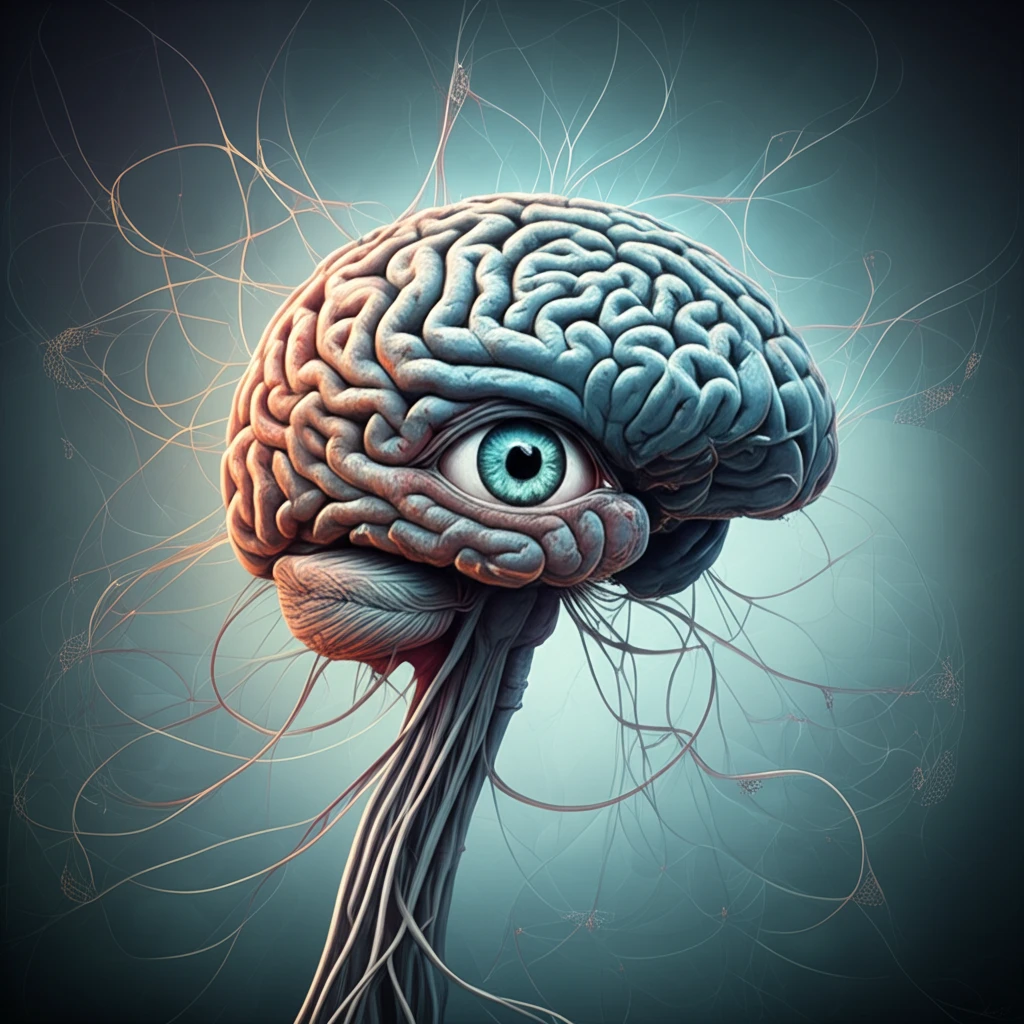
Unlocking Your Body's Rhythms: Why Breathing Patterns Change During Mental Tasks

"Discover how cognitive engagement impacts the connection between breathing and pupil dilation, affecting focus and stress levels."
Our bodies are constantly orchestrating a symphony of automatic processes, from the gentle rise and fall of our chest to the subtle adjustments in our heart rate. Respiratory sinus arrhythmia (RSA), the natural variation in heart rate that occurs with each breath, is a well-known example of this intricate dance. It's a sign of a healthy, responsive parasympathetic nervous system, often measured to assess our overall well-being. Similarly, our pupils, those windows to the soul, subtly dilate and constrict with each inhalation and exhalation, reflecting the interplay between our sympathetic and parasympathetic nervous systems.
But what happens to these rhythms when we engage our minds in complex tasks? How do our breathing patterns and pupil responses shift when we demand focus and concentration? Pupil diameter is modulated by cognitive processes via the locus coeruleus (LC) and prefrontal cortex and is used as an index of the cognitive or arousal state. A recent study has shed light on this fascinating question, revealing how cognitive engagement can override the body's natural autonomic control.
The study published in Respiratory Physiology & Neurobiology sought to investigate how respiratory-linked pupil fluctuations behave during cognitive tasks, challenging assumptions about autonomic stability under mental load. By understanding these shifts, we can potentially unlock new strategies for optimizing focus, managing stress, and enhancing cognitive performance.
Cognitive Tasks at Scale: How Performance Is Measured
Cognitive tasks are the standard workhorse of research into how the mind operates, and recent work shows that a consistent set of brain areas is engaged across diverse tasks. A 2024 study in Nature Communications revealed a unifying latent brain state that predicts performance across seven different tasks, linking a core control network to cognitive flexibility and adaptive behavior. In practice, such task batteries are typically scored for number correct and number of errors, as seen in aroma-and-cognition studies, while researchers increasingly combine statistical methods to evaluate, model, and predict mental workload. Even in educational settings, study playlists such as those aimed at GCSE Statistics may help students start revising, though research does not show a reliable improvement in cognitive performance.
Standard Methods and Where They Fall Short
Cognitive Task Analysis (CTA) is a standard method for defining systems design and training requirements, often built on a modification of Klein's critical decision method. Yet even mature fields struggle with measurement: researchers studying simultaneous interpreting note that there is little agreement on the most suitable method to measure the cognitive load a task generates. Psychometric reviews add that repeated exposure can raise test-specific scores without changing underlying cognitive capacity, and that commercial brain-training claims often outpace the scientific evidence. Another limitation emerges in studies of children with ADHD, who report applying significantly less effort on cognitive tasks than their peers yet do not find the tasks any more difficult, revealing a gap between perceived exertion and actual task demands.
From Early Task Analysis to Modern Test Batteries
Task analysis traces its origins to the earliest applied psychology and has evolved into modern forms that focus on the study of cognitive work. This lineage unfolded alongside the broader history of psychology as the discipline matured from its 19th-century roots into a scientific field. Today's standardized tasks are deployed at enormous scale: one reasoning task, Polygons, has been played over 12 million times by more than 85,000 people, and tasks similar to it have long been used to help diagnose cognitive decline in old age. At the same time, researchers have documented a 'reliability paradox' in which even robust, well-established cognitive tasks fail to produce reliable individual differences, a persistent obstacle to linking cognition to brain structure, chemistry, and function.
The Cognitive Task Switch: How Mental Focus Changes Your Breathing and Pupils
Researchers at Hyogo College of Medicine and the National Institute of Physiological Sciences in Japan recruited healthy volunteers to participate in a delayed matching-to-sample (DMTS) task. This task required participants to memorize a sequence of visual figures and then identify matching figures after a short delay, testing their attention and memory. Throughout the experiment, the researchers meticulously measured the participants' pupil sizes, breathing patterns (through nasal airflow), and heart rate variability (R wave-to-R wave intervals, or RRIs).
- Respiratory fluctuations in pupil size vanished.
- Heart rate variability remained linked to breathing.
- Cognitive engagement led to increased pupil dilation.
- The task revealed a cognitive state override.
New Directions in Cognitive Task Research
Ongoing coverage of cognitive task research spans education, industry, and health applications. In education, cognitive independence combined with cognitive activity is described as radically improving the whole process of cognition, making the activation of cognition a central aim of teaching. A 2018 overview published in the International Journal of Operational Research raises questions that could enhance the study of errors in cognitive task performance and suggests extending the analysis to include other representation categories. In the health domain, a systematic review on exercise and cognitive ageing concludes the field still lacks a clear account of what constitutes an effective 'dose' of exercise when cognition is the target.
Where the Field Falls Short: Measurement and Application
Critics argue that widely used developmental constructs such as the Zone of Proximal Development suffer from problems of operationalisation and measurement, being extremely difficult to quantify even when they are conceptually sound. Cognitive load theory, introduced in Sweller's 1988 work, similarly shows that heavy problem-solving demands can interfere with learning itself. Gender-focused analyses ask whether there are cognitive tasks at which women are especially strong relative to men and offer cognitive assessment tools developed out of that research. Even adjacent fields acknowledge limits, with positive psychology criticized for being problematic in countries that lack well-developed social support systems for mental health.
Training Programs, Alternatives, and Dual-Task Trade-offs
Commercial cognitive training programs such as Lumosity and Peak use structured routines aimed at improving memory retention, processing speed, and logical reasoning, making them popular with users seeking targeted skill enhancement. However, judgment research shows that whether people engage in selective versus comparative processing of available options shapes their decisions, complicating simple comparisons between approaches. Dual-task findings further challenge tidy comparisons: it has long been assumed that walking combined with a cognitive task makes both suffer, but a new study finds that some young, healthy people actually improve cognitive performance while walking by changing how they use neural resources.
What This Means for You: Practical Applications and Future Directions
This study offers valuable insights into the complex relationship between our minds and bodies. It highlights how cognitive engagement can influence autonomic functions, potentially impacting our ability to focus, manage stress, and perform optimally. By understanding these mechanisms, we can explore strategies to enhance cognitive performance and overall well-being.
What Experts Converge On
Experts note that analytical assessment of costs, projections of effectiveness, and expert opinion may be the only means of ensuring that a design solution addresses the correct cognitive requirements, with mock-ups and early prototypes of a decision aid tested as the next step. Research on expertise shows the picture is nuanced: tennis expertise reduces cognitive costs in dual-tasking situations but does not reduce costs in motor skills, indicating that training benefits do not transfer evenly across all components of a task. Commentary on technology's role adds a cautionary note, finding that while AI tools that automate routine or repetitive tasks decreased burnout, any use of AI that mainly serves to make core business tasks cognitively less demanding should be treated with caution.
AI and the Next Generation of Cognitive Work
The future of cognitive work is increasingly bound up with AI, which is expanding from structured applications into daily life by supporting human care and household tasks and boosting workplace research and efficiency through advances in generative models, automation, and intelligent decision-making. Practical resources aimed at cognitive tasks for adults point toward applied directions such as cognitive programming for improving outcomes in Alzheimer's and dementia. The sector itself is growing quickly enough that companies in the space advertise urgent openings for roles such as recruitment managers, signaling a broadening hiring landscape beyond purely technical positions.
The Digital Mind: Attention, Effort, and Engagement
Digital lifestyles are reshaping cognitive demands: constant task-switching, a hallmark of the modern digital lifestyle, actively erodes the brain's working-memory workspace, and neuroscience indicates the brain cannot truly multitask—it switches rapidly between tasks, and every switch carries a cognitive cost. On the other end, evidence shows that staying active can fight declines in cognitive engagement, defined as taking part in activities that are mentally challenging. Neuroimaging studies continue to map the brain areas engaged by attention-demanding cognitive tasks, grounding these debates in neuroscience. In laboratory settings, monitoring blood pressure allows researchers to track how hard study participants are working to accomplish cognitive tasks.
From Lab Bench to Everyday Life
Cognitive task research reaches into everyday experience: one study found that plasma levels of the compound 1,8-cineole—absorbed following exposure to rosemary aroma—correlate with cognitive performance and mood. Physiological impact cuts both ways, as attention-demanding cognitive tasks worsened postural control in a pilot case-control study of 22 patients with cervical dystonia and 19 healthy controls assessed on a stabilometric platform. Psychometric work ties these lab measures to real life through the g factor, a broad tendency to perform well across many different cognitive tasks, and recommends combining test results with real-world outcomes such as grades, project completion, and persistence when tasks are unfamiliar. Yet AI benchmarks show how far machines remain from this human versatility: current systems are strong on structured, well-defined tasks but would need to match humans on messy, unstructured ones too.