
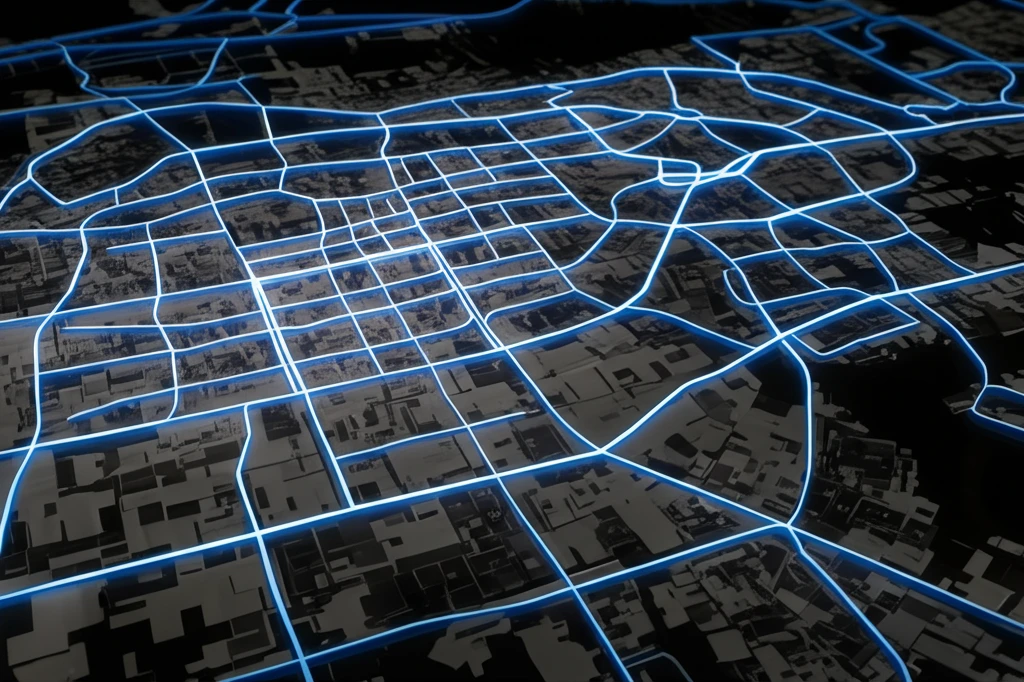
Unlocking Urban Secrets: Finding the Real Heart of St. Petersburg

"Discover how a new study uses data and digital tools to pinpoint the true consumer center of this historic Russian city, revealing insights for urban development and real estate investment."
In any urban landscape, the distribution of people and the value of real estate are heavily influenced by the location of the central business district. Generally, as you move further away from the city center, both property prices and population density tend to decrease. This is largely because the cost of travel, both in terms of time and money, increases with distance.
However, as manufacturing industries gradually move out of cities, the importance of consumer amenities in attracting residents to urban areas has grown significantly. The traditional role of a business center is now being complemented, and in some cases replaced, by the rise of the consumer center. This shift highlights the increasing importance of factors like restaurants, shops, and cultural venues in shaping urban life.
This study focuses on pinpointing the consumer center of St. Petersburg, Russia's second-largest city and former capital. By analyzing data from diverse online sources about various urban amenities, the research seeks to identify the area with the highest concentration of consumer-focused locations. This information has practical implications, from informing real estate investment decisions to improving urban planning strategies.
Measuring the City's Economic Pulse
According to CEIC regional inflation data, the value of the consumer basket of goods and services in St. Petersburg rose to 30,397.070 rubles in February 2026, an increase over the previous reading. Statista complements that economic snapshot with its 2024 breakdown of the share of consumers in Moscow and Saint Petersburg by selected class. At the infrastructure scale, Brightlio's compilation of 255 verified data center statistics for 2025 underscores the digital capacity underpinning any modern city's economy. A reminder that "St. Petersburg" also names a very different place: the Florida city in Pinellas County is one of the state's most popular destinations behind Tampa and forms part of the Tampa–St. Petersburg–Clearwater metropolitan statistical area, according to a relocation guide.
How We Map a City's True Character
The standard toolkit for profiling a city blends official tourism promotions, mapping platforms, and user-review services, each with built-in limitations. Visit Florida's profile of St. Petersburg, Florida, leans on sunny superlatives—notably the claim of 768 consecutive days of sunshine—which captures climate but little else. Mapping services such as Yandex Maps for Saint Petersburg foreground ratings, reviews, photos, and real-time traffic directions, making discoverability a function of digital visibility rather than objective quality. Listing platforms round out the picture: Airbnb's downtown St. Petersburg, Florida, stays are rated 4.9 out of 5, with guests said to prize location and cleanliness, while a Zillow listing for the Vantage St. Pete apartments in the 33705 neighborhood surfaces practical details such as a policy allowing up to two other pets per unit. Together these sources reveal a common limitation—they emphasize amenities, ratings, and convenience while rarely measuring the social texture or lived character of a neighborhood.
Two Cities, One Name, Deep Histories
The name "St. Petersburg" belongs to two very different places, and their histories diverge sharply. The Russian Saint Petersburg anchors its identity in landmark achievements: the Hermitage, one of the largest art museums in the world; the Lakhta Center, the tallest skyscraper in Europe; and host-city roles in the 2018 FIFA World Cup and UEFA Euro 2020. Its Nevsky Avenue, captured on a walking tour filmed in late August 2025, is praised for elegant architecture, luxury shopping, and a lively atmosphere, and is described by the filmmaker as one of Europe's most beautiful city avenues. The American St. Petersburg, a popular resort in Pinellas County, Florida, counted an estimated 253,693 residents in 2014, per the U.S. Census Bureau. Traveler interest runs high in the Russian city as well, with Tripadvisor logging 727,218 reviews of its hotels, attractions, and restaurants.
Mapping Amenities: The Key to Unlocking the City's Center
To determine the consumer center of St. Petersburg, researchers gathered data on a wide array of urban amenities. These included essential services like banks, pharmacies, and healthcare facilities, as well as lifestyle and leisure destinations such as cinemas, fitness clubs, restaurants, and shopping malls. Cultural attractions like museums and theaters were also considered. The sheer volume of data was considerable, with over 7,000 data points for shops alone.
- Data Collection: Gathering comprehensive data on various urban amenities, including shops, restaurants, and cultural venues.
- Spatial Density Calculation: Employing kernel density estimation to map the concentration of each amenity across the city.
- Weighting and Aggregation: Combining individual amenity densities using variation-based and survey-based weights to create overall centrality indices.
- Validation: Cross-referencing the results with alternative methods like population density gradients and user-generated content analysis.
New Evidence on How We Experience Place
New research and review channels are changing how urban character is understood. PsyPost reports psychological research suggesting that a common response to negative emotions is actually worse for people in certain countries, a finding relevant to how residents and visitors cope with intense city environments. A Science article (DOI 10.1126/science.aat7693) describes the latest effort in its line of inquiry. On the evidence-gathering side, Tripadvisor now aggregates over a billion reviews and contributions—offering hotel savings, tours, restaurants, and travel advice—while AP News supplies a stream of breaking headlines and independent journalism from around the world.
When Local Favorites Clash with the Rules
The most instructive failures come when popular civic features run afoul of official standards. In St. Petersburg, Florida, the city asked the state to keep five colorful streets after state and federal transportation authorities ordered the removal of crosswalk murals, citing safety concerns—including the Rainbow Progress Pride crosswalk mural at the intersection of 25th Street and Central Avenue. The dispute illustrates the tension between identity-driven public art and the safety regulations that govern roadways. Even scientific reporting has drawn this kind of pushback: a Science article (DOI 10.1126/science.1114655) appears to have prompted federal criticism connected to an acid rain report.
Benchmarking Cities Like We Benchmark Tech
Comparative analysis of cities increasingly borrows the tools of consumer electronics. Versus, a platform with over 100 categories, offers side-by-side comparison with detailed specifications, filters, and data visualizations, and its companion service versusutil.com lets users enter a product or service to find relevant alternatives. The same benchmarking logic powers PassMark, which compares up to five CPUs at once using millions of PerformanceTest results updated daily. Applied to a city, this approach inventories exactly the goods that define material life—stpetersburg.com notes that local consumer electronics stores carry televisions, computers, and kitchen appliances to make a house a home.
A New Lens on the City
This study offers a new way to understand the urban landscape of St. Petersburg. By combining data analysis with insights from urban economics and geography, it provides a practical framework for identifying consumer centers in cities. The findings have implications for urban planning, real estate development, and economic analysis, offering a valuable tool for understanding how cities function and evolve.
Watchdogs, Residents, and Researchers Weigh In
A synthesis of St. Petersburg's character benefits from three layers of commentary: institutional, community, and academic. Rospotrebnadzor, the Russian consumer protection agency, anchors the institutional layer with offices in Saint Petersburg on Stremyannaya Street 19 and Udelniy Avenue 20, where residents can pursue consumer complaints. The community layer is represented by the @petersburg_live channel on the MAX messenger, which packages all the main news of Petersburg—including emergencies, incidents, and road accidents—alongside a city events lineup. On the academic side, an article indexed on Project MUSE analyzes the tactics of St. Petersburg consumers who buy food directly from farmers, illustrating how residents exercise agency in everyday economic life.
From Farmer's Markets to Viral Feeds
The next frontier in understanding St. Petersburg's consumers lies where grassroots commerce meets algorithmic discovery. Research on ResearchGate documents the tactics of St. Petersburg consumers who buy food directly from local farmers through short food supply chains—on-farm sales, collective purchasing, and street trade—reading these practices through James Scott's ideas of "everyday resistance" and "moral economy." Those analog habits now sit alongside tools like Trendsee, which analyzes millions of viral videos from around the world and converts them into ready-made scenarios for brands. The pattern mirrors how a review of global poultry production published via Taylor & Francis pairs a current-state assessment with future outlook and challenges.
Cities Inside Bigger Systems
A city's trajectory is set within systems far larger than its own boundaries. Caroline Corbett-Thompson, Wise's Global ESG Lead, argues that "ESG isn't a separate project, it's a part of how we build a global product"—a principle that applies as readily to urban governance as to corporate strategy. Seasonality is one of the most visible systemic constraints, with travel guidance for St. Petersburg advising visitors on the best season, month, and period for pleasant weather, vibrant nightlife, and memorable experiences. Evidence from other fields reinforces that local outcomes hinge on broader conditions: a ScienceDirect article frames its findings in terms of their broader impact on AI credibility and adoption, while an ERIC-documented study on rural early-care educators in Tennessee explores how skills training and wage-based incentives shape social mobility through lived experiences of upskilling.
The Daily Life Beneath the Postcards
A city's real character shows up in everyday incidents and unvarnished accounts. One YouTube guide to moving to St. Petersburg, Florida, warns prospective newcomers to prepare for the lesser-known aspects of the city that "can truly make a difference," offering a counterweight to promotional imagery. In the Russian city, the Emergency Ministry's official Telegram channel records that reality: one post logged a fire extinguished at 01:27, with no casualties and two units of equipment and ten personnel deployed to the scene. Even routine service encounters carry hidden consequences—a study published via Taylor & Francis reports the adverse impacts of revealing the presence of artificial intelligence in service interactions, a caution for a city whose hospitality and retail increasingly run on technology.