
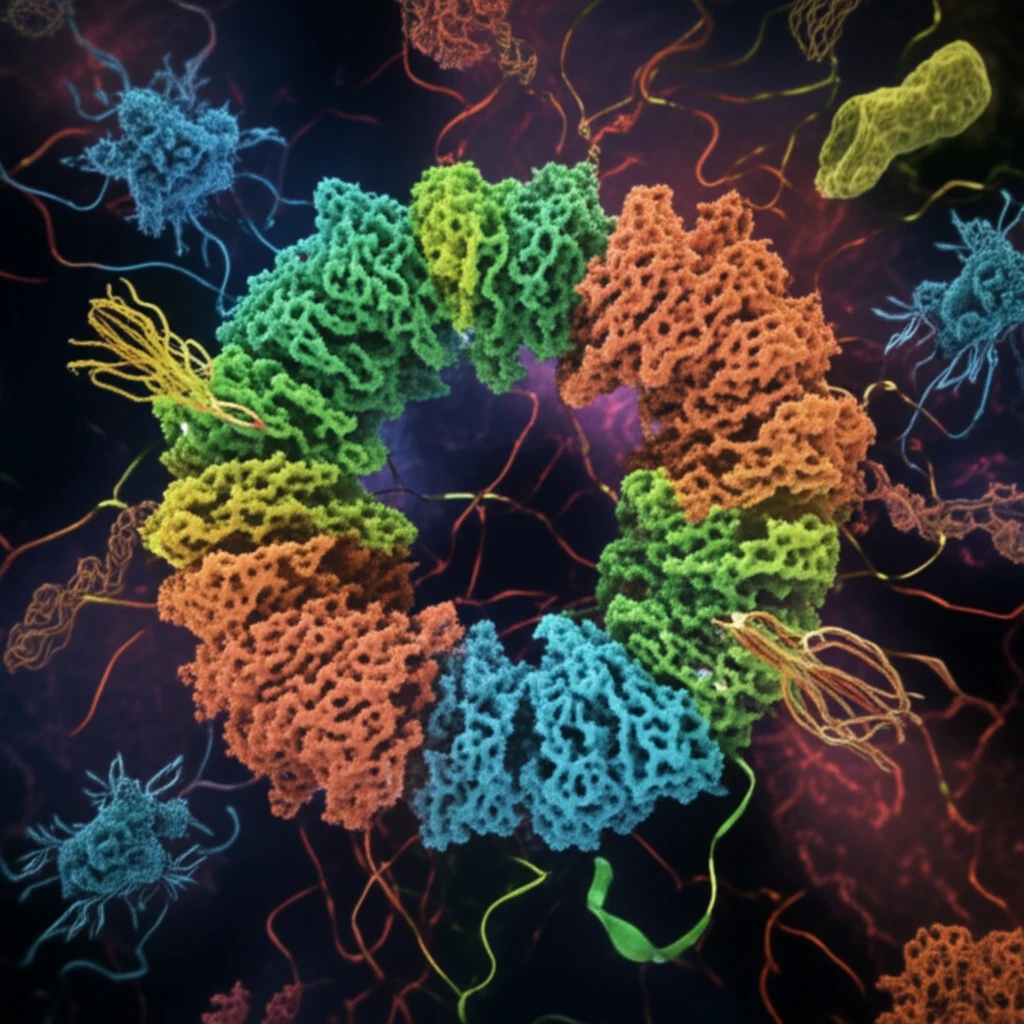
Illustration of bacterial cell division showing the FtsZ and SepF proteins, highlighting the complexity and beauty of the process.

Unlocking the Secrets Within: How Scientists are Fighting Bacterial Infections at the Cellular Level

"Delving into the intricate world of bacterial cell division to discover new ways to combat antibiotic resistance and infectious diseases."


In a world grappling with the ever-growing threat of antibiotic resistance, scientists are turning their attention to the microscopic battleground where bacteria wage war. The rise of drug-resistant pathogens has created an urgent need for new strategies to combat infections. This article explores a fascinating area of research: the intricate process of bacterial cell division, and how understanding it could lead to groundbreaking treatments.

Bacteria, like all living organisms, must divide and replicate to survive. This process, known as cell division or cytokinesis, is a complex dance of molecular interactions. Researchers are now meticulously examining the players in this dance, particularly focusing on proteins like SepF and FtsZ. Their interactions are crucial in the process, making them potential targets for future medications.

This is more than just a scientific exploration; it's a race against time. Pathogenic bacteria are becoming increasingly adept at evading antibiotics, causing a wide range of diseases. By understanding how these microbes divide, scientists hope to disrupt the process and develop new drugs that can effectively combat infections, saving countless lives.

The Intricate Dance: Unpacking the Cellular Division Process

Illustration of bacterial cell division showing the FtsZ and SepF proteins, highlighting the complexity and beauty of the process.

The cell division process in bacteria is a finely orchestrated series of events, often referred to as the divisome. This molecular machinery involves a multitude of proteins, each with a specific role. Understanding the roles of these proteins and how they interact is vital to the development of effective antimicrobial therapies. This is the central focus of the work conducted by researchers.

At the heart of bacterial cell division is a protein called FtsZ, a tubulin homologue that forms a ring-like structure at the division site. This ring acts as a scaffold, recruiting other proteins to the site and initiating the process. Researchers are zeroing in on the role of FtsZ and its interactions with other proteins, particularly SepF, to understand the mechanisms of cell division.

  • FtsZ's Central Role: Forms a ring that directs cell division.
  • SepF Interaction: Overlaps the function of this proteins and interacts with FtsZ, influencing the division.
  • The Divisome: This is the name of the entire machinery that includes FtsZ, the interacting proteins, and the rest of the molecular components.
Scientists are using various techniques, including molecular docking and protein-protein interaction analysis, to study these interactions. These methods help to identify how proteins bind together, revealing potential vulnerabilities in the cell division process. This knowledge is then used to devise new ways to stop the bacteria from replicating. This work presents novelties on molecules participating in the cell division event, from the interaction of FtsZ and SepF, as new therapeutic targets.

A Glimpse into the Future: The Promise of Targeted Therapies

The quest to understand and disrupt bacterial cell division is an exciting area of research that holds immense promise. By targeting the specific proteins involved in this process, scientists hope to develop highly effective and targeted therapies that will minimize side effects and prevent the development of resistance. The work in this field is a critical step towards a future where bacterial infections are more manageable and the threat of antibiotic resistance is significantly diminished.

About this Article -

This article was crafted using a human-AI hybrid and collaborative approach. AI assisted our team with initial drafting, research insights, identifying key questions, and image generation. Our human editors guided topic selection, defined the angle, structured the content, ensured factual accuracy and relevance, refined the tone, and conducted thorough editing to deliver helpful, high-quality information.See our About page for more information.

This article is based on research published under:

DOI-LINK: 10.1590/0001-3765201820170385, Alternate LINK

Title: Cell Division In Genus Corynebacterium: Protein-Protein Interaction And Molecular Docking Of Sepf And Ftsz In The Understanding Of Cytokinesis In Pathogenic Species

Subject: Multidisciplinary

Journal: Anais da Academia Brasileira de Ciências

Publisher: FapUNIFESP (SciELO)

Authors: Alberto F. Oliveira Jr, Edson L. Folador, Anne C.P. Gomide, Aristóteles Goes-Neto, Vasco A.C. Azevedo, Alice R. Wattam

Published: 2018-08-01

Everything You Need To Know

1

What is the significance of studying bacterial cell division in the context of antibiotic resistance?

Studying bacterial cell division is crucial in the fight against antibiotic resistance because it provides a new avenue for developing therapies. As bacteria become increasingly resistant to existing antibiotics, scientists are exploring ways to disrupt the fundamental processes that bacteria need to survive and replicate. The cell division, also known as cytokinesis, is essential for bacterial survival. By targeting proteins involved in this process, such as FtsZ and SepF, researchers hope to create new drugs that specifically inhibit bacterial division, thereby preventing the spread of infections and overcoming antibiotic resistance. This approach offers a way to combat drug-resistant pathogens by exploiting their weaknesses.

2

What are the roles of FtsZ and SepF in bacterial cell division?

FtsZ and SepF are key proteins involved in bacterial cell division. FtsZ forms a ring-like structure at the division site, acting as a scaffold to recruit other proteins and initiating the process. SepF interacts with FtsZ and influences the division process. It's important to understand that both proteins work together as part of the divisome, a complex molecular machinery. The interactions between FtsZ and SepF are being actively studied by scientists because they represent potential targets for new antimicrobial therapies. By interfering with these interactions, scientists aim to disrupt the bacterial cell division process, preventing the bacteria from replicating and causing infections.

3

How does the understanding of the 'divisome' contribute to the development of new therapies?

The 'divisome' is the entire machinery of bacterial cell division, and understanding its components and how they interact is critical for developing new therapies. The divisome is a complex of proteins, including FtsZ and SepF, and other molecular components that orchestrate the cell division process. By studying the interactions within the divisome, scientists can identify specific vulnerabilities that can be targeted by new drugs. For example, understanding how FtsZ and SepF interact allows researchers to develop molecules that disrupt these interactions, preventing the formation of the division ring and stopping the bacteria from replicating. This targeted approach minimizes side effects and reduces the likelihood of resistance development compared to broad-spectrum antibiotics.

4

What techniques are scientists using to study the interactions between proteins like FtsZ and SepF?

Scientists are employing various advanced techniques to study the interactions between proteins such as FtsZ and SepF. These methods include molecular docking, which allows researchers to simulate how proteins bind together at a molecular level. Additionally, protein-protein interaction analysis is used to identify and characterize the specific interactions between these proteins. These techniques provide detailed insights into the structure and function of the divisome, helping researchers understand how these proteins work together during cell division. This knowledge is then used to design new drugs that can interfere with these interactions, potentially stopping the bacteria from dividing and causing infection.

5

What are the potential benefits of targeting bacterial cell division for future therapies?

Targeting bacterial cell division offers several significant benefits for future therapies. Firstly, it provides a novel approach to combat antibiotic resistance by focusing on a different mechanism than traditional antibiotics. By targeting specific proteins like FtsZ and SepF, researchers can develop highly targeted therapies that disrupt the cell division process, preventing bacteria from replicating and causing infections. This targeted approach can minimize side effects, as it is less likely to harm the beneficial bacteria in the human body. Furthermore, it has the potential to prevent or delay the development of resistance, as bacteria may find it more challenging to evolve resistance to drugs that target essential cellular processes. This research field is essential in the quest for more effective and sustainable treatments for bacterial infections, and a key step towards a future where bacterial infections are more manageable.

Newsletter Subscribe

Subscribe to get the latest articles and insights directly in your inbox.