
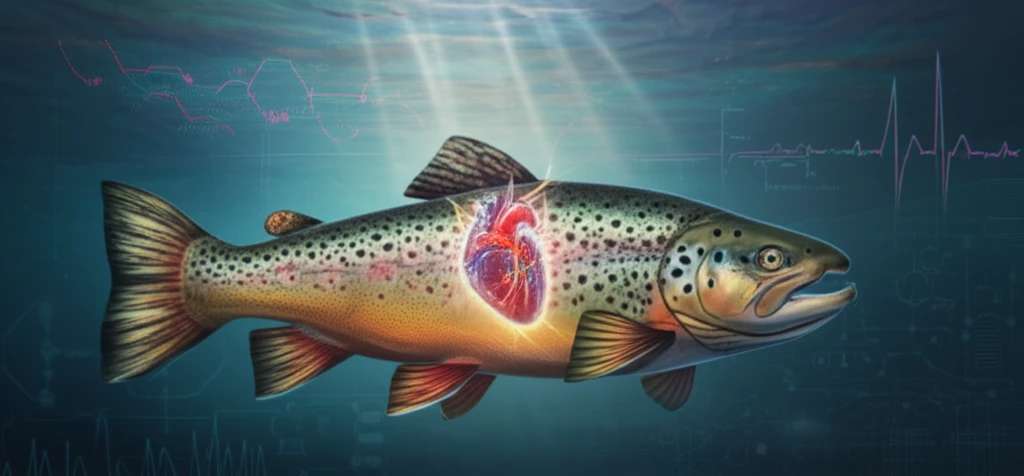
Illustration of a brown trout with a glowing heart, representing cardiac research.

Unlocking the Secrets of Your Heartbeat: New Research Reveals Surprising Insights

"Scientists Discover Unexpected Roles of Tiny Channels in the Brown Trout's Heart, Offering Clues to Human Heart Health"


Your heart, a tireless muscle, beats about 100,000 times a day, a rhythm essential for life. But what dictates this steady pulse? Scientists are constantly seeking to understand the intricate mechanisms that govern the heartbeat, and new research into the humble brown trout is offering fascinating clues. This research delves into the tiny ion channels within heart cells and their surprising influence on heart rhythm.

This study, inspired by the need to unravel the mysteries of the heart, focuses on the 'funny current' (If) and its connection to the hyperpolarization-activated cyclic nucleotide-gated (HCN) channels. These channels, previously thought to be crucial in regulating heart rate, are proving to have unexpected functions. By studying the brown trout, researchers are gaining insights that could reshape our understanding of heart health.

This article explores the study's findings and their implications. We'll delve into the roles of HCN channels, the significance of the 'funny current', and what these discoveries might mean for future treatments of heart conditions. The story of the brown trout's heart is more than just a fish tale; it's a journey into the very core of life's rhythm.

Unveiling the Brown Trout's Heart: A Deep Dive into Cardiac Channels

Illustration of a brown trout with a glowing heart, representing cardiac research.

The study examined the expression of HCN channel transcripts in the brown trout heart. Six HCN transcripts were found, with their abundance varying across different heart regions. The SA pacemaker tissue showed the highest expression levels, suggesting a critical role for these channels in regulating the heart's rhythm. The researchers then looked at the 'funny current,' a key component of the heart's electrical activity.

The 'funny current' (If) is generated by hyperpolarization-activated HCN channels. This current is believed to be crucial for the membrane clock, which regulates the cardiac pacemaker mechanism. It was expected that If would be active, but the research revealed a surprising outcome.

  • HCN channels are the gatekeepers of the heart's electrical system.
  • HCN channels (HCN1, HCN2a, HCN2ba, HCN2bb, HCN3, and HCN4) are expressed in the brown trout heart.
  • Total HCN transcript abundance was 4.0 and 4.9 times higher in SA pacemaker tissue than in atrium and ventricle, respectively.
  • HCN3 and HCN4 were the main isoforms in the SA pacemaker.
Researchers found that the role of the 'funny current' (If) in the brown trout's heart differs greatly from expectations. The study's results strongly suggest that If regulation in the brown trout heart is largely independent of If. The findings challenge previous assumptions about If's role, opening up new avenues for understanding the heart's complex mechanisms.

Looking Ahead: The Future of Heart Health Research

The research on the brown trout's heart is an important step towards a deeper understanding of cardiac health. By focusing on the role of HCN channels and the 'funny current', scientists are gaining valuable insights that could transform how we approach heart disease. As research continues, we can expect to see even more fascinating discoveries that bring us closer to healthier hearts for everyone.

About this Article -

This article was crafted using a human-AI hybrid and collaborative approach. AI assisted our team with initial drafting, research insights, identifying key questions, and image generation. Our human editors guided topic selection, defined the angle, structured the content, ensured factual accuracy and relevance, refined the tone, and conducted thorough editing to deliver helpful, high-quality information.See our About page for more information.

Everything You Need To Know

1

What exactly are ion channels, and why are they so important in understanding how the heart functions?

Ion channels are tiny gatekeepers within heart cells that control the flow of ions, which are electrically charged atoms. These channels, including hyperpolarization-activated cyclic nucleotide-gated (HCN) channels, are critical because they generate electrical signals that dictate the heart's rhythm and contractile force. Understanding their function, as studied in the brown trout, can provide insights into how to maintain a healthy heartbeat in humans. Further research into the specific types of ion channels and how they interact could uncover new therapeutic targets for heart conditions.

2

The research mentions a 'funny current' (If). What is this current, and what was surprising about its role in the brown trout's heart?

The 'funny current' (If) is an electrical current in the heart generated by hyperpolarization-activated cyclic nucleotide-gated (HCN) channels. It plays a role in regulating the cardiac pacemaker mechanism. The surprising finding in the brown trout was that If regulation appeared to be largely independent of If. This challenges the conventional understanding of If's function and suggests that the mechanisms controlling heart rhythm may be more complex than previously thought.

3

How does studying the brown trout's heart help us understand human heart health?

Studying the brown trout's heart allows researchers to examine the fundamental mechanisms that regulate heart function in a simpler system. The research focuses on hyperpolarization-activated cyclic nucleotide-gated (HCN) channels and the 'funny current' (If), which are also present in human hearts. By identifying how these components function in the brown trout, scientists can gain insights into how they might work or malfunction in humans, potentially leading to new treatments for heart conditions. The study provides a comparative model to understand the evolutionary conservation and divergence of cardiac electrophysiology.

4

What are hyperpolarization-activated cyclic nucleotide-gated (HCN) channels, and what role do they play in the heart?

Hyperpolarization-activated cyclic nucleotide-gated (HCN) channels are a type of ion channel found in heart cells, specifically within the sinoatrial (SA) node, which is the heart's natural pacemaker. There are multiple types, including HCN1, HCN2a, HCN2ba, HCN2bb, HCN3, and HCN4. These channels generate the 'funny current' (If), which contributes to the heart's rhythmic beating by controlling the flow of ions across the cell membrane. The study shows that these channels may have different roles than previously thought, and further research into their specific functions is needed. Future studies could explore how these channels respond to different stimuli and how their dysfunction contributes to arrhythmias.

5

The study found different expressions of hyperpolarization-activated cyclic nucleotide-gated (HCN) channels in different regions of the brown trout heart. Why is this significant, and what does it imply?

The varying expression of hyperpolarization-activated cyclic nucleotide-gated (HCN) channels, specifically HCN1, HCN2a, HCN2ba, HCN2bb, HCN3, and HCN4 transcripts, across different heart regions, particularly the higher abundance in the SA pacemaker tissue, suggests that these channels have specialized roles in regulating heart rhythm. This implies that different regions of the heart rely on different combinations and levels of HCN channels to maintain proper electrical activity. For example, the SA pacemaker had the highest expression of HCN3 and HCN4. Understanding these regional differences could help in developing targeted therapies that address specific heart rhythm abnormalities. Further research could investigate how these expression patterns change in diseased hearts.

Newsletter Subscribe

Subscribe to get the latest articles and insights directly in your inbox.