
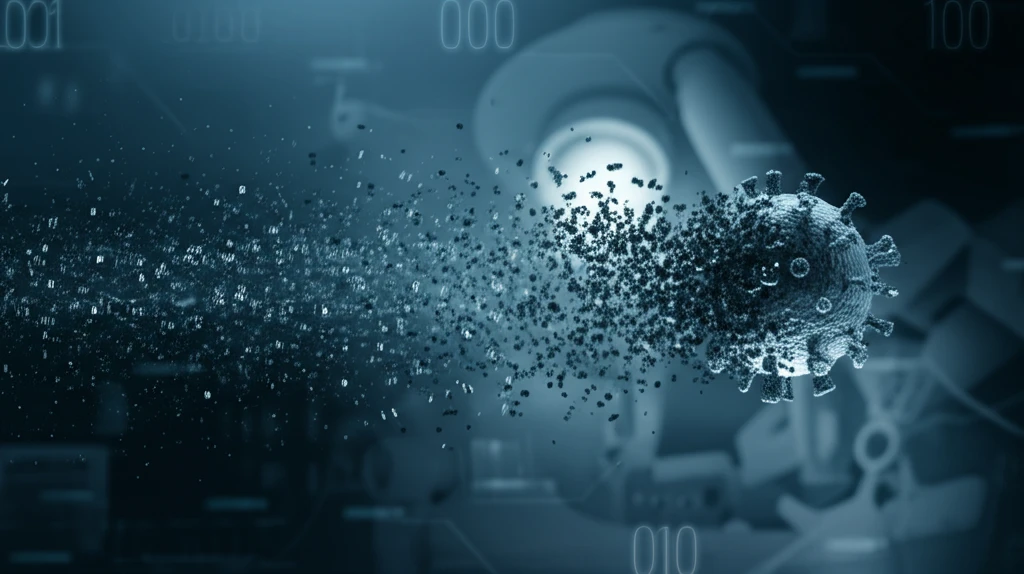
Unlocking the Secrets of Viruses: How New Tech is Changing 3D Imaging

"Revolutionizing Virus Research with Multiresolution MAPEM: A Breakthrough in 3D Reconstruction"
Understanding viruses is crucial for developing effective vaccines and antiviral treatments. Visualizing their structure in three dimensions (3D) allows scientists to decipher how they assemble, infect cells, and evade the immune system. Traditional methods, however, often fall short due to limitations in image resolution and clarity. This is where innovative techniques like multiresolution Maximum a Posteriori Probability Expectation Maximization (MAPEM) come into play, promising a clearer and more detailed view of these tiny invaders.
Single Particle Reconstruction (SPR) is a widely used method that involves collecting two-dimensional (2D) projection images of numerous virus particles, all randomly oriented. Imagine taking thousands of snapshots of the same object from different angles. These images, captured using electron microscopy, are then computationally processed to reconstruct a 3D model. However, these images are notoriously noisy, and the reconstruction process is complex, demanding advanced algorithms to produce accurate results.
The challenge lies in improving the signal-to-noise ratio and compensating for the limited range of viewing angles achieved during data collection. This article explores how the multiresolution MAPEM method addresses these challenges, providing a pathway to high-resolution 3D reconstructions of symmetrical particles, ultimately advancing our understanding and treatment of viral diseases.
Measuring the Threat Landscape
Scanning platforms and security vendors document that malware, including trojan horse viruses, is a persistent digital threat, with VirusTotal aggregating results from multiple antivirus engines and Fortinet cataloguing common types of trojan horse viruses. Reliable quantitative tracking of such phenomena depends on official statistical agencies, such as the Australian Bureau of Statistics, which provides trusted official statistics across economic, social, population, and environmental matters. Historical statistics from the U.S. Reconstruction era illustrate how dramatically figures can shift, including a 375% population growth of Chicago between 1850 and 1860, 15 rail lines terminating there in 1860, and 30,000 miles of railroad track laid in the United States by 1860.
Precision Phase Mapping and Its Limits
Advanced 3D reconstruction techniques rely on precise phase measurement; one fringe-projection method constructs a wrap-aware Hessian-trace quality term from a circular phase representation, fuses it with modulation confidence, and uses edge-conditioned compensation, selective smoothing, and adaptive thresholding to preserve reliable boundary pixels. In clinical practice, 3D reconstruction of a target tooth occlusal surface from a single-view image has been developed to support root canal surgical navigation. For skull-infiltrating tumours, combined resection and immediate cranioplastic reconstruction has predominantly relied on freehand-moulded solutions, so techniques that make this procedure easier in routine clinical practice would be useful. Across these methods, preserving reliable edge and boundary pixels is central, and boundary accuracy remains a recurring limitation of standard approaches.
Documenting Milestones in Reconstruction
Foundational stories in virus reconstruction reach general audiences through documentaries; a Bedtime Stories program titled "Reconstructing the World's Deadliest Virus" addresses the topic while explicitly declining to give medical advice and directing viewers to the official web sites of the CDC, WHO, and Johns Hopkins School of Public Health. Institutional records of historical milestones take many forms, including the U.S. State Department's retired "Milestones in the History of U.S. Foreign Relations" series, which covers the Truman Doctrine era of 1945-1952. Such records illustrate that "milestones" serve as progress markers across very different fields, from foreign policy to digital tools.
The Power of Multiresolution MAPEM
The multiresolution MAPEM method builds upon conventional MAPEM techniques, which have already proven successful in suppressing noise and addressing incomplete angular sampling. This innovative approach refines the reconstruction process by incorporating prior knowledge about the symmetry of the virus particle being studied. Think of it as having a blueprint that guides the construction, ensuring a more accurate and reliable final product.
- Symmetry Incorporation: Exploits the inherent symmetry of virus particles to improve reconstruction accuracy.
- Median Root Prior: Utilizes statistical methods to reduce noise and enhance image clarity.
- Multiresolution Approach: Employs a series of reconstruction grids with increasing dimensions, allowing for progressive refinement of the 3D image.
- Iterative Refinement: Repeats the reconstruction process multiple times to optimize the final result.
From Endosymbionts to Maximum-Likelihood Methods
Recent research highlighted by Nature includes three-dimensional images revealing the impact of the endosymbiont Midichloria mitochondrii on host mitochondria; this symbiont lives in the hard tick Ixodes ricinus, the main vector for Lyme disease. On the methodological side, maximum-likelihood 3D virus reconstruction from projections of unknown orientation has been developed for cryo-electron microscopy, with image origin-offset uncertainty addressed via 5-D integration rules, enabling classification and 3D virus reconstruction from image data. Complementary work at IIT Madras includes PhotonSplat, a 3D scene reconstruction and colorization approach based on SPAD sensors. In built environments, research combines GIS-based methods such as data pre-processing, building height extraction, roof identification, and building reconstruction for visualization.
Learning From the Failures of Reconstruction
Large-scale reconstruction efforts have drawn substantial criticism, and historical accounts note that criticism of the Reconstruction era focuses on the failure to prevent violence, corruption, starvation, and disease. Some consider the Union's policy toward freed slaves inadequate and its treatment of former slaveholders too lenient, even as Reconstruction is credited with restoring the federal Union. Such mixed assessments show that reconstruction programs can succeed in restoring structures and institutions while still facing documented failures in protecting people.
Side-by-Side Comparison of Reconstruction Methods
Comparative evaluation of 3D reconstruction methods is an established research direction. A review of passive multi-view 3D reconstruction compares the passive stereo vision, shape from silhouette, and space carving techniques. Software comparisons such as Hi3D versus Reconstruct assess features including AI texturing, 3D relief generation, multi-color model segmentation for 3D printing, portrait-focused 3D reconstruction, and de-lighted texture generation. At the image level, a comparison of zebrafish 3D reconstructions uses ground-truth volumes generated through 100 iterations of the RL algorithm using a measured PSF.
The Future of Virus Imaging
The multiresolution MAPEM method represents a significant step forward in virus imaging, offering the potential to unlock new insights into viral structure and function. By providing more accurate and detailed 3D reconstructions, this technique can accelerate the development of effective vaccines and antiviral therapies, ultimately helping to combat a wide range of viral diseases. As technology continues to advance, we can expect even more sophisticated imaging techniques to emerge, further revolutionizing our understanding of the microscopic world.
Expert Interpretation Grounded in Objective 3D Data
Expert practice in reconstruction increasingly rests on objective 3D documentation; in forensic medicine, virtopsy refers to expert opinion based on 3D surface and radiological scanning, where secondary interpretation is built on primary information from real 3D documentation and on the expert's experience. Reconstructions based directly upon forensic evidence are called primary information, and historically this consisted of documenting findings. Specialist firms apply this principle commercially, as Veracity Engineering does in accident reconstruction using advanced 3D technology and EDR data. The broader 3D reconstruction technology market, spanning software and services, has been analyzed globally with growth and forecast coverage through 2031.
Heritage, Content, and the Next Frontier
Future 3D reconstruction is being explored across cultural heritage and content media. A reconstruction of the ancient site of Chogha Zanbil, published as a video on September 17, 2022, demonstrates how 3D technology can digitally recreate historic architecture. In parallel, trend-analytics services analyze millions of viral videos from around the world and convert them into ready-made scripts for brands, hinting at how reconstruction-style tools may expand into content generation.
Infrastructure Demands and Clinical Complexity
Broader deployment of 3D applications carries systemic requirements that shape accessibility. For example, running the widely played game Genshin Impact requires a 64-bit Windows 10 or 11 operating system with at least a 7th-generation Intel Core i7 or AMD Ryzen 5000-series processor or better, illustrating the hardware burden of modern 3D workloads. Meanwhile, scientific meetings continue to address complex clinical challenges, such as the impact of inflammatory activity on the development of pulmonary fibrosis and the severity of systemic sclerosis presented at European Respiratory Society sessions, showing how imaging and modeling connect to systemic disease.
How Reconstruction Changes Real Outcomes
Reconstruction carries direct consequences for people when applied to real events. Case studies show how reconstruction changes outcomes: in a multi-car highway pileup, experts used data, weather reports, and vehicle positioning to reveal that poor visibility and speeding triggered the chain reaction. Interactive tools extend similar benefits to everyday users, letting them explore mapped environments to discover hidden treasures, complete quests, and collect resources.