
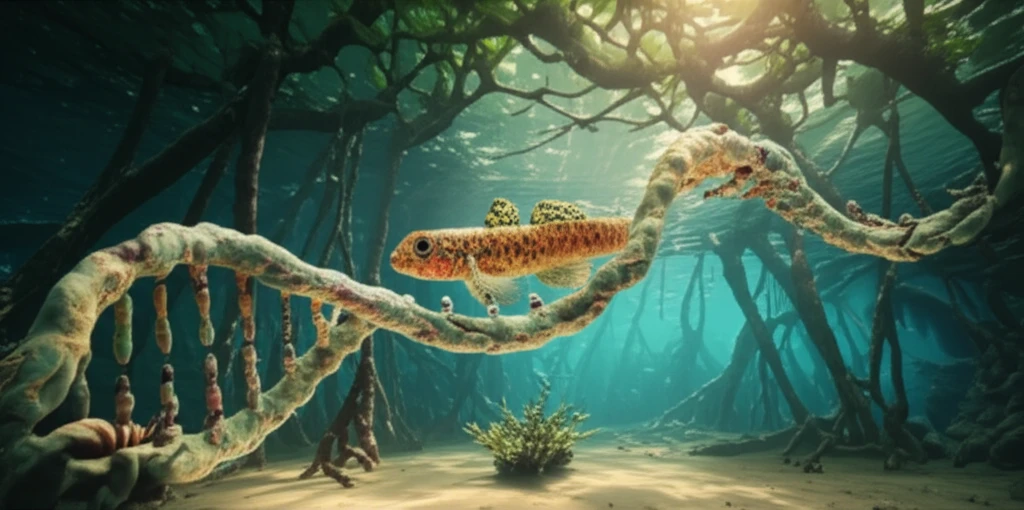
Tropical sand goby swimming through DNA in a mangrove forest.

Unlocking the Secrets of the Tropical Sand Goby: What Its DNA Tells Us

"Dive into the world of the Acentrogobius caninus and discover how its complete mitochondrial genome is reshaping our understanding of goby evolution and classification."


The tropical sand goby, Acentrogobius caninus, thrives in the Indo-West Pacific's muddy and sandy mangrove estuaries. While these fish are common, much remains unknown about them, with previous studies primarily focusing on basic measurements like length and weight. Many species within the Acentrogobius genus remain poorly understood, limiting our knowledge of goby evolution and biodiversity.

Recent advances in DNA sequencing have opened new avenues for exploring the genetic makeup of these elusive fish. Only a couple of Acentrogobius species have had their complete mitochondrial genomes sequenced, highlighting a significant gap in our understanding. This lack of genetic data hinders efforts to accurately classify and study the evolutionary relationships between different goby species.

Now, researchers have successfully sequenced the complete mitochondrial genome of Acentrogobius caninus. This breakthrough offers a detailed genetic map that promises to clarify the goby's place in the tree of life and deepen our understanding of the complex evolution within the Gobiidae family. This article will explore the findings of this research, explaining how this genetic information is reshaping our understanding of these fascinating fish.

Decoding the Goby Genome: What the DNA Reveals

Tropical sand goby swimming through DNA in a mangrove forest.

The newly sequenced mitochondrial genome of Acentrogobius caninus is 16,614 base pairs long and contains a standard set of genetic components: 13 protein-coding genes, 22 transfer RNA (tRNA) genes, 2 ribosomal RNA (rRNA) genes, a control region (CR), and a light-strand replication origin (OL). The arrangement of these genes is typical for most fish, with a few exceptions in the location of certain tRNA genes.

A key characteristic of the A. caninus genome is its base composition. It's slightly AT-biased, meaning it has a higher proportion of adenine (A) and thymine (T) nucleotides compared to guanine (G) and cytosine (C). Specifically, the base composition is 28.24% adenine, 29.20% cytosine, 16.77% guanine, and 25.79% thymine. This genetic data provides a foundation for comparing A. caninus to other goby species.

  • Protein-Coding Genes: These genes provide the instructions for building proteins essential for the goby's survival. The genome encodes 3803 amino acids.
  • Non-Coding Regions: These regions, like the control region, play a vital role in regulating gene expression and DNA replication. The control region is 977 base pairs long.
  • Start and Stop Codons: Most protein-coding genes begin with the standard start codon ATG, while stop codons like TAA and TAG signal the end of protein synthesis.
Phylogenetic analysis, which reconstructs the evolutionary relationships between organisms, revealed that Acentrogobius isn't a single, unified group. Instead, different Acentrogobius species are scattered across the goby evolutionary tree. A. caninus, for example, is closely related to Yongeichthys criniger, while other Acentrogobius species cluster separately. This suggests the current classification of Acentrogobius may need revision to better reflect their true evolutionary history.

Why This Matters: The Bigger Picture for Marine Biology

Sequencing the complete mitochondrial genome of Acentrogobius caninus is more than just a scientific exercise; it has significant implications for understanding marine biodiversity and evolution. By providing a detailed genetic blueprint, this research contributes to a more accurate classification of goby species and sheds light on their complex evolutionary relationships.

This study also highlights the importance of genetic research in conservation efforts. Understanding the genetic diversity within and between species is crucial for developing effective strategies to protect vulnerable populations and habitats. As marine ecosystems face increasing threats from pollution and climate change, genetic data can help prioritize conservation efforts and ensure the long-term survival of these fascinating fish.

Further research is needed to explore the genomes of other Acentrogobius species and related goby genera. By comparing these genetic blueprints, scientists can gain a deeper understanding of the evolutionary forces that have shaped the diversity of gobies and their adaptation to a wide range of marine environments. This knowledge is essential for preserving the biodiversity of our oceans and ensuring the health of marine ecosystems.

About this Article -

This article was crafted using a human-AI hybrid and collaborative approach. AI assisted our team with initial drafting, research insights, identifying key questions, and image generation. Our human editors guided topic selection, defined the angle, structured the content, ensured factual accuracy and relevance, refined the tone, and conducted thorough editing to deliver helpful, high-quality information.See our About page for more information.

Everything You Need To Know

1

What exactly does the complete mitochondrial genome of Acentrogobius caninus consist of?

The complete mitochondrial genome of Acentrogobius caninus is a detailed genetic map composed of 16,614 base pairs. It includes essential genetic components such as 13 protein-coding genes that code for 3803 amino acids, 22 transfer RNA (tRNA) genes, 2 ribosomal RNA (rRNA) genes, a control region (CR) which is 977 base pairs long, and a light-strand replication origin (OL). The arrangement of these genes is typical for fish, with slight variations in tRNA gene locations. This also reveals its base composition is slightly AT-biased, having a higher proportion of adenine (A) and thymine (T) nucleotides compared to guanine (G) and cytosine (C).

2

Why is sequencing the complete mitochondrial genome of Acentrogobius caninus so important?

The sequencing of the Acentrogobius caninus mitochondrial genome is vital because it provides a deeper understanding of goby evolution and classification. The genetic blueprint helps clarify the relationships between different goby species, revealing that the current classification of Acentrogobius may need revision. This research helps to accurately classify goby species, offering insights into their complex evolutionary relationships, and understanding how they adapt to diverse marine environments. This is key to understanding marine biodiversity and the evolutionary processes within the Gobiidae family.

3

Where does the Acentrogobius caninus live, and what specific aspect of the goby is the research focused on?

Acentrogobius caninus thrives in the Indo-West Pacific's muddy and sandy mangrove estuaries. The research on Acentrogobius caninus focuses on its complete mitochondrial genome, which is the genetic material found within the mitochondria of its cells. This differs from previous studies that focused on external features like length and weight. The mitochondrial genome provides a detailed map of the goby's genetic makeup, which is essential for understanding its evolutionary history and relationships with other goby species.

4

What are the broader implications of the genetic data from this research?

The implications of this genetic data are significant for several reasons. Firstly, it allows for a more accurate classification of goby species, potentially leading to revisions in the current understanding of the Acentrogobius genus. Secondly, the data helps to reconstruct the evolutionary relationships between different goby species using phylogenetic analysis. The research reveals the relationship of Acentrogobius caninus to Yongeichthys criniger. Finally, this genetic information contributes to a broader understanding of marine biodiversity and evolutionary processes in the Gobiidae family.

5

What is phylogenetic analysis, and what did it reveal about the Acentrogobius caninus?

Phylogenetic analysis is a method used to reconstruct the evolutionary relationships between organisms. By analyzing the complete mitochondrial genome of Acentrogobius caninus, researchers can create an evolutionary tree that maps out how different goby species are related to each other. This analysis revealed that the Acentrogobius genus isn't a single, unified group. The genetic data from Acentrogobius caninus shows its close relationship to Yongeichthys criniger, highlighting the complexity of goby evolution and the need for revising their classification to reflect their true evolutionary history. The tree is built using the genetic information from the 13 protein coding genes and the non-coding regions to understand how species evolved.

Newsletter Subscribe

Subscribe to get the latest articles and insights directly in your inbox.