
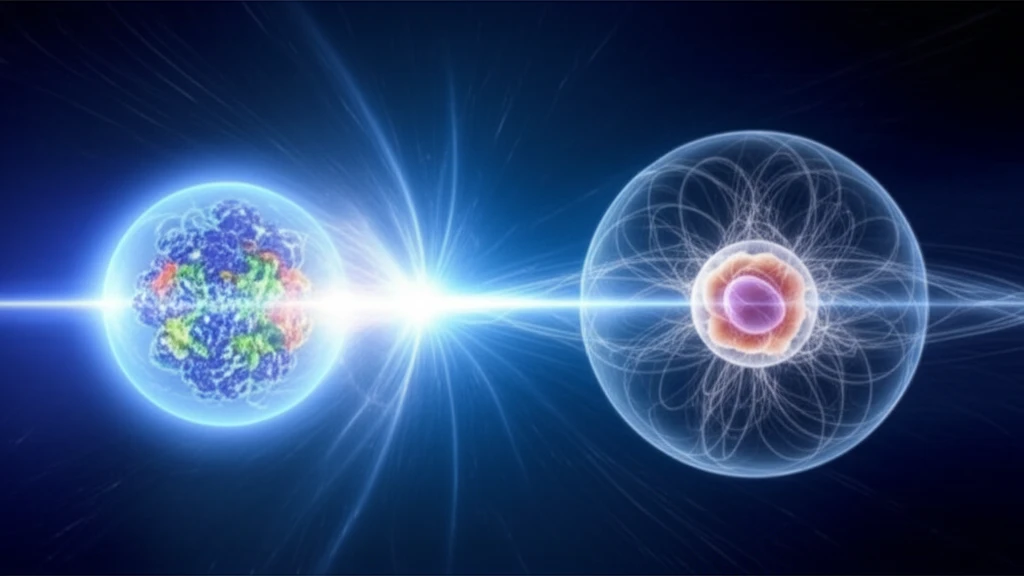
Digital illustration of an electron-proton collision revealing quark-gluon structure.

Unlocking the Secrets of the Nucleon: A Deep Dive into Spin Asymmetries

"Explore how the SANE experiment at Jefferson Lab is revealing the fundamental structure of protons and neutrons."


The quest to understand the fundamental building blocks of matter has led scientists to probe the inner structures of protons and neutrons, collectively known as nucleons. One powerful method for exploring these structures is the study of spin asymmetries, which reveal how the intrinsic angular momentum, or 'spin,' of these particles is distributed among their constituents.

The Spin Asymmetries of the Nucleon Experiment (SANE) at Jefferson Lab has provided valuable data on nucleon spin structure. By scattering polarized electrons off a polarized proton target, SANE collected data covering a wide range of kinematic conditions, from elastic scattering to deep inelastic scattering. This allows scientists to map out the spin-dependent structure functions of the proton.

This article will explore the key findings and implications of the SANE experiment, highlighting how this research contributes to our understanding of the strong force and the fundamental structure of matter. We'll break down the complex concepts of spin asymmetries, structure functions, and their connection to the underlying quark and gluon constituents of nucleons.

What are Spin Asymmetries and Why Do They Matter?

Digital illustration of an electron-proton collision revealing quark-gluon structure.

Inelastic inclusive electromagnetic scattering provides a way to probe the internal structure of nucleons. When electrons are scattered off protons or neutrons, they exchange photons, and the way these photons interact with the nucleon reveals information about its structure. The hadronic tensor, a mathematical object describing this interaction, can be broken down into structure functions. These structure functions, denoted as W₁, W₂, G₁, and G₂, encapsulate the nucleon's response to the electromagnetic probe.

The unpolarized structure functions, W₁ and W₂, describe the overall distribution of charge and momentum within the nucleon. The spin-dependent structure functions, G₁ and G₂, reveal how the nucleon's spin is distributed among its constituents. They depend on two key variables: the energy transfer (v) and the four-momentum transfer squared (Q²).

  • W₁ and W₂: Unpolarized structure functions, describing overall charge and momentum distribution.
  • G₁ and G₂: Spin-dependent structure functions, revealing spin distribution among constituents.
  • v (Energy Transfer): The energy lost by the electron during the scattering process.
  • Q² (Four-Momentum Transfer Squared): A measure of the 'hardness' of the collision, or how deeply the electron probes the nucleon.
At high energies, in the deep inelastic scattering (DIS) regime, the structure functions exhibit a phenomenon called scaling, meaning they become primarily functions of a single variable, the Bjorken scaling variable x. This variable is related to the fraction of the nucleon's momentum carried by the struck quark. The scaling spin-dependent functions, g₁(x) and g₂(x), are related to the quark helicity distributions, providing insights into how the quarks' spins align within the nucleon.

The Ongoing Quest to Understand the Nucleon

The SANE experiment has significantly contributed to our understanding of the nucleon's spin structure. By providing precise measurements of spin asymmetries over a broad kinematic range, SANE has helped to constrain theoretical models of nucleon structure and has revealed the importance of quark-gluon correlations.

Future research will continue to build upon the foundation laid by SANE. Scientists are working to extract even more detailed information from the SANE data, including the twist-3 matrix elements, which are sensitive to quark-gluon interactions. Further experiments with improved precision and wider kinematic coverage are planned to provide an even more complete picture of the nucleon's spin structure.

Unlocking the secrets of the nucleon remains a central goal of nuclear physics. By understanding the spin structure of protons and neutrons, we gain deeper insights into the strong force, the fundamental interactions that govern the behavior of matter at the smallest scales.

About this Article -

This article was crafted using a human-AI hybrid and collaborative approach. AI assisted our team with initial drafting, research insights, identifying key questions, and image generation. Our human editors guided topic selection, defined the angle, structured the content, ensured factual accuracy and relevance, refined the tone, and conducted thorough editing to deliver helpful, high-quality information.See our About page for more information.

This article is based on research published under:

DOI-LINK: 10.1051/epjconf/20147302001, Alternate LINK

Title: Overview And Highlights Of The Spin Asymmetries Of The Nucleon Experiment – Sane

Subject: General Medicine

Journal: EPJ Web of Conferences

Publisher: EDP Sciences

Authors: Oscar A. Rondon

Published: 2014-01-01

Everything You Need To Know

1

What exactly are spin asymmetries, and why are they important in understanding the structure of protons and neutrons?

Spin asymmetries are crucial because they unveil how the intrinsic angular momentum, or 'spin,' of nucleons (protons and neutrons) is distributed among their constituents, such as quarks and gluons. Studying spin asymmetries, especially through experiments like SANE at Jefferson Lab, allows scientists to map out the spin-dependent structure functions G₁ and G₂, providing valuable insights into the internal dynamics and composition of nucleons. Understanding spin asymmetries helps constrain theoretical models and enhances our knowledge of the strong force.

2

How does the SANE experiment at Jefferson Lab work, and what specific techniques does it use to study nucleon spin?

The SANE experiment at Jefferson Lab utilizes polarized electron scattering off a polarized proton target to gather data across a wide range of kinematic conditions, from elastic scattering to deep inelastic scattering. This data enables scientists to map the spin-dependent structure functions of the proton. By measuring spin asymmetries, SANE provides precise measurements that constrain theoretical models of nucleon structure and reveal the importance of quark-gluon correlations.

3

Can you explain what structure functions are (W₁, W₂, G₁, G₂) and how they help us understand the internal composition of nucleons?

Structure functions are mathematical objects that encapsulate a nucleon's response to an electromagnetic probe during electron scattering. They're categorized into unpolarized structure functions (W₁ and W₂) and spin-dependent structure functions (G₁ and G₂). W₁ and W₂ describe the overall charge and momentum distribution within the nucleon, while G₁ and G₂ reveal how the nucleon's spin is distributed among its constituents. At high energies, in the deep inelastic scattering regime, these structure functions exhibit scaling, becoming functions of the Bjorken scaling variable x, which relates to the fraction of the nucleon's momentum carried by the struck quark. The scaling spin-dependent functions, g₁(x) and g₂(x), are related to the quark helicity distributions, providing insights into how the quarks' spins align within the nucleon.

4

What is deep inelastic scattering (DIS), and how does it relate to understanding the spin structure of nucleons in experiments like SANE?

Deep inelastic scattering (DIS) is a regime where high-energy electrons are scattered off nucleons, probing their internal structure. In DIS, structure functions exhibit scaling, meaning they become primarily functions of the Bjorken scaling variable x. This scaling behavior allows scientists to relate the structure functions to the quark helicity distributions, offering insights into how the quarks' spins align within the nucleon. Experiments like SANE rely on DIS to gather precise measurements of spin asymmetries, providing crucial data for understanding nucleon structure.

5

What are the key contributions of the SANE experiment to our understanding of nucleon spin, and what future research directions might build upon its findings?

The SANE experiment has significantly improved our understanding of nucleon spin structure by providing precise measurements of spin asymmetries over a broad kinematic range. These measurements have helped constrain theoretical models of nucleon structure and highlighted the importance of quark-gluon correlations. While SANE has focused on proton targets, future experiments could extend these studies to neutron targets, providing a more complete picture of nucleon spin structure. Further research may also explore the transverse spin structure of nucleons, offering additional insights into the complex dynamics within these fundamental building blocks of matter.

Newsletter Subscribe

Subscribe to get the latest articles and insights directly in your inbox.