
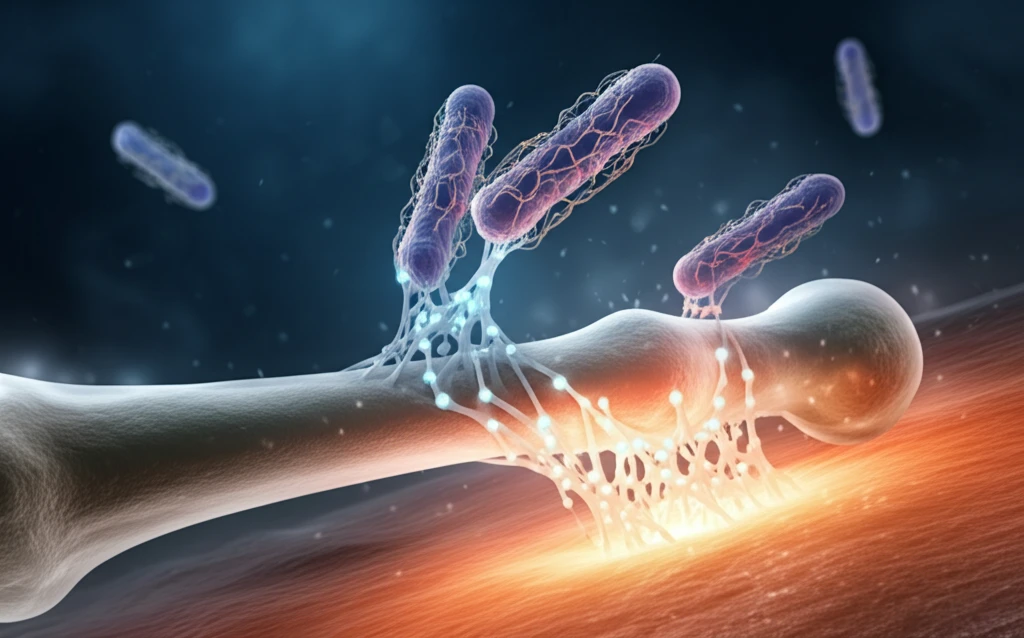
Unlocking the Secrets of Staphylococcus Aureus: How Bacteria Invade Your Bones

"Decoding the process of Staphylococcus aureus internalization by osteoblasts, and what it means for treating bone infections."
Staphylococcus aureus is a common bacterium, often found on the skin or in the nose, and is a leading cause of implant-related orthopedic infections. While it was once believed to primarily exist outside of cells, research has revealed its ability to invade eukaryotic cells, including those in bone tissue. This discovery has transformed our understanding of how these infections take hold and persist.
The initial step in Staphylococcus aureus infection is adhesion to the tissues surrounding an implant. This adhesion sets the stage for the bacteria to internalize, or enter, the host cells. Once inside, the bacteria can evade the body's natural defenses and antibiotic treatments, leading to chronic and difficult-to-treat infections like osteomyelitis.
Recent studies have focused on the specific mechanisms that Staphylococcus aureus uses to invade bone cells, particularly osteoblasts, which are responsible for bone formation. By understanding these processes, scientists hope to develop more effective strategies to prevent and treat implant-related infections.
A Ubiquitous Colonizer With Serious Potential
Staphylococcus aureus is a gram-positive, spherically shaped bacterium that is a usual member of the human microbiota, frequently found in the upper respiratory tract and on the skin. According to GOV.UK, it commonly colonises human skin and mucosa without causing problems, but can cause disease when there is an opportunity for the bacteria to enter the body, such as through broken skin or a medical procedure. The Minnesota Department of Health tracks statistics for both MRSA and Staphylococcus aureus as part of its communicable disease reporting. S. aureus can cause illness directly through infection or indirectly through the toxins it produces, according to MedicineNet.
Diagnostic Challenges in Identifying S. aureus
Traditional phenotypic methods for identifying S. aureus from clinical specimens can produce variable characteristics leading to ambiguity, creating a need for rapid and reliable identification methods. The vicK gene has been investigated as a potential identification marker to address this diagnostic gap and expedite appropriate antibiotic therapy. S. aureus is classified as a pathobiont of humans as well as a multitude of animal species, complicating research models. In dairy products, lateral flow tests are being developed because contamination with S. aureus is particularly concerning due to its potential to lead to spoilage, foodborne illnesses, and compromised product quality.
The Scale of a Persistent Pathogen
Staphylococcus aureus is a gram-positive bacterium that appears under the microscope as spherical coccus organisms appearing in pairs, short chains, or bunched, grape-like clusters. It is a common cause of life-threatening bacterial infections, causing over 400,000 hospital patient infections per year and 100,000 deaths from complications. This combination of morphological identification and its enormous clinical burden has made it one of the most studied pathogens in medical history.
The Role of Adhesins and Fibronectin in Bacterial Internalization
Adhesins, also known as MSCRAMMs (Microbial Surface Components Recognizing Adhesive Matrix Molecules), are essential for Staphylococcus aureus to interact with bone matrix proteins such as fibronectin, collagen, and bone sialoprotein. These interactions facilitate the bacteria's attachment to bone tissue, allowing them to colonize the area and initiate the infection process.
- FnBPA: Appears to play a crucial role in the internalization process.
- CNA and Bbp Adhesins: Can play a synergistic role by acting in the initial adhesion of S. aureus to osteoblasts, thus favoring the subsequent FnBPA-mediated internalization.
- Genetically Different Strains: Different strains of S. aureus exhibit varying abilities to adhere and internalize due to differences in their genetic makeup, particularly in the genes coding for adhesins.
Intracellular Mechanisms and Food Safety Frontiers
Recent research on S. aureus spans its intracellular dynamics during infections, with pioneering discoveries emerging around how the bacterium survives and replicates within host cells. S. aureus is also recognized as an important foodborne pathogen associated with food intoxication and multiple infections in humans, with its presence in salted food being a particular concern due to its salt tolerance potential. The latest science news and features on S. aureus continue to highlight advancements and breakthroughs in understanding its pathogenic mechanisms.
MRSA Resistance and Uncommon Infection Sites
Methicillin-Resistant Staphylococcus aureus (MRSA) remains a prevalent problem across healthcare clinics, sports facilities, and broader society. Despite its notoriety, S. aureus is an uncommon cause of urinary tract infection in the general population, accounting for only 0.4% to 4% of positive urine cultures. However, when S. aureus bloodstream infections do originate from the urinary tract, they carry significant clinical implications and 30-day mortality risk that demand attention.
Distinguishing S. aureus From Other Staphylococci
Staphylococcus aureus is a major human pathogen that causes a wide range of clinical infections, yet it is virtually never a nonpathogenic isolate or contaminant in contrast to coagulase-negative staphylococci and propionibacteria. Comparative genomics of human versus animal isolates reveals important host specificity differences. S. aureus can cause a wide variety of infections including skin and soft tissue infections, bacteremia, pneumonia, and food poisoning, setting it apart from less virulent staphylococcal species found throughout the meat supply chain and clinical settings.
Future Directions and Therapeutic Implications
Understanding the mechanisms by which Staphylococcus aureus adheres to and invades bone cells opens the door to new therapeutic strategies. By targeting specific adhesins or the fibronectin-mediated internalization process, researchers hope to develop treatments that can prevent or disrupt bone infections. This may involve designing drugs that block the interaction between bacterial adhesins and bone matrix proteins or developing vaccines that stimulate the immune system to target these bacteria more effectively. Continued research in this area is essential for improving the outcomes of patients with implant-related orthopedic infections and osteomyelitis.
The Enduring Threat of a Well-Armed Pathogen
Staphylococcus aureus remains one of the leading causes of morbidity and mortality worldwide, a status driven in large part by antibiotic-resistant strains, particularly methicillin-resistant variants. The burden of S. aureus infections on hospitals in the United States is substantial, as documented in nationwide inpatient sample database analyses. This Gram-positive pathogen is armed with a battery of virulence factors that facilitate its establishment of infections across nosocomial and community settings, making management of S. aureus infections a persistent clinical challenge.
Efflux Pumps, Resistance Mechanisms, and New Therapeutic Targets
Decades after it was first reported, beta-lactam-resistant S. aureus remains a subject of intense research owing to the ever-increasing issue of drug resistance. Antimicrobial efflux pumps in S. aureus represent a growing area of investigation, with researchers exploring their inhibitors as potential new therapeutic strategies. S. aureus has become resistant to all antibiotics used to combat infection through acquisition of resistance mechanisms via horizontal gene transfer. The MRSA testing systems market is also evolving, with key trends including the rise of natural alternatives, sustainable practices, and technological innovations.
Biofilms, Colonization, and Global Health Burden
Staphylococcus aureus uses numerous adhesins that contribute to skin colonisation and survival, as well as biofilm production during implanted device-related, wound, skin and burn infections. MRSA remains a leading cause of healthcare- and community-acquired infections, imposing substantial morbidity, mortality, and economic burden worldwide. S. aureus is found in the nasal passages of about 30% of healthy people, and its presence in the gut microbiome is also medically significant. Bacterial meningitis, including that caused by S. aureus, remains a major cause of morbidity and mortality in children, particularly in low- and middle-income countries.
Colonization Dynamics and Pediatric Vulnerability
The composition of vaginal microbial communities has been shown to impact tampon colonisation by S. aureus during menses, as studied in 108 healthy women and 7 menstrual toxic shock syndrome cases. S. aureus bacteriuria has been identified as an important indicator of coexistent bacteremia, requiring careful clinical evaluation. Community-acquired S. aureus infections among children in Türkiye have been evaluated for their clinical features, antimicrobial resistance patterns, and temporal trends at a tertiary hospital, highlighting the ongoing need for surveillance in pediatric populations.