
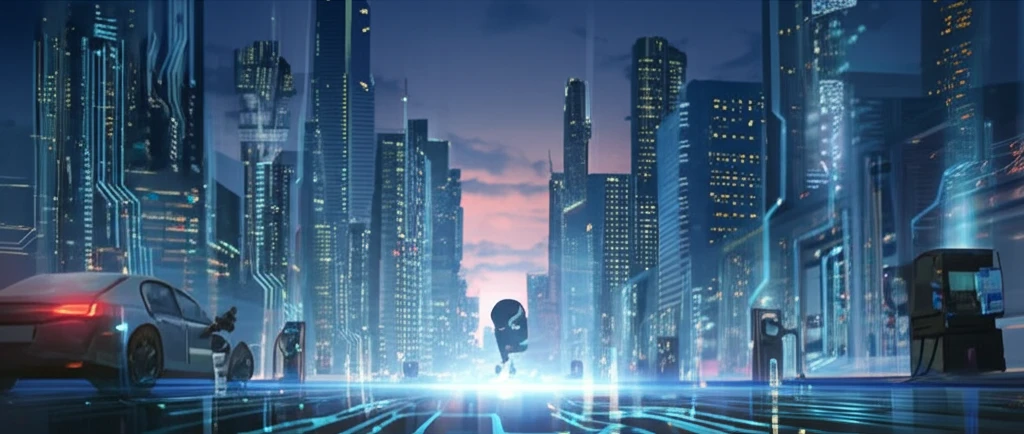
Smart Grid Revolution: How Energy Games Can Power Your Savings

"Unlock the secrets of noncooperative energy charging and discharging games for a smarter, greener, and more affordable future. Explore smart grid technologies and energy optimization strategies."
Imagine a world where your electric vehicle not only gets you from A to B but also actively participates in balancing the energy grid, reducing costs, and promoting sustainability. With the rise of electric vehicles (EVs), our energy distribution systems face unprecedented challenges. However, these challenges also bring unique opportunities. The key lies in smart grid technology and innovative approaches like noncooperative energy charging and discharging games.
The integration of EVs into the power grid presents a dual challenge: the significant new load on the existing energy distribution system and the potential for grid overload during peak hours if EV charging isn't managed effectively. However, the average car spends most of its time parked—often connected to the grid. This idle time can be harnessed to stabilize the grid and reduce energy costs, turning EVs into valuable assets rather than liabilities.
This is where the concept of Vehicle-to-Building (V2B) operation comes into play, allowing EVs to discharge energy back into buildings. V2B not only enhances grid flexibility and reliability but also offers additional benefits to EV owners by reducing their energy expenses.
Savings Through Renewable Integration
Smart grids change how households and businesses consume electricity by integrating renewable sources like solar and wind directly onto the system. Because saving energy directly saves money, grid customers are positioned to benefit financially from smarter usage. This win-win dynamic makes the modern grid a foundation for both personal savings and sustainable power.
From Bills to Smart Meter Data
Traditional energy management typically begins with data collection, drawing on monthly utility bills, manual meter checks, or automatic uploads from smart meters. These methods give households a baseline for tracking consumption, but they are limited by how passive and periodic the data can be. Smart grids aim to overcome these limitations through real-time communications and richer, more frequent information.
Policy Milestones Shaping the Grid
Smart grid policy has developed through formal frameworks such as the Smart Grid European Technology Platform in Europe and Title 42 of the United States Code in the U.S. These institutional milestones mark the transition from one-way power delivery toward an organized, technology-enabled grid. Policy organization, in turn, paved the way for the communications-driven revolution seen today.
Decentralized Energy Management: Game Theory to the Rescue
The heart of this innovative approach is a noncooperative game-theoretical framework. In this model, each EV owner acts as an independent player aiming to minimize their energy costs. This decentralized system contrasts with traditional centralized control, where a central authority dictates the charging and discharging schedules of all EVs. By allowing each EV to make its own decisions, the system respects user privacy and reduces the immense signaling required for centralized control.
- Reduced Peak Demand: By strategically managing when EVs charge and discharge, the system minimizes the highest points of energy demand, preventing grid overloads.
- Cost Savings: EV owners can lower their energy bills by participating in V2B operations and responding to energy price signals.
- Enhanced Grid Stability: The ability to discharge energy back into the grid provides a flexible resource that can help stabilize the power supply.
- Privacy Protection: Decentralized systems protect user data by allowing EVs to make independent decisions without sharing private information with a central authority.
Stability Through Continuous Innovation
Recent work highlights that smart grid technology keeps the network stable even when renewables make energy supply unpredictable. To make a smart grid strategy last, businesses are advised to prioritize continuous innovation and collaboration with stakeholders. Automation and real-time analysis are emerging as core themes in the latest research.
Challenges and Solutions on the Ground
Smart grid implementation is not without obstacles, and analysts catalog real challenges alongside the solutions developed to address them. These hurdles range from technical integration to the coordination required across the electricity ecosystem. Acknowledging such challenges is essential, since failures in early deployments inform how the next generation of grids is built.
Utility-Side vs. Customer-Side Innovation
Smart grid innovations occur at, and can affect, any or all steps of the electricity ecosystem, from generation to consumption. Some technologies focus on the utility side of the system, while others address the customer directly. This split means savings opportunities vary depending on where a consumer sits in the value chain.
The Future of Energy: Smart, Sustainable, and Savings-Oriented
The integration of EVs into smart grids using game-theoretical approaches represents a significant step toward a more sustainable and efficient energy future. By empowering EV owners to actively participate in energy management, we can reduce peak demand, lower energy costs, and enhance grid stability. As technology advances and more EVs hit the road, these strategies will become increasingly important in creating a resilient and cost-effective energy ecosystem.
Communications as the Core Enabler
Experts describe the smart grid as a way to facilitate the transition to a new energy paradigm through extensive use of communications and ubiquitous real-time analysis. This continuous flow of data is what lets customers act on their consumption and unlock savings. The consensus is that connectivity, not hardware alone, defines the modern grid.
EVs as the Next Frontier
For EV owners, the smart grid creates a win-win-win for the environment, the power grid, and drivers. Smart scheduling optimizes charging costs, and EVs may even serve as home backup power. This points toward vehicles becoming active participants in household energy savings rather than passive loads.
Energy as a Manageable Resource
At a higher level, energy management turns energy from a simple cost item into a manageable and optimizable resource. That reframing gives households and businesses a framework for treating electricity strategically. The smart grid is the infrastructure that makes this resource-level view practical at scale.
A Win-Win for Budgets and Planet
For everyday consumers, the payoff is simple: saving energy saves money, a win-win for the budget and the environment. Clean energy integration promotes sustainable power and reduces environmental impact, giving individuals a tangible role in the transition. Real-world savings, in short, are the human face of the smart grid revolution.