
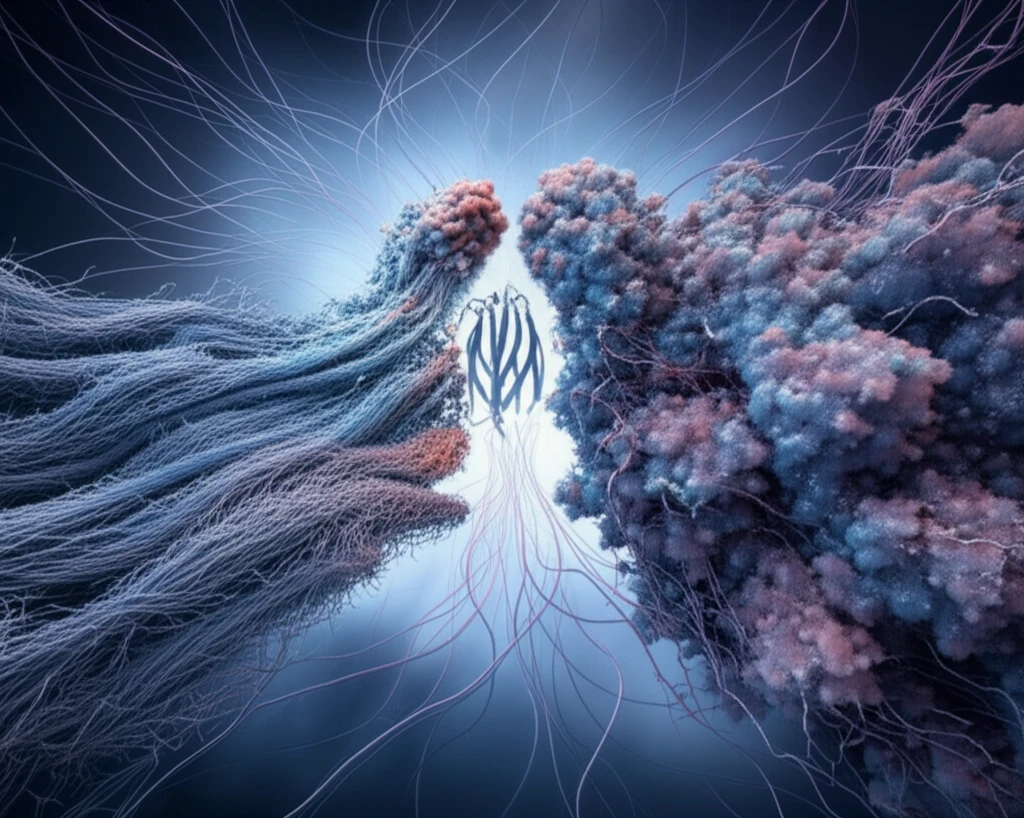
Unlocking the Secrets of Protein Aggregation: How Stability Dictates Amyloid Formation

"New research reveals the critical role of native structure stability in determining whether a protein forms harmful amyloid structures or benign aggregates, paving the way for new therapeutic strategies."
The quest to understand the molecular basis of amyloid-related diseases, including Alzheimer's, Parkinson's, and type 2 diabetes, has intensified in recent years. These diseases, now numbering over 40, share a common feature: the accumulation of misfolded proteins into aggregates characterized by a cross-beta structure.
While much research has focused on short peptides, intrinsically disordered proteins, or proteins under harsh denaturing conditions, understanding how structured globular proteins aggregate under near-physiological conditions remains a challenge. This is where the latest research steps in, offering a fresh perspective on the factors governing protein aggregation.
Researchers investigated the influence of amino acid substitutions on the propensity of sperm whale apomyoglobin (sw ApoMb), a completely helical protein, to form amyloid structures from its native, structured state without the need for denaturing agents. By studying the stability and aggregation behavior of mutated sw ApoMb, the scientists uncovered a fascinating link between protein stability and aggregation pathways.
Stability is Key: How Protein Structure Dictates Aggregation Pathways
The study demonstrates that the stability of a protein's native state is a critical determinant of both its propensity to aggregate and the structural characteristics of the resulting aggregates. Structurally stable mutants exhibited a low tendency to aggregate, while moderately destabilized variants formed amyloids. Intriguingly, strongly destabilized mutants gave rise to a mix of both amyloid and non-amyloid aggregates.
- Stable Mutants: Show low aggregation propensity.
- Moderately Destabilized Mutants: Primarily form amyloid structures.
- Highly Destabilized Mutants: Form a mixture of amyloid and non-amyloid aggregates.
Implications and Future Directions: Targeting Stability to Combat Disease
These findings offer new insights into the complex process of protein aggregation and highlight the crucial role of native state stability in determining aggregation pathways. Understanding this intricate relationship could lead to novel therapeutic strategies for amyloid-related diseases.
By focusing on stabilizing the native protein structure or modulating its aggregation pathway, scientists may be able to prevent the formation of toxic amyloid aggregates and mitigate the progression of these devastating conditions.
Further research is needed to fully elucidate the mechanisms governing the competition between different aggregation pathways and to identify specific interventions that can promote protein stability and prevent amyloid formation. This knowledge will be crucial in the development of effective treatments for the growing number of amyloid-related diseases.