
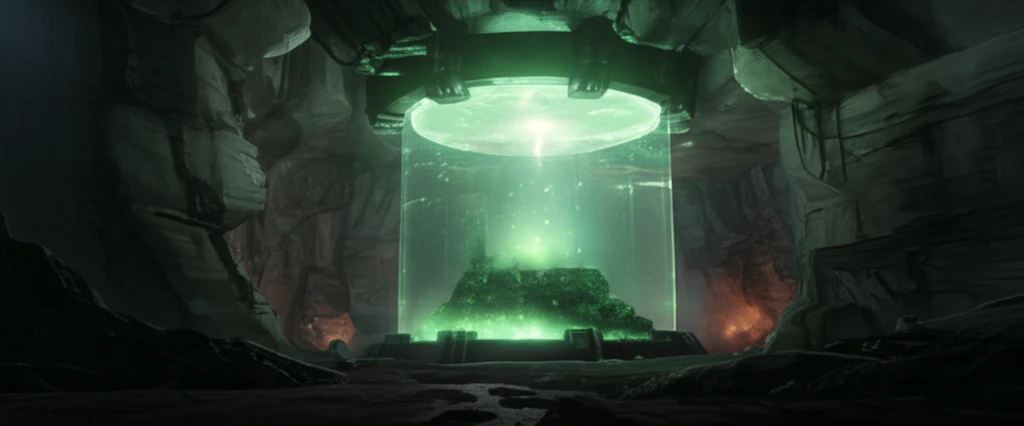
Unlocking the Secrets of Nuclear Waste: How Glass Dissolution Impacts Long-Term Storage

"Dive into the groundbreaking research on International Simple Glass (ISG) and its forward dissolution rate in alkaline solutions, crucial for understanding the safety of nuclear waste disposal."
The challenge of safely disposing of high-level nuclear waste is one of the most pressing environmental concerns of our time. Vitrification, the process of encapsulating nuclear waste in glass, is a widely adopted strategy to immobilize these hazardous materials. Understanding how this glass behaves over extended periods is crucial for ensuring the integrity of waste repositories.
Enter the International Simple Glass (ISG), a benchmark reference material used in a collaborative effort to study the dissolution mechanisms of vitrified nuclear waste. Scientists are meticulously examining how ISG interacts with various environmental conditions to predict the long-term stability of nuclear waste forms. This research is particularly vital for countries like Belgium, which have specific concepts for the geological disposal of vitrified waste.
This article delves into a study focused on determining the forward dissolution rate of ISG in alkaline solutions, mimicking the conditions expected in a Belgian geological disposal scenario. By understanding this process, we can better assess and improve the safety of nuclear waste storage.
A Long-Running Stumbling Block
Nuclear waste has long been cited as one of the biggest challenges facing nuclear power and a leading argument against it, with opponents pointing to substantial environmental, financial, and health costs. Global statistics are complicated by the fact that much of the data is a mix of measured and modelled sources, with global totals based on World Nuclear statistics that collate national data and apply modelling where data gaps exist. Finland is changing that narrative, with plans to deal with the waste challenge by 2026 after decades in which the issue was seen as intractable. Industry watchers also track the economics of the sector, including rankings of the leading companies in the global nuclear waste market by revenue.
Vitrification and Geological Repositories
The accepted approach for high-level radioactive material involves vitrifying the waste and sealing it inside a geological repository deep underground. The IAEA describes nuclear energy as the energy released through nuclear reactions, with power generation forming the scientific basis of the industry. Current standardisation efforts include the UK NDA's cross-estate initiative to standardize radioactive waste container design and procurement, intended to transform decommissioning costs. Proposed alternatives such as transmutation aim to convert radioactive material into less hazardous forms, though related technologies remain among the least developed areas of nuclear engineering.
Decades of Searching for a Home for Waste
The United States has struggled for more than half a century to find a permanent disposal solution, with nearly 70,000 tons of nuclear waste still sitting outside nuclear power plants across the country and the proposed Yucca Mountain repository, located about 90 miles outside Las Vegas, repeatedly failing to advance. The Nuclear Waste Policy Act of 1982 created the legal framework for a permanent geologic repository, requiring the Department of Energy to nominate at least five potential sites and recommend three for detailed study. Even the Mariana Trench has been examined as a possible nuclear waste disposal site in the search for options. The cultural anxiety around radiation has even been linked to the so-called Pharaoh's Curse, with a study featured in the Journal of Archaeological Science suggesting unexplained radiation in ancient Egyptian tombs might be connected to the storage of nuclear waste.
The Science of Dissolution Rates
The study meticulously examined the dissolution rate of ISG in various alkaline solutions, simulating the conditions found in cement-based geological repositories. These repositories are designed to contain vitrified waste, but over time, the alkaline pore water from the cement can interact with the glass, potentially leading to the release of radionuclides. To replicate these conditions, researchers tested ISG in different potassium hydroxide (KOH) solutions, with pH levels ranging from 9 to 14, and in artificial cementitious water at a pH of 13.5. The experiments were conducted at a controlled temperature of 30°C.
- The dissolution rate of ISG generally increases with higher pH levels in KOH solutions.
- The dissolution rates in artificial cementitious water were lower than in KOH solutions of similar pH, likely due to the presence of calcium.
- Comparison with previous studies on SON68 glass showed similar dissolution rates at moderately alkaline pH, but ISG exhibited lower rates at very high pH.
Research Turns Toward Long-Term Solutions
Recent research highlights emphasise that long-term, sustainable solutions to radioactive waste management remain a central challenge, even as nuclear power plays a pivotal role in ensuring a scalable, affordable, and reliable low-carbon electricity supply. Nuclear waste is usually a by-product of nuclear fission reactors, but it can also be generated through industrial processes and medical applications, and the nuclei resulting from fission are typically radioactive themselves. That has driven research into better radiation monitoring for nuclear waste and into engineering systems that can support nuclear waste sorting and maintenance in real-world situations. Ongoing news coverage continues to track innovations, research, and breakthroughs across the field.
Growing Stockpiles and Disputed Fixes
Critics argue that waste mountains just keep growing, and that the waste stored in numerous US facilities is dangerous and urgently needs to be packaged and given a final resting place, with Hanford, a former nuclear weapons production site, holding stores of unstable waste. Some recycling ventures have drawn sharp criticism, as when the Canadian Coalition for Nuclear Responsibility called a company's claim that fission products would remain radioactive for only three centuries outrageous. Concerns over the proliferation of nuclear weapons, especially among countries with established civil nuclear power capabilities, are another long-standing criticism of nuclear energy. Local communities also carry fraught histories, such as Plymouth, where plant issues were usually attributed to mechanical failures that, according to the owner, did not put the public at risk.
Comparing Waste Across Reactors and Fuels
Comparisons show that nuclear energy produces very little waste per unit of energy, as illustrated by the amount of lifetime waste a person would generate if their energy consumption were entirely nuclear. The comparison differs by reactor type: Light Water Reactors (LWR) and Heavy Water Reactors (HWR), such as CANDU reactors, differ in the waste generated per unit of used uranium and the time required for spent fuel to become safe. Infographics commonly contrast nuclear energy density against conventional fossil fuels and renewables. Broader analyses also compare the waste produced from nuclear generation with that from coal.
Implications and Future Directions
This research provides essential data for refining models that predict the long-term behavior of vitrified nuclear waste in geological repositories. Understanding the forward dissolution rate of ISG in alkaline environments is crucial for ensuring the safety and security of these disposal sites. Future studies should focus on further elucidating the role of specific ions, such as calcium, in influencing glass dissolution, as well as exploring the formation and properties of alteration layers on the glass surface. By continuing to unravel the complexities of glass dissolution, we can better manage and mitigate the risks associated with nuclear waste disposal, safeguarding our environment for future generations.
Experts Split Between Onsite Storage and Buried Repositories
Nuclear waste experts have warned that Japan is literally playing with fire in the way spent fuel continues to be stored onsite, especially in reactor 4, which contains the most irradiated fuel, holding ten times the deadly cesium-137 released during the 1986 Chernobyl nuclear accident. Some experts argue that this category of waste is dangerous enough for long enough that it should be isolated in a geologic repository like the proposed Yucca Mountain facility in Nevada. Others point to accelerator-driven approaches in which the heat generated by splitting waste nuclei can be used to generate electricity, with the failsafe mechanism that when the beam is turned off the reaction stops. Figuring out how to bury radioactive atoms safely blends particle physics, careful geology, engineering, and a high tolerance for reams of regulations.
Bigger Capacity, New Treatments, and Messages Across Millennia
Global nuclear energy capacity could increase by 25% by 2030, amplifying the need for robust waste management solutions and propelling the spent fuel and nuclear waste management market forward. In the roughly 70 years since humans first split the atom, the world has accumulated between 250,000 and 300,000 tonnes of high-level nuclear waste that will remain radioactive for at least 100,000 years. New treatment technologies, such as advanced ionic exchange resins with higher selectivity and efficiency in removing radioactive isotopes from liquid nuclear waste, are being developed. Communicating across those timescales is itself a frontier, with experts grappling with language barriers and how to send messages into the future.
A Reputation Shaped by the Weapons Industry
The safety and waste reputations of nuclear power have been polluted largely by the nuclear weapons industry, with the historic challenges of waste management for the two often conflated. Critics nonetheless argue that nuclear energy brings a new set of challenges, from radioactive waste to questions over long-term safety. Environmentalists warn of the possibility of trading one problem for another, exchanging carbon emissions for nuclear waste management. The debate is now colliding with the AI boom, as commentators argue that AI's growing energy appetite is pushing the UK to go nuclear, which brings the waste question back to the fore.
Underground Labs and the Search for a Workable Tomb
Japan's Horonobe underground research laboratory, one of only two such laboratories the country has built to study geological disposal of high-level radioactive waste and the only one still operating, is studying disposal in sedimentary rock. Finland has built a facility to store nuclear waste underground and is now asking whether it can survive for 100,000 years. Industry efforts continue, including a US collaboration to study used nuclear fuel recycling announced in 2026. At its most basic level, nuclear waste management is about how radioactive waste is handled, stored, and disposed of safely.