
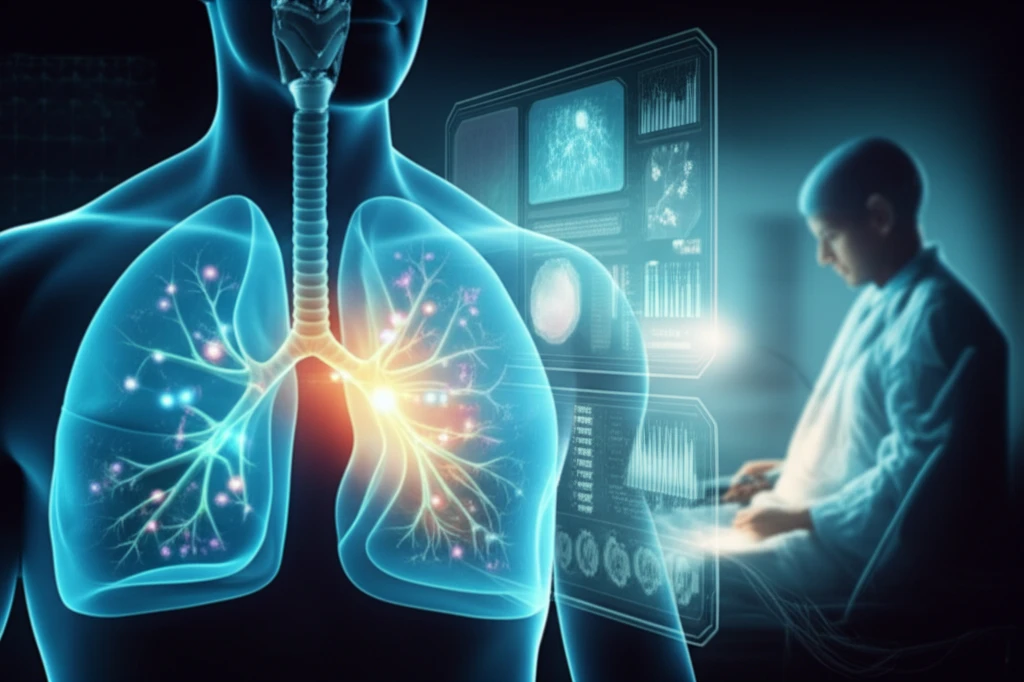
Illustration of a lung with glowing sections, data visualizations, and a patient receiving targeted therapy.

Unlocking the Secrets of Lung Cancer Treatment: How Cutting-Edge Technology is Revolutionizing Care

"From Radiomic Features to Adaptive Therapy: A Deep Dive into the Latest Advancements"


Lung cancer remains a formidable challenge, but the landscape of treatment is rapidly evolving. Recent advances in technology and medical understanding are paving the way for more effective, personalized, and precise approaches to battling this disease. This article explores some of the most promising breakthroughs, offering insights into how these innovations are changing the way lung cancer is diagnosed and treated.

The journey through lung cancer treatment is complex, involving a delicate balance of precision, speed, and personalization. Traditional methods, while providing a foundation for care, often lack the nuance required to address the unique characteristics of each patient's condition. However, modern technologies are providing ways to look deeper inside the cancer and understand their characteristics.

We'll explore how these methods, from sophisticated imaging techniques to the application of machine learning, are not just enhancing treatment, but also offering new hope for patients. This will be a journey through science and innovation, offering insights for patients, caregivers, and anyone interested in the future of cancer care.

The Power of Radiomics: Decoding Features to Improve Treatment

Illustration of a lung with glowing sections, data visualizations, and a patient receiving targeted therapy.

Radiomics, the extraction and analysis of quantitative features from medical images (like CT scans and PET scans), is at the forefront of personalized medicine. These features go beyond what the human eye can see, providing detailed information about tumor characteristics.

One area of focus is the impact of breathing motion on the accuracy of radiomic features. Because tumors in the lungs move with each breath, it is important to understand how these features stay stable across different breathing phases. Research has shown that not all radiomic features are equally robust. Some features are highly stable, even with motion, while others are more sensitive to changes caused by breathing. Understanding these differences is key to using radiomics effectively in clinical research and treatment planning.

  • Shape Features: These features, which describe the form of the tumor, tend to be very stable, even with breathing motion.
  • Other Features: Features related to the tumor's texture and intensity can be more affected by breathing, which means they need careful consideration.
  • Impact on Treatment: By understanding these stability variations, doctors can make more informed decisions about which radiomic features to use in their treatment plans.
This detailed analysis allows doctors to personalize treatments, ensuring the best possible outcomes based on the specific characteristics of each patient's cancer.

The Future is Now: Embracing Innovation in Lung Cancer Care

The advancements discussed here represent a significant step forward in lung cancer treatment. As research continues and these technologies become more integrated into clinical practice, patients can look forward to more effective treatments, fewer side effects, and an improved quality of life. The journey is ongoing, but the future of lung cancer care is bright, driven by the relentless pursuit of innovation and a commitment to patient-centered care.

About this Article -

This article was crafted using a human-AI hybrid and collaborative approach. AI assisted our team with initial drafting, research insights, identifying key questions, and image generation. Our human editors guided topic selection, defined the angle, structured the content, ensured factual accuracy and relevance, refined the tone, and conducted thorough editing to deliver helpful, high-quality information.See our About page for more information.

Everything You Need To Know

1

What is radiomics and how does it improve lung cancer treatment?

Radiomics involves extracting and analyzing quantitative features from medical images, like CT and PET scans, to gain detailed insights into tumor characteristics that are not visible to the naked eye. This data enables personalized medicine, allowing doctors to make informed decisions and tailor treatments based on the specific characteristics of each patient's cancer. This approach contrasts with traditional methods that may not fully capture the nuances of individual cases. However, it's important to note that radiomics is still an evolving field, and more research is needed to fully understand its potential and limitations.

2

Why is it important to consider breathing motion when using radiomic features in lung cancer treatment?

Tumors in the lungs move with each breath, which can affect the accuracy of radiomic features derived from medical images. Some radiomic features are highly stable despite breathing motion, while others are more sensitive to changes. For example, shape features tend to be stable, but features related to texture and intensity can be more affected. Understanding these stability variations is crucial for making informed decisions about which radiomic features to use in treatment planning and clinical research, ensuring that the selected features accurately reflect the tumor's characteristics.

3

Can you elaborate on how machine learning is used in lung cancer treatment?

While not explicitly detailed, machine learning is implied as a tool that analyzes the complex data generated by radiomics and other advanced imaging techniques. Machine learning algorithms can identify patterns and relationships within this data, predicting treatment response or identifying high-risk patients. This analysis refines treatment strategies and improves patient outcomes. Integration of machine learning enhances the precision of personalized care, guiding clinicians toward more effective therapeutic interventions.

4

What does 'adaptive therapy' mean in the context of innovative lung cancer treatments and how might it improve outcomes?

The text mentions 'adaptive therapy' as a cutting-edge technology revolutionizing care. While the article does not explicitly define adaptive therapy, it refers to treatment strategies that adjust over time in response to how the cancer is reacting. Instead of using a fixed treatment plan, adaptive therapy would likely involve monitoring the tumor's response through imaging and biomarkers, then modifying the treatment plan (drug dosages, combinations, or even treatment modalities) to maintain effectiveness and minimize resistance. This approach leads to better outcomes by preventing the cancer from adapting and becoming resistant to the initial treatment.

5

What are the potential future benefits for lung cancer patients as these innovative technologies become more integrated into clinical practice?

As technologies like radiomics, machine learning, and adaptive therapy become more integrated, lung cancer patients can expect more effective and personalized treatments. This may lead to fewer side effects, an improved quality of life, and better overall outcomes. The ongoing research and innovation in lung cancer care signals hope for continued advancements, driven by a commitment to patient-centered approaches. The development of less invasive diagnostic techniques will also play an important role.

Newsletter Subscribe

Subscribe to get the latest articles and insights directly in your inbox.