
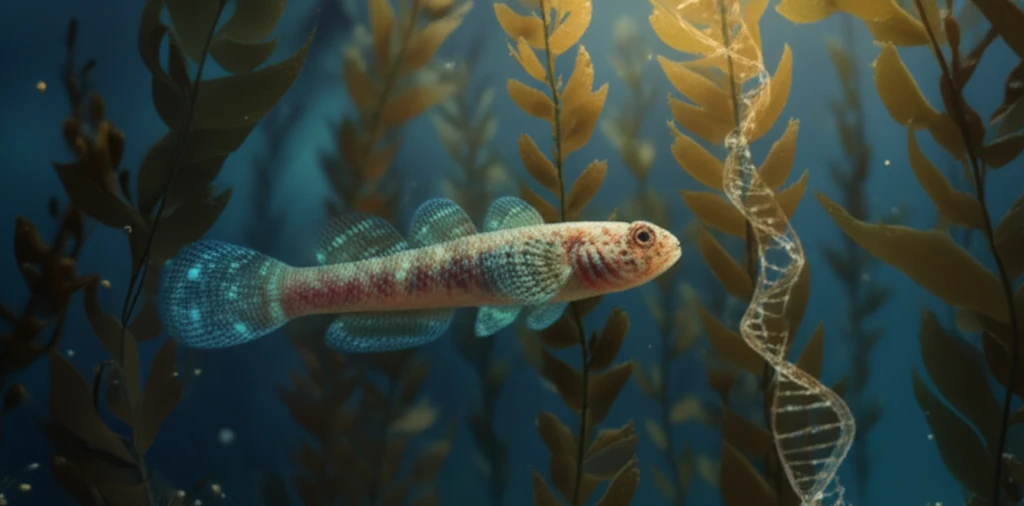
Unlocking the Secrets of Korea's Goby Fish: A Genetic Dive

"Researchers map the complete mitochondrial genomes of two Luciogobius species, revealing vital clues for conservation and understanding aquatic biodiversity."
The Luciogobius genus, a group of gobies, thrives primarily in Northeast Asia, with seven species calling Korean waters home. Despite their presence, a significant gap exists in our understanding of these creatures, particularly concerning their biological characteristics and genetic makeup. Understanding the genetic diversity within a species is crucial for effective conservation efforts and for grasping the broader picture of aquatic biodiversity.
A groundbreaking study has successfully mapped the complete mitochondrial genomes of two prominent Luciogobius species: Luciogobius grandis and Luciogobius elongatus. This achievement marks a significant leap forward in our knowledge of these fascinating fish and provides valuable data for future research and conservation initiatives.
By exploring the genetic intricacies of these gobies, we can gain deeper insights into their evolutionary history, ecological roles, and potential vulnerabilities. This newfound knowledge will empower us to make informed decisions about protecting these species and preserving the delicate balance of their aquatic ecosystems.
Decoding the Goby Genome: What the Data Reveals
The research team collected specimens of L. grandis and L. elongatus from Jangmok-myeon, Geoje-si, Gyoungsangnam-do, located on the southern coast of South Korea. After careful analysis, the mitogenomes of L. grandis and L. elongatus were found to be 16,477 bp and 16,486 bp long, respectively. These lengths align with those observed in other goby species, suggesting a conserved genome size within this family of fish.
- Most of the genes are encoded on the heavy strand of the mitochondrial DNA, except for one protein-coding gene (ND6) and eight transfer RNA genes.
- All protein-coding genes start with the standard ATG start codon, except for the COX1 gene, which uses GTG as a start codon. The GTG start codon has been seen in other Luciogobius species.
- In L. grandis, six PCGs stop with TAA, and three stop with TAG. In L. elongatus, seven PCGs stop with TAA, and two stop with TAG.
- Four PCGs (COX2, COX3, ND4, CYTB) in both species have incomplete stop codons, a common feature in vertebrate mitochondrial genes.
- The gene order and composition in L. grandis and L. elongatus match those of other gobies, including other Luciogobius species.
Conserving Korea's Aquatic Treasures: The Road Ahead
This study provides a crucial foundation for future research on Luciogobius species and related gobies. The detailed genetic information now available can be used to:
<ul><li>Distinguish between closely related species, improving taxonomic accuracy.</li><li>Assess the genetic diversity within and between populations, informing conservation strategies.</li><li>Investigate the evolutionary history and biogeography of these fish.</li></ul>
By continuing to explore the genetic secrets of these fascinating creatures, we can ensure their survival and protect the rich biodiversity of Korea's aquatic ecosystems for generations to come.