
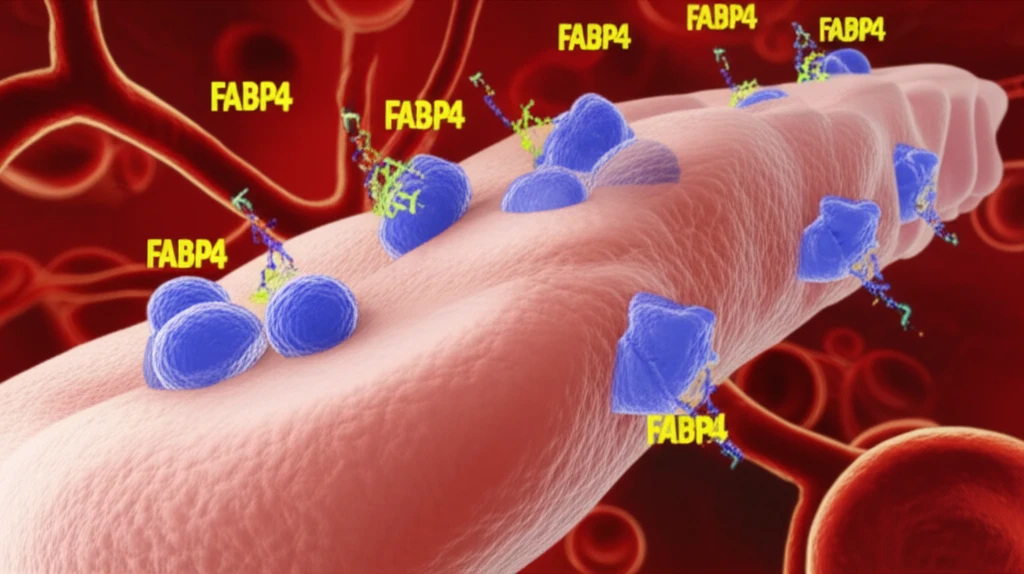
Illustration of endothelial cell with FABP4 molecules and CK1 gates.

Unlocking the Secrets of FABP4: How This Protein Impacts Your Health

"New research reveals the critical role of FABP4 and cytokeratin 1 in endothelial cell function, offering potential breakthroughs for treating metabolic diseases."


In an era where obesity and related metabolic disorders are increasingly prevalent, understanding the intricate mechanisms governing fat metabolism is more critical than ever. Adipose tissue dysfunction, driven by excess fat storage, leads to elevated levels of fatty acids in the bloodstream and the secretion of various adipose-derived factors, among which Fatty Acid-Binding Protein 4 (FABP4) stands out.

FABP4, a cytosolic protein primarily found in adipocytes, macrophages, and endothelial cells, has been linked to insulin resistance, type 2 diabetes, and cardiovascular diseases. This protein plays a crucial role in transporting fatty acids within cells, influencing how our bodies process and utilize fat. When the body is under conditions of high fat, FABP4 is actively released, acting as a signal that affects various cell types, including those lining our blood vessels.

Recent scientific investigations have focused on how circulating FABP4 affects the function of endothelial cells, which are vital for maintaining blood vessel health. Studies indicate that FABP4 can disrupt insulin signaling, leading to reduced nitric oxide production and, consequently, endothelial dysfunction—a key factor in the development of atherosclerosis. Understanding the molecular mechanisms that control how cells take up FABP4 is essential for developing new treatments.

Cytokeratin 1: The Unsuspected Gatekeeper of FABP4 Uptake

Illustration of endothelial cell with FABP4 molecules and CK1 gates.

Recent research sheds light on the interaction between FABP4 and cytokeratin 1 (CK1), a structural protein found on the surface of endothelial cells. This interaction is pivotal in regulating how endothelial cells take up FABP4. A study highlighted the direct binding of FABP4 to a specific region of CK1, specifically a sequence within the H1 subdomain. The study employed surface plasmon resonance (SPR) technology to monitor the direct interaction between the CK1 protein and recombinant FABP4, revealing that blocking CK1 expression significantly reduces the cellular uptake of FABP4.

Researchers monitored the direct interaction between FABP4 and CK1 using surface plasmon resonance and blocking exogenous FABP4 (eFABP4) cellular uptake by using specific siRNA to knock down the expression of CK1 in human umbilical vein endothelial cells (HUVECs).

  • CK1 and FABP4 Work Together: They physically and functionally interact in endothelial cells.
  • CK1's Role in Cellular Uptake: CK1 expression influences how cells uptake eFABP4 and mediates the effects of eFABP4-transported fatty acids, including inflammation and oxidative stress.
  • Potential Therapeutic Target: The interaction between CK1 and FABP4 in endothelial cell membranes could be targeted to prevent eFABP4-mediated endothelial dysfunction, offering a new approach to preventing cardiovascular diseases linked to obesity and diabetes.
These findings suggest that CK1 acts as a receptor-like protein, facilitating the entry of FABP4 into endothelial cells. By reducing CK1 levels, cells uptake less FABP4 which then decreases the activation of downstream inflammatory and oxidative stress pathways. This groundbreaking discovery highlights CK1 as a potential therapeutic target. Interventions that disrupt the CK1-FABP4 interaction could protect endothelial cells from the harmful effects of excess FABP4, potentially preventing the onset of cardiovascular and metabolic diseases.

Future Directions and Therapeutic Implications

The identification of CK1 as a key regulator of FABP4 uptake opens new avenues for therapeutic development. Future research will focus on fully elucidating the mechanisms by which CK1 and FABP4 interact and exploring the potential of CK1 inhibition as a strategy to combat endothelial dysfunction. By targeting this specific interaction, scientists hope to develop more effective treatments for metabolic and cardiovascular diseases, offering new hope for individuals at risk.

About this Article -

This article was crafted using a human-AI hybrid and collaborative approach. AI assisted our team with initial drafting, research insights, identifying key questions, and image generation. Our human editors guided topic selection, defined the angle, structured the content, ensured factual accuracy and relevance, refined the tone, and conducted thorough editing to deliver helpful, high-quality information.See our About page for more information.

Everything You Need To Know

1

What is FABP4 and why is it important for understanding metabolic diseases?

FABP4, or Fatty Acid-Binding Protein 4, is a protein found in adipocytes, macrophages, and endothelial cells. It plays a critical role in transporting fatty acids within cells, influencing how our bodies process and utilize fat. Understanding FABP4's function is crucial because it has been linked to insulin resistance, type 2 diabetes, and cardiovascular diseases, all of which are significant metabolic disorders. Its active release under high-fat conditions acts as a signal that affects various cell types, including those lining our blood vessels. Understanding FABP4 is thus key to finding new treatments.

2

How does FABP4 affect endothelial cell function and contribute to cardiovascular issues?

FABP4 can disrupt insulin signaling in endothelial cells, leading to reduced nitric oxide production. This disruption causes endothelial dysfunction, a key factor in the development of atherosclerosis. The molecular mechanisms that control how cells take up FABP4 are critical. Endothelial dysfunction is an early step in the progression of cardiovascular diseases, making the role of FABP4 in this process significant for therapeutic interventions. Further, when cytokeratin 1 interacts with FABP4, it can cause inflammation and oxidative stress.

3

What role does cytokeratin 1 (CK1) play in the uptake of FABP4 by cells, and why is this significant?

Cytokeratin 1 (CK1) acts as a gatekeeper for FABP4 uptake by endothelial cells. CK1, a structural protein found on the surface of these cells, directly binds to FABP4, specifically to a sequence within the H1 subdomain, facilitating its entry. This interaction is significant because reducing CK1 levels decreases the cellular uptake of FABP4, which in turn lowers the activation of downstream inflammatory and oxidative stress pathways. Consequently, the interaction between CK1 and FABP4 in endothelial cell membranes could be targeted to prevent FABP4-mediated endothelial dysfunction, offering a novel approach to preventing cardiovascular diseases linked to obesity and diabetes.

4

How can the interaction between CK1 and FABP4 be targeted for therapeutic purposes?

Given that CK1 facilitates the entry of FABP4 into endothelial cells, interventions that disrupt the CK1-FABP4 interaction could protect endothelial cells from the harmful effects of excess FABP4. By inhibiting or modulating the interaction between CK1 and FABP4, scientists aim to develop treatments that prevent the onset of cardiovascular and metabolic diseases. This approach may involve developing drugs that specifically block the binding of FABP4 to CK1 or that reduce the expression of CK1 on endothelial cells. Future research will focus on fully elucidating the mechanisms by which CK1 and FABP4 interact.

5

What are the future directions of research concerning FABP4 and CK1, and what therapeutic implications might arise from this research?

Future research will focus on elucidating the specific mechanisms by which CK1 and FABP4 interact and exploring the potential of CK1 inhibition as a therapeutic strategy to combat endothelial dysfunction. The goal is to develop more effective treatments for metabolic and cardiovascular diseases by targeting this specific interaction. This may involve exploring novel therapeutic agents that disrupt the CK1-FABP4 binding, reducing the cellular uptake of FABP4 and mitigating its harmful effects on endothelial cells. Success in this area could lead to new hope for individuals at risk of obesity-related cardiovascular complications.

Newsletter Subscribe

Subscribe to get the latest articles and insights directly in your inbox.