
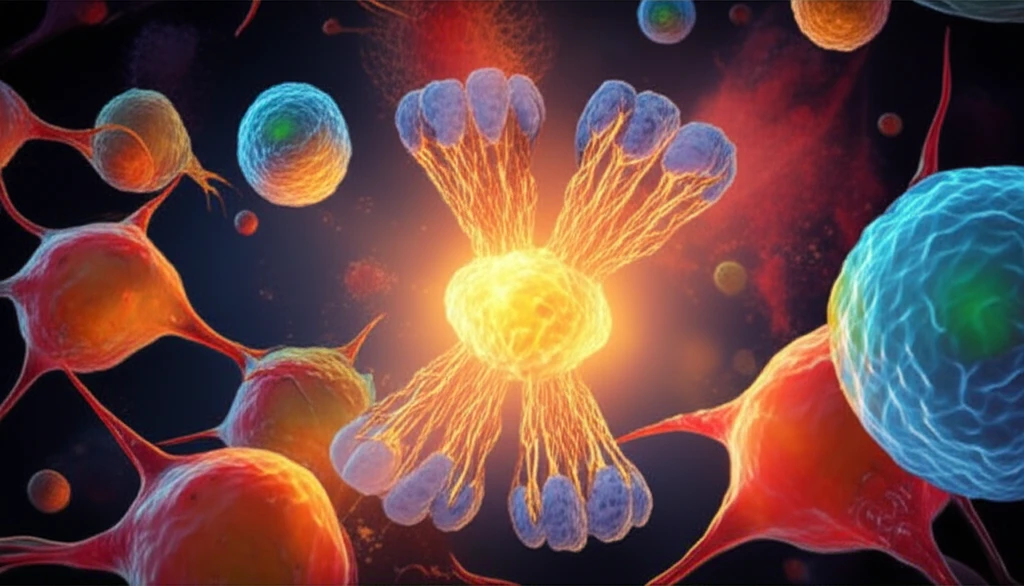
Unlocking the Secrets of Cell Behavior: How Cancer Research is Revolutionizing Our Understanding of Disease

"Exploring the intricate dance of cells, from normal function to the chaos of cancer, and the innovative research shedding light on this complex world."
The human body, a marvel of intricate design, functions thanks to the tireless efforts of trillions of cells. These microscopic units, each a world unto itself, work in harmony to keep us healthy and alive. But what happens when this delicate balance is disrupted? Cancer, a formidable foe, arises when cells begin to behave erratically, growing and dividing uncontrollably. Understanding the mechanisms that govern normal cell behavior and how they go awry in cancer is key to developing effective treatments and strategies for prevention.
This article dives into the fascinating realm of cancer research, with a specific focus on the interactions between cells, the behavior of a protein called survivin, and the process of programmed cell death, known as apoptosis. We will explore how scientists are using cell culture models to uncover the secrets of cancer development and progression, offering insights into the potential for new therapies.
Our journey will take us through the complex world of cellular communication, where the molecules and proteins orchestrate the symphony of life. We'll examine how the environment of a cell can influence its fate, the role of key players like E-cadherin, and how disruptions in these processes can lead to the uncontrolled growth that defines cancer. Prepare to discover the groundbreaking research that is reshaping our understanding of disease and paving the way for a healthier future.
The Dance of Life and Death: Unraveling the Role of Cell Interactions and Apoptosis
At the heart of every tissue and organ is a bustling community of cells, each interacting with its neighbors and the surrounding environment. These interactions are critical for maintaining tissue structure, function, and overall health. One key player in this cellular communication is E-cadherin, a protein that acts like a molecular "Velcro," binding cells together and helping them to form cohesive tissues. When E-cadherin functions correctly, it helps to keep cells in their place, preventing them from breaking away and spreading, which is a hallmark of cancer. However, the relationship between E-cadherin and cancer is not always simple. In some cases, E-cadherin expression decreases in tumor tissues.
- Cell-Cell Interactions: The way cells interact with their neighbors (trans interactions) and the surrounding environment (matrix interactions).
- E-Cadherin's Role: How E-cadherin facilitates the cell to cell connections.
- Apoptosis: Process of programmed cell death
- Survivin’s Role: A protein involved in cell cycle progression and apoptosis inhibition
- How these factors can influence cancer development and progression.
A Brighter Future: The Promise of Cancer Research
The research discussed in this article provides just a glimpse of the remarkable progress being made in the fight against cancer. By understanding the intricate mechanisms that govern cell behavior, scientists are developing new strategies to target cancer cells and improve patient outcomes. As we continue to unravel the secrets of cellular life and death, we move closer to a future where cancer is no longer a feared disease, but a manageable condition. The dedication and innovation of researchers worldwide offer hope for a healthier and brighter tomorrow.