
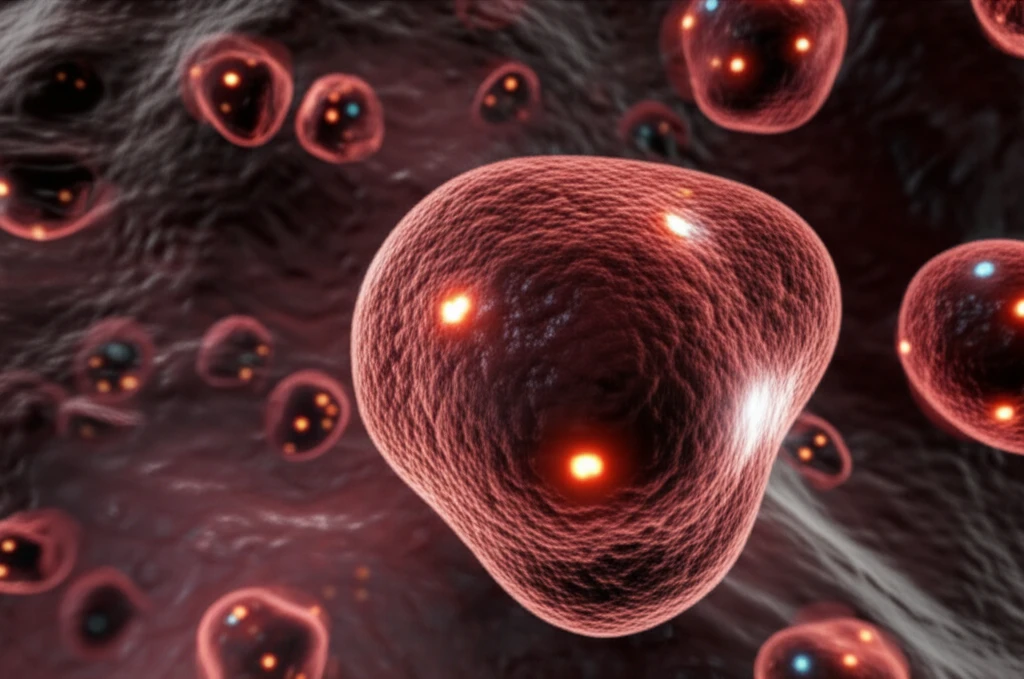
Microscopic view of tongue cancer cells with glowing CCR4 receptors.

Unlocking the Secret to Oral Cancer Survival: Is CCR4 the Key?

"New research identifies CCR4 as a potential game-changer in predicting and treating early-stage oral tongue cancer."


Oral cancer, particularly tongue cancer, poses a significant threat, with its ability to spread and resist treatment. While advances have been made, predicting its behavior, especially in early stages, remains a challenge. Imagine a future where doctors could accurately foresee the course of the disease and tailor treatment accordingly. That future may be closer than we think.

New research is shedding light on a molecule called CCR4 and its surprising link to the progression of early-stage oral tongue cancer. Chemokine receptors like CCR4 act as messengers, influencing how cancer cells move and spread. Understanding their role could be a game-changer in how we treat this disease.

This article breaks down the groundbreaking study, explaining how CCR4 expression could serve as a potential biomarker – a signpost that helps predict survival rates and recurrence in patients with early-stage oral tongue cancer. We'll explore the implications of this discovery, offering a beacon of hope for more effective, targeted therapies.

CCR4: A Double-Edged Sword in Oral Cancer?

Microscopic view of tongue cancer cells with glowing CCR4 receptors.

The study, published in the Journal of Oral and Maxillofacial Surgery, investigated CCR4 expression in patients with histologically node-negative (pN0) oral tongue cancer – meaning the cancer hadn't visibly spread to the lymph nodes. Researchers analyzed data from 128 tongue cancerous samples, looking at the relationship between CCR4 levels, clinical characteristics, and patient survival.

Here's what they found:

  • CCR4 is Highly Expressed in Tumor Tissues: Cancer cells showed significantly higher levels of CCR4 compared to normal tongue tissue.
  • Linked to Tumor Stage: Higher CCR4 expression was associated with more advanced tumor stages.
  • Poorer Survival Rates: Patients with CCR4-positive tumors experienced poorer overall and disease-free survival rates.
  • Independent Risk Factor: CCR4 expression emerged as an independent factor for unfavorable outcomes, meaning its impact was significant regardless of other known risk factors.
In essence, the study suggests that CCR4 acts like a switch, potentially driving cancer progression even in its early stages. While the absence of lymph node involvement is typically a positive sign, high CCR4 expression could signal a more aggressive form of the disease.

A New Era of Personalized Oral Cancer Treatment?

This research offers a significant step towards personalized medicine in oral cancer. By identifying CCR4 as a potential prognostic biomarker, doctors may be able to:

<ul><li>Identify High-Risk Patients Earlier: CCR4 expression could help pinpoint individuals with early-stage cancer who are more likely to experience recurrence or poorer outcomes.</li><li>Tailor Treatment Strategies: Patients with high CCR4 expression might benefit from more aggressive or targeted therapies.</li><li>Develop New Therapies: CCR4 itself could become a target for novel drugs designed to block its activity and slow cancer progression.</li></ul>

While further research is needed, this study provides a compelling rationale for exploring CCR4-targeted therapies and incorporating CCR4 expression into routine clinical assessments. As we continue to unravel the complexities of oral cancer, discoveries like this offer hope for a future where every patient receives the most effective, personalized care possible.

About this Article -

This article was crafted using a human-AI hybrid and collaborative approach. AI assisted our team with initial drafting, research insights, identifying key questions, and image generation. Our human editors guided topic selection, defined the angle, structured the content, ensured factual accuracy and relevance, refined the tone, and conducted thorough editing to deliver helpful, high-quality information.See our About page for more information.

This article is based on research published under:

DOI-LINK: 10.1016/j.joms.2018.09.035, Alternate LINK

Title: Ccr4 Expression Is Associated With Poor Prognosis In Patients With Early Stage (Pn0) Oral Tongue Cancer

Subject: Otorhinolaryngology

Journal: Journal of Oral and Maxillofacial Surgery

Publisher: Elsevier BV

Authors: Lei Wang, Mei Zhang, Yuntao Zhu, Xin Zhang, Yongmei Yang, Chuanxin Wang

Published: 2019-02-01

Everything You Need To Know

1

What is CCR4 and why is it important?

The molecule CCR4 is a chemokine receptor. It acts as a messenger, influencing how cancer cells move and spread. The research indicates that CCR4 is highly expressed in oral tongue cancer tissues compared to normal tongue tissue, and its presence is linked to more advanced tumor stages and poorer survival rates. Therefore, CCR4 is a crucial factor to consider in oral cancer.

2

How was the research on CCR4 conducted?

Researchers investigated CCR4 expression in patients with histologically node-negative (pN0) oral tongue cancer. They looked at the relationship between CCR4 levels, clinical characteristics, and patient survival. The study involved 128 tongue cancerous samples, analyzing the correlation between CCR4 expression, tumor stages, and the survival rates of the patients. The key finding was that CCR4 expression can serve as a potential prognostic biomarker, helping predict survival rates and recurrence in patients with early-stage oral tongue cancer.

3

What is the significance of CCR4 in the context of this research?

The significance of CCR4 lies in its potential as a prognostic biomarker, which could revolutionize oral cancer treatment. If CCR4 expression is high, it could signal a more aggressive form of the disease even in early stages. This knowledge could lead to more effective, targeted therapies. By identifying CCR4, doctors may be able to predict the course of the disease and tailor treatment accordingly, leading to better prognoses for patients with oral tongue cancer.

4

What are the implications of CCR4's role in oral cancer?

The implications of CCR4's role include the potential for more personalized medicine in treating oral cancer. Doctors could use CCR4 expression as a guide to determine the aggressiveness of the cancer and choose appropriate treatment strategies. High CCR4 expression in early-stage oral tongue cancer could indicate a need for more aggressive treatments, while low expression might suggest a less aggressive approach. This could lead to better outcomes and survival rates.

5

What does it mean that CCR4 is an independent risk factor?

The study suggests that CCR4 expression could be an independent risk factor for unfavorable outcomes in oral tongue cancer. This means that its impact is significant regardless of other known risk factors. High CCR4 expression is associated with more advanced tumor stages and poorer survival rates. The research implies that CCR4 acts like a switch, potentially driving cancer progression even in its early stages. Thus, the presence or absence of CCR4 becomes a crucial factor.

Newsletter Subscribe

Subscribe to get the latest articles and insights directly in your inbox.