
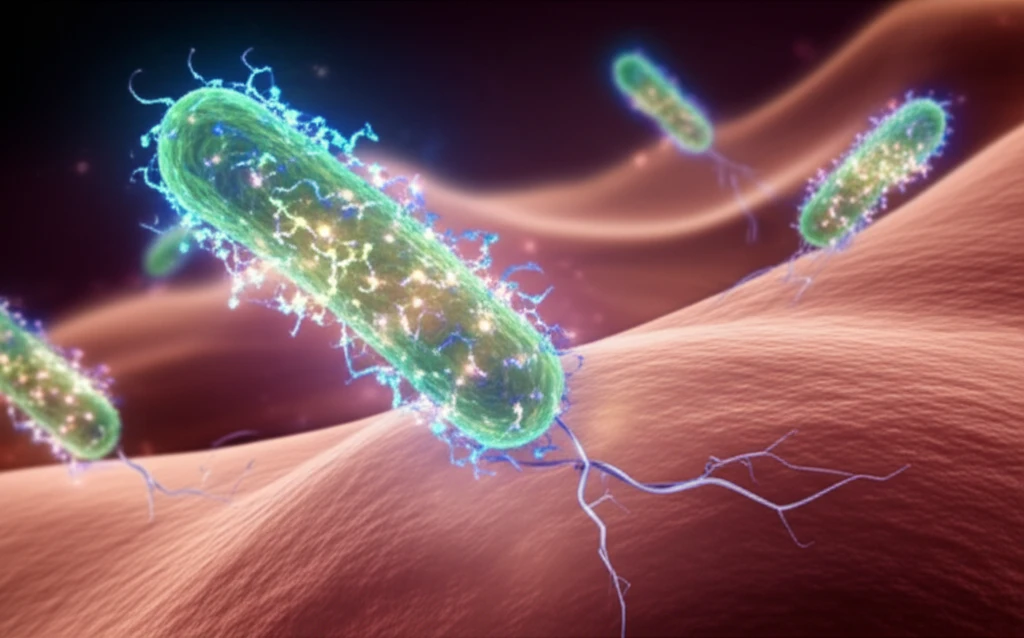
Unlocking the Potential of Probiotics: New Insights into Lactobacillus S-Layer Proteins

"Scientists are exploring the hidden capabilities of Lactobacillus acidophilus by studying its silent slpB gene and comparing it to its active counterpart, slpA, for enhanced probiotic applications."
Probiotics, like Lactobacillus, play a vital role in maintaining gut health by balancing bacteria, preventing harmful microbes, producing antimicrobial molecules, and boosting immunity. A crucial aspect of their effectiveness is their ability to adhere to intestinal cells.
This adhesion capability allows probiotics to interact with the host, influencing immune responses and interfering with pathogen adhesion. Lactobacillus S-layer proteins are key players in this process, facilitating attachment to host cells, gastrointestinal tissue, and the extracellular matrix.
S-layer proteins, forming a lattice-like structure on the bacterial surface, vary in mass and display different symmetries. Researchers are keenly interested in understanding the structure, chemistry, and genetics of these proteins to harness their potential. This study focuses on comparing two S-layer proteins, SlpA and SlpB, in Lactobacillus acidophilus NCFM to unlock new biotechnological applications.
SlpA vs. SlpB: Decoding the Differences and Unlocking Probiotic Potential
Lactobacillus acidophilus possesses two S-layer protein genes: slpA, which is active under normal conditions, and slpB, which remains silent. This study successfully cloned and expressed the slpB gene, creating a recombinant protein (His-SlpB) for detailed analysis. The researchers then compared His-SlpB to the naturally expressed SlpA protein.
- Successful Expression of Silent Gene: The slpB gene, normally silent, was successfully expressed and purified, creating a His-SlpB fusion protein.
- Structural Similarities: Both SlpA and SlpB exhibited high β-sheet content and low α-helix structure, suggesting similar structural properties.
- Adhesion Differences: SlpA demonstrated superior adhesion to Caco-2 cells compared to SlpB, indicating functional differences.
Future Directions and Implications for Probiotic Development
This research provides a foundation for understanding the functional differences between SlpA and SlpB, two S-layer proteins in Lactobacillus acidophilus. By successfully expressing the silent slpB gene and comparing its protein to SlpA, the study opens new avenues for exploring the potential of S-layer proteins in probiotic applications.
The finding that SlpA exhibits higher adhesion to intestinal cells suggests its importance in probiotic efficacy. Future studies could focus on manipulating the expression of S-layer proteins to enhance adhesion and improve probiotic performance. Understanding the mechanisms behind S-layer protein adhesion could lead to the development of targeted probiotics with enhanced functionality.
Furthermore, exploring the structure and function of SlpB could reveal its unique properties and potential applications. While SlpA may be more effective for adhesion, SlpB might possess other beneficial characteristics. Further research into the silent slpB gene in Lactobacillus and other bacteria has the potential to unlock novel strategies for improving gut health and developing next-generation probiotics.