
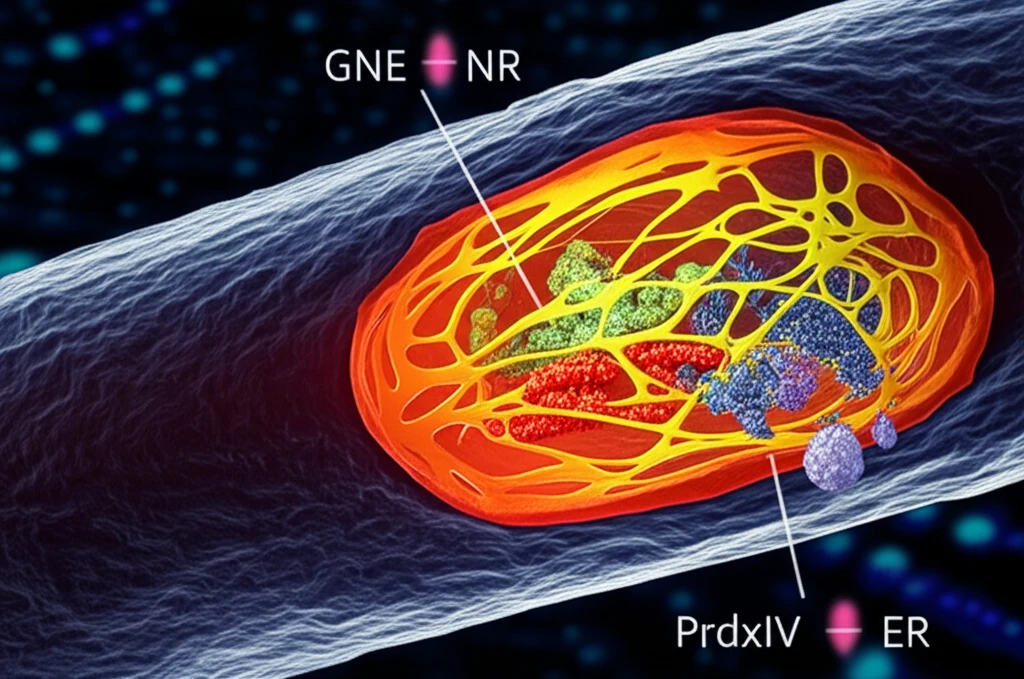
Illustration of a muscle fiber cell with an affected ER network due to GNE myopathy.

Unlocking the Mystery: How a Rare Genetic Disorder Impacts Muscle Health

"Exploring GNE Myopathy: The Genetic Culprit Behind Muscle Weakness and the Promise of Future Treatments"


Imagine a life where everyday movements become a challenge, where muscles gradually lose their strength, and where the cause remains a mystery. This is the reality for individuals with GNE myopathy, a rare genetic disorder that primarily affects muscle function. Characterized by progressive muscle weakness, this condition emerges in early adulthood, slowly eroding the ability to perform simple tasks.

GNE myopathy is caused by mutations in the GNE gene, responsible for producing an enzyme critical for the synthesis of sialic acid. This acid plays a vital role in the proper function of various cellular processes. Consequently, the mutations lead to a cascade of cellular malfunctions, including hyposialylation (insufficient sialic acid) of glycoproteins, the body's cellular building blocks.

While hyposialylation has been a primary suspect in the disease's progression, the intricate mechanisms behind muscle wasting and the overall impact on cellular processes have remained elusive. Recent research has begun to unravel the complex interplay of cellular functions affected by GNE mutations, opening new avenues for understanding and, ultimately, treating this challenging condition. This article will provide a deep dive into the intricacies of GNE myopathy, focusing on the latest findings and potential therapeutic strategies.

Deciphering the Cellular Impact: How GNE Mutations Disrupt Muscle Health

Illustration of a muscle fiber cell with an affected ER network due to GNE myopathy.

The impact of GNE mutations extends far beyond the realm of sialic acid production. Scientists have discovered that GNE also influences crucial cellular functions like cell adhesion, apoptosis (programmed cell death), and the regulation of other cellular processes. One study examined the effect of mutant GNE proteins on human cells, focusing on a type of cell called HEK293, and found that several proteins were affected, leading to a better understanding of the condition.

One of the key findings of the research points to the critical role of a protein called Peroxiredoxin IV (PrdxIV). PrdxIV is an ER-resident H2O2 sensor that regulates neurogenesis, meaning that it acts as a sensor for hydrogen peroxide (H2O2) within the endoplasmic reticulum (ER). The ER is a vital cellular compartment responsible for protein folding and other essential functions. The study revealed that GNE mutations significantly reduced the levels of PrdxIV.

  • GNE myopathy is a rare genetic disorder causing progressive muscle weakness.
  • Mutations in the GNE gene disrupt sialic acid production and other cellular functions.
  • The protein PrdxIV plays a crucial role in regulating oxidative stress within the endoplasmic reticulum (ER).
  • The study indicates that reduced PrdxIV levels affect the ER redox state, contributing to protein misfolding and aggregation.
  • This research opens up new therapeutic avenues for GNE myopathy.
The reduction in PrdxIV levels has significant consequences within the cell. Because PrdxIV plays a role in maintaining the delicate balance of the ER, its deficiency leads to an altered ER redox state. This imbalance contributes to misfolding and aggregation of proteins, further exacerbating the cellular dysfunction in GNE myopathy. The altered ER redox state may contribute to misfolding and aggregation of proteins, exacerbating the cellular dysfunction in GNE myopathy.

Looking Ahead: Hope for Improved Treatments and a Better Quality of Life

The ongoing research into GNE myopathy offers a beacon of hope for those affected by this condition. By identifying the impact of GNE mutations on cellular processes, scientists are paving the way for developing targeted therapies. Future research efforts will focus on understanding the role of PrdxIV and the ER redox state and how to restore them, potentially slowing the progression of the disease and improving the quality of life for individuals with GNE myopathy.

About this Article -

This article was crafted using a human-AI hybrid and collaborative approach. AI assisted our team with initial drafting, research insights, identifying key questions, and image generation. Our human editors guided topic selection, defined the angle, structured the content, ensured factual accuracy and relevance, refined the tone, and conducted thorough editing to deliver helpful, high-quality information.See our About page for more information.

This article is based on research published under:

DOI-LINK: 10.1007/s12017-017-8467-5, Alternate LINK

Title: Mutation In Gne Downregulates Peroxiredoxin Iv Altering Er Redox Homeostasis

Subject: Cellular and Molecular Neuroscience

Journal: NeuroMolecular Medicine

Publisher: Springer Science and Business Media LLC

Authors: Pratibha Chanana, Gayatri Padhy, Kalpana Bhargava, Ranjana Arya

Published: 2017-09-11

Everything You Need To Know

1

What is GNE myopathy and how does it affect those who have it?

GNE myopathy is a rare genetic disorder characterized by progressive muscle weakness. It stems from mutations in the GNE gene, which disrupts the normal production of sialic acid. This disruption impacts various cellular functions, ultimately leading to muscle wasting and impaired movement, typically emerging in early adulthood.

2

How do mutations in the GNE gene cause muscle weakness in GNE myopathy?

Mutations in the GNE gene impair the production of sialic acid, which is crucial for many cellular processes. This deficiency, known as hyposialylation, affects glycoproteins. The GNE mutations also disrupt other cellular functions such as cell adhesion and apoptosis. The dysfunction of Peroxiredoxin IV (PrdxIV), a protein which acts as a sensor for hydrogen peroxide, also contributes to GNE myopathy.

3

What is the significance of Peroxiredoxin IV (PrdxIV) in understanding GNE myopathy?

Peroxiredoxin IV (PrdxIV) is a key protein residing in the endoplasmic reticulum (ER) that acts as a sensor for hydrogen peroxide. Research indicates that GNE mutations lead to reduced levels of PrdxIV, disrupting the ER redox state. This imbalance causes protein misfolding and aggregation, exacerbating cellular dysfunction. Thus, understanding PrdxIV's role is crucial for developing potential therapies for GNE myopathy.

4

What are the potential therapeutic strategies being explored for GNE myopathy, based on recent research?

Current research is focused on understanding how GNE mutations impact cellular processes, particularly the role of Peroxiredoxin IV (PrdxIV) and the ER redox state. Potential therapeutic strategies involve finding ways to restore PrdxIV levels and correct the ER redox imbalance. By targeting these specific mechanisms, researchers hope to slow the progression of the disease and improve the quality of life for those affected by GNE myopathy. Future therapies might also target cell adhesion and apoptosis, which are also affected by GNE mutations.

5

Beyond muscle weakness, how do GNE mutations impact other cellular functions, and what are the implications for individuals with GNE myopathy?

GNE mutations extend beyond sialic acid production and directly influence critical cellular functions such as cell adhesion, apoptosis (programmed cell death), and the regulation of other cellular processes. This broad impact suggests that GNE myopathy is not solely a muscle disorder but a systemic cellular dysfunction. Individuals with GNE myopathy may experience a range of symptoms beyond muscle weakness, potentially affecting various organs and systems. Further research is needed to fully understand these broader implications and develop comprehensive treatment strategies.

Newsletter Subscribe

Subscribe to get the latest articles and insights directly in your inbox.