
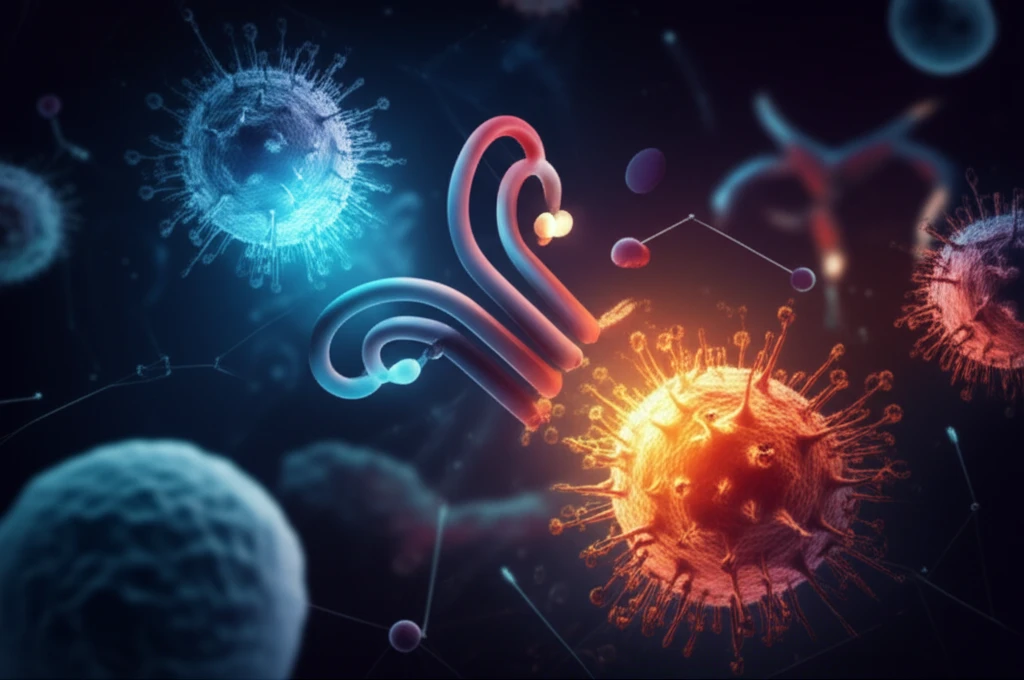
Illustration of a bispecific antibody targeting cancer cells. The antibody is central to the image, symbolizing precision medicine.

Unlocking the Future: A Deep Dive into Bispecific Antibodies and Their Revolutionary Potential

"From Targeted Therapies to Cutting-Edge Treatments: Exploring the Science and Promise of Bispecific Antibodies"


Imagine a world where medical treatments can precisely target diseases, minimizing harm to healthy cells. That future is closer than ever, thanks to the innovative field of bispecific antibodies (bsAbs). Unlike traditional antibodies that target a single molecule, bsAbs are engineered to recognize two different targets simultaneously, offering a new level of precision and efficacy.

This article will explore the fascinating realm of bsAbs, delving into their unique mechanisms, advantages, and the transformative potential they hold for various diseases, especially in the realm of cancer therapy. We will also look at the challenges in producing these complex molecules and the innovative strategies scientists are employing to overcome these hurdles.

Get ready to unlock the secrets behind these cutting-edge therapies and discover how they are reshaping the landscape of modern medicine. From their design and production to their real-world applications, we'll provide a comprehensive overview of bsAbs, their impact on healthcare, and the exciting possibilities they unlock for the future of treatment.

What are Bispecific Antibodies and How Do They Work?

Illustration of a bispecific antibody targeting cancer cells. The antibody is central to the image, symbolizing precision medicine.

At the heart of bsAbs lies a simple yet powerful concept: they are designed to bind to two different targets at the same time. These targets can be anything from two different proteins on a cancer cell to a cancer cell and an immune cell, like a T-cell. This dual targeting ability sets bsAbs apart, allowing them to perform functions traditional antibodies cannot.

The creation of bsAbs involves intricate protein engineering. Scientists carefully design these molecules to bind to two specific targets. The bsAb can work in various ways, depending on the targets and the desired effect. For example, they can bring cancer cells and immune cells together to enhance the immune system's ability to destroy cancer cells. They can also block two different pathways involved in cancer growth or neutralize two disease-causing agents simultaneously.

  • Dual Targeting: bsAbs bind to two distinct targets, enabling precise and versatile therapeutic actions.
  • Enhanced Immune Response: They can recruit and activate immune cells to fight cancer more effectively.
  • Blocking Multiple Pathways: bsAbs can disrupt multiple disease pathways at once, providing a more comprehensive approach.
  • Versatile Applications: The technology is applicable to many diseases, including cancer, autoimmune disorders, and infectious diseases.
The ability to target multiple targets and to engage the immune system makes bsAbs a powerful tool. Their ability to tackle complex diseases by hitting multiple targets at once makes them very attractive for many areas of medicine.

The Future of Bispecific Antibodies

BsAbs represent a major leap forward in medical science. They are not just a new treatment; they are a new way of thinking about disease. As research continues and the technology matures, we can expect to see more bsAbs approved for clinical use, offering hope and new possibilities for patients. The future of medicine is here, and it's bispecific.

About this Article -

This article was crafted using a human-AI hybrid and collaborative approach. AI assisted our team with initial drafting, research insights, identifying key questions, and image generation. Our human editors guided topic selection, defined the angle, structured the content, ensured factual accuracy and relevance, refined the tone, and conducted thorough editing to deliver helpful, high-quality information.See our About page for more information.

This article is based on research published under:

DOI-LINK: 10.1016/j.pep.2018.11.011, Alternate LINK

Title: A Brief Introduction Of Igg-Like Bispecific Antibody Purification: Methods For Removing Product-Related Impurities

Subject: Biotechnology

Journal: Protein Expression and Purification

Publisher: Elsevier BV

Authors: Yifeng Li

Published: 2019-03-01

Everything You Need To Know

1

What are bispecific antibodies (bsAbs), and what makes them different from traditional antibodies?

Bispecific antibodies (bsAbs) are engineered antibodies designed to bind to two different targets simultaneously. Unlike traditional antibodies that target only one molecule, bsAbs' dual-targeting capability allows them to perform functions that traditional antibodies cannot, such as bringing immune cells into close proximity with cancer cells, or blocking two different pathways involved in cancer growth at the same time.

2

How do bispecific antibodies enhance the immune system's ability to fight cancer?

Bispecific antibodies (bsAbs) can enhance the immune system by bringing cancer cells and immune cells, such as T-cells, together. This close proximity activates the immune cells, boosting their ability to recognize and destroy cancer cells more effectively. This method of action is particularly valuable in cancers that evade normal immune responses.

3

Beyond cancer, what other types of diseases could bispecific antibodies potentially treat?

While bispecific antibodies (bsAbs) are significantly impacting cancer therapy, their applications extend to autoimmune disorders and infectious diseases. In autoimmune diseases, bsAbs can be designed to modulate the immune response. For infectious diseases, they can neutralize multiple disease-causing agents simultaneously, offering a broad spectrum approach to treatment. Although this potential is significant, it requires careful engineering of the bsAb to ensure specificity and minimize off-target effects.

4

What are some of the challenges involved in the design and production of bispecific antibodies?

The design and production of bispecific antibodies (bsAbs) present several challenges due to their complex structure. Engineering these molecules to bind to two specific targets requires intricate protein engineering. Ensuring that the bsAb has high specificity for its intended targets, while minimizing off-target binding and potential toxicity, is crucial. Producing bsAbs at a large scale, while maintaining their stability and activity, also poses a significant hurdle. Scientists are actively developing innovative strategies to overcome these production and design challenges.

5

In what ways do bispecific antibodies represent a new way of thinking about disease treatment, and what future advancements can we expect in this field?

Bispecific antibodies (bsAbs) represent a shift from traditional, single-target therapies to a more comprehensive approach that addresses the complexity of diseases. By targeting multiple pathways or bringing different cells together, bsAbs offer enhanced efficacy and versatility. Future advancements in this field may include the development of more sophisticated bsAbs with improved targeting capabilities, reduced immunogenicity, and enhanced delivery methods. As research continues and the technology matures, we can expect to see more bsAbs approved for clinical use, offering hope and new possibilities for patients.

Newsletter Subscribe

Subscribe to get the latest articles and insights directly in your inbox.