
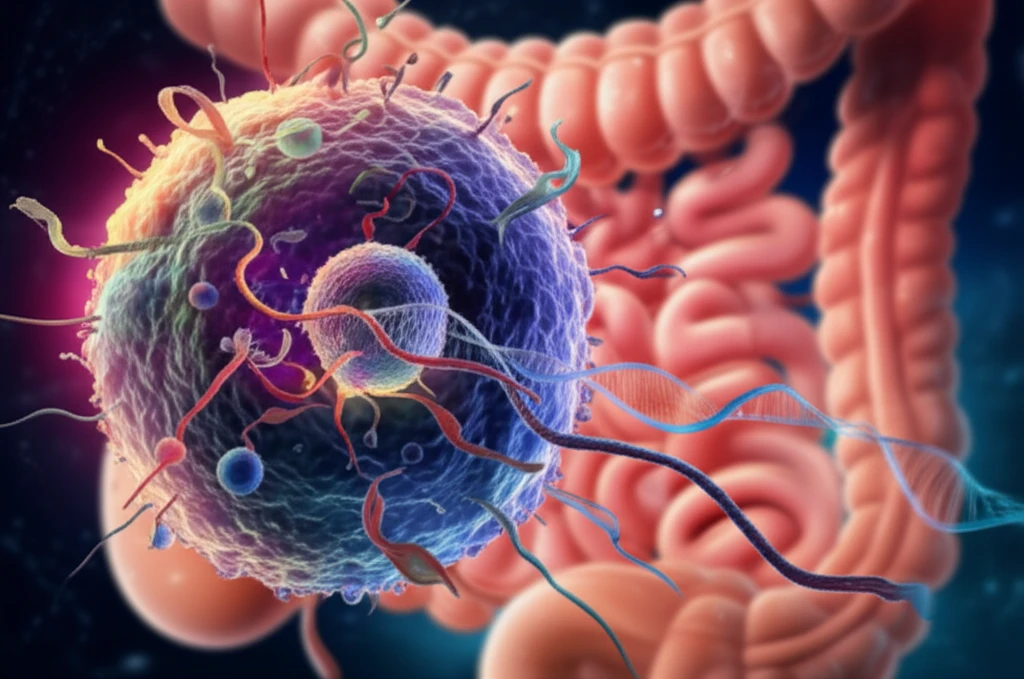
Illustration of a colon cancer cell with disrupted DNA strands, symbolizing frameshift mutations.

Unlocking the Code: How Gene Mutations Offer New Clues in Colon Cancer Treatment

"A deeper look into frameshift mutations and their potential to revolutionize colon cancer therapies."


Colon cancer remains a significant health challenge, but groundbreaking research is offering new hope. Scientists are increasingly focusing on the role of specific gene mutations in the development and progression of this disease. Understanding these mutations is crucial for creating more effective and personalized treatments.

Among the various genetic alterations, frameshift mutations—where the DNA sequence is disrupted—are proving particularly relevant. These mutations can alter the way proteins are made, impacting cellular functions and potentially driving cancer growth. Identifying and studying these mutations can lead to innovative therapeutic strategies.

A recent study published in Pathology and Oncology Research delves into the prevalence and significance of frameshift mutations in several genes linked to colon cancer. This research highlights how genes like ANK3, HACD4, TP53BP1, and MFN1, among others, exhibit these mutations, especially in tumors with high microsatellite instability (MSI-H). This discovery opens exciting new possibilities for targeted therapies.

What are Frameshift Mutations and Why Do They Matter in Colon Cancer?

Illustration of a colon cancer cell with disrupted DNA strands, symbolizing frameshift mutations.

Frameshift mutations occur when there’s an insertion or deletion of nucleotides (the building blocks of DNA) in a gene sequence. This shift alters the reading frame, causing the genetic code to be read incorrectly. As a result, the protein produced from the mutated gene is often non-functional or has a different function altogether. In the context of colon cancer, frameshift mutations can disrupt the normal activity of tumor suppressor genes.

The study focused on genes with mononucleotide repeats—sequences where the same nucleotide (A, T, C, or G) is repeated multiple times. These repeats are prone to mutations, especially in tumors with high microsatellite instability (MSI-H). MSI-H tumors have a defect in their DNA repair mechanisms, leading to a higher rate of mutations. The researchers analyzed 124 colorectal cancer (CRC) samples, categorizing them by MSI status to identify frameshift mutations in key genes.

  • ANK3: Involved in cell survival and detachment-induced apoptosis.
  • TP53BP1: Interacts with the tumor suppressor protein p53.
  • MFN1: Encodes a mitochondrial membrane protein involved in mitochondrial fusion and apoptosis.
  • HACD4 and TCP10L: Involve fatty acid synthesis and transcription regulation.
  • LCMT2, RNMT, TRMT6, METTL8, and METTL16: Involved in DNA methylation processes.
The findings revealed that several of these genes harbored frameshift mutations in MSI-H CRC samples. For example, ANK3 showed mutations in 13.9% of MSI-H CRCs, while TP53BP1 had mutations in 6.3% of cases. These mutations were conspicuously absent in microsatellite stable (MSS) cancers, underscoring their link to MSI-H. Furthermore, some cases exhibited intratumoral heterogeneity (ITH), meaning that the mutations were not uniformly present throughout the tumor, adding another layer of complexity.

The Future of Colon Cancer Treatment: Personalized Approaches

The study underscores the potential of targeting frameshift mutations for colon cancer therapy, suggesting that identifying these mutations could help tailor treatments to individual patients, especially those with MSI-H tumors. As research continues, it is vital to delve deeper into the functional consequences of these mutations and explore how they can be exploited for therapeutic benefit. This research contributes to the growing understanding of the molecular landscape of colon cancer, paving the way for more effective and personalized treatment strategies.

About this Article -

This article was crafted using a human-AI hybrid and collaborative approach. AI assisted our team with initial drafting, research insights, identifying key questions, and image generation. Our human editors guided topic selection, defined the angle, structured the content, ensured factual accuracy and relevance, refined the tone, and conducted thorough editing to deliver helpful, high-quality information.See our About page for more information.

Everything You Need To Know

1

What exactly are frameshift mutations, and how do they contribute to the development of colon cancer?

Frameshift mutations are alterations in the DNA sequence caused by the insertion or deletion of nucleotides. This disrupts the reading frame, leading to the production of non-functional proteins or proteins with altered functions. In colon cancer, these mutations can affect genes like ANK3, HACD4, TP53BP1, and MFN1, among others. These genes play crucial roles in cell survival, apoptosis, and other cellular functions. When these genes are disrupted by frameshift mutations, it can lead to uncontrolled cell growth and tumor development. The study showed that these mutations are significantly linked with MSI-H tumors, which have deficiencies in DNA repair mechanisms, leading to a higher rate of these frameshift mutations.

2

Which specific genes are most commonly affected by frameshift mutations in colon cancer, and what are their roles?

The study identified several genes, including ANK3, TP53BP1, MFN1, and HACD4, as frequently harboring frameshift mutations in colon cancer, particularly in MSI-H tumors. ANK3 is involved in cell survival and detachment-induced apoptosis. TP53BP1 interacts with the tumor suppressor protein p53. MFN1 encodes a mitochondrial membrane protein involved in mitochondrial fusion and apoptosis. HACD4 and TCP10L involve fatty acid synthesis and transcription regulation. LCMT2, RNMT, TRMT6, METTL8, and METTL16 are involved in DNA methylation processes. The disruption of these genes due to frameshift mutations can impair essential cellular functions, promoting cancer progression.

3

What is the significance of microsatellite instability (MSI-H) in relation to frameshift mutations in colon cancer?

MSI-H (high microsatellite instability) tumors have defects in their DNA repair mechanisms, leading to a higher rate of mutations, including frameshift mutations. The study found that frameshift mutations in genes like ANK3, TP53BP1, MFN1, and HACD4 were significantly more prevalent in MSI-H colon cancers compared to microsatellite stable (MSS) cancers. This suggests a strong link between MSI-H status and the occurrence of frameshift mutations. The absence of these mutations in MSS cancers underscores their association with MSI-H and the importance of understanding the underlying DNA repair deficiencies.

4

How can the identification of frameshift mutations lead to more personalized treatment approaches for colon cancer?

Identifying frameshift mutations can help tailor treatments to individual patients, especially those with MSI-H tumors. The presence or absence of these mutations in genes like ANK3, TP53BP1, MFN1, and HACD4 can serve as a biomarker to guide treatment decisions. If a patient's tumor is found to have specific frameshift mutations, targeted therapies that address the consequences of those mutations can be considered. This personalized approach could lead to more effective treatments and improved patient outcomes by focusing on the specific genetic alterations driving the cancer's growth.

5

Beyond the genes mentioned, what other genes are involved in the DNA methylation processes, and what is the significance of their mutations?

In addition to the genes discussed in the study, genes such as LCMT2, RNMT, TRMT6, METTL8, and METTL16, which are involved in DNA methylation processes, can also harbor frameshift mutations. DNA methylation is a crucial epigenetic mechanism that can regulate gene expression. These mutations can disrupt the normal methylation patterns, leading to altered gene expression and potentially contributing to cancer development. The study highlights the importance of understanding these broader genetic and epigenetic alterations to develop comprehensive therapeutic strategies.

Newsletter Subscribe

Subscribe to get the latest articles and insights directly in your inbox.