
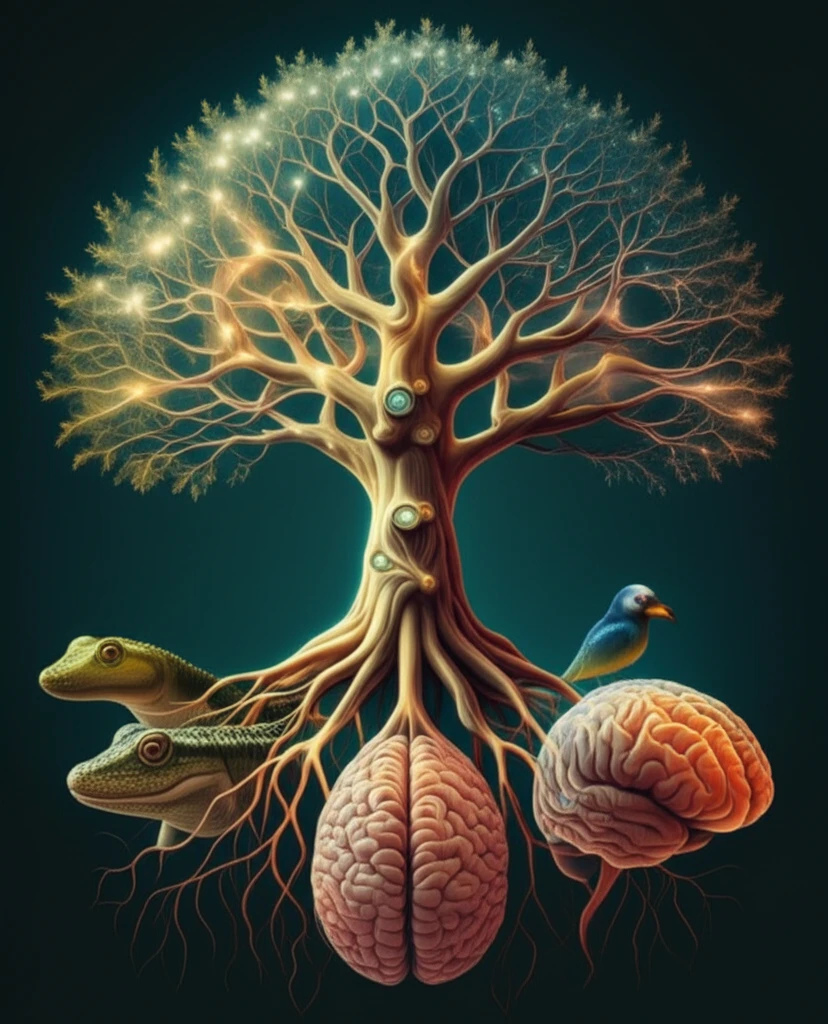
Unlocking the Brain's GPS: How Comparative Anatomy Illuminates the Hippocampus

"Exploring the evolutionary journey of the hippocampus, from reptiles to mammals, and what it means for understanding memory and spatial navigation."
What can we learn by comparing the brains of different animals, particularly when it comes to a structure as crucial as the hippocampus? This question isn't as straightforward as it seems. It depends on what we hope to achieve through such comparisons and, fundamentally, what we consider to be the hippocampus in the first place.
In this article, we will delve into the essential considerations for conducting meaningful comparative studies of the hippocampus. To make valid comparisons, we need a clear definition of what constitutes the hippocampus, including its subdivisions and the relevant circuitry levels. As we will see, defining these elements, as well as the level of biological classification (species, family, order), depends heavily on the available data.
We'll adopt a pragmatic approach, focusing on available data relevant to our narrative and emphasizing connectivity patterns as a powerful tool for proposing potential homologies in the hippocampus across species. Consider this a companion piece emphasizing the 'wiring' that defines this essential brain structure.
What Exactly Is the Hippocampus? A Matter of Definition
The term 'hippocampus,' first coined to describe a structure in the mammalian brain resembling a seahorse, has become synonymous with memory and spatial navigation. But how do we identify the 'hippocampus' in animals with vastly different brain structures? In mammals, the hippocampus includes the dentate gyrus, cornu ammonis (CA) fields (CA1, CA2, and CA3), and the subiculum. It's a three-layered cortex, each layer with distinct cellular compositions.
- The Fornix: Historically seen as the main output pathway, connecting the hippocampus to subcortical structures like the septal complex and mammillary bodies.
- The Entorhinal Cortex (EC): The primary cortical input to the hippocampus via the perforant pathway.
- The Trisynaptic Circuit: A traditional model emphasizing a specific pathway: EC to dentate gyrus, dentate gyrus to CA3, and CA3 to CA1. Recent views propose a greater emphasis on EC layer III projections and CA1/subiculum reciprocal connections.
The Big Picture: Why Hippocampal Comparisons Matter
By comparing the hippocampus across different species, we can gain valuable insights into the evolution of memory, spatial navigation, and related cognitive functions. For all mammalian species studied, the hippocampus receives key cortical inputs from the entorhinal cortex, organized in a consistent manner. However, in reptiles and birds, the picture is less clear.
While genetically defined areas homologous to the lateral and medial entorhinal cortex might exist in these groups, data on their connectivity is limited. Further research is needed to fully understand the similarities and differences in hippocampal organization across the animal kingdom.
Ultimately, comparative studies of the hippocampus can reveal fundamental principles about brain structure, function, and evolution, shedding light on the neural basis of cognition and behavior.