
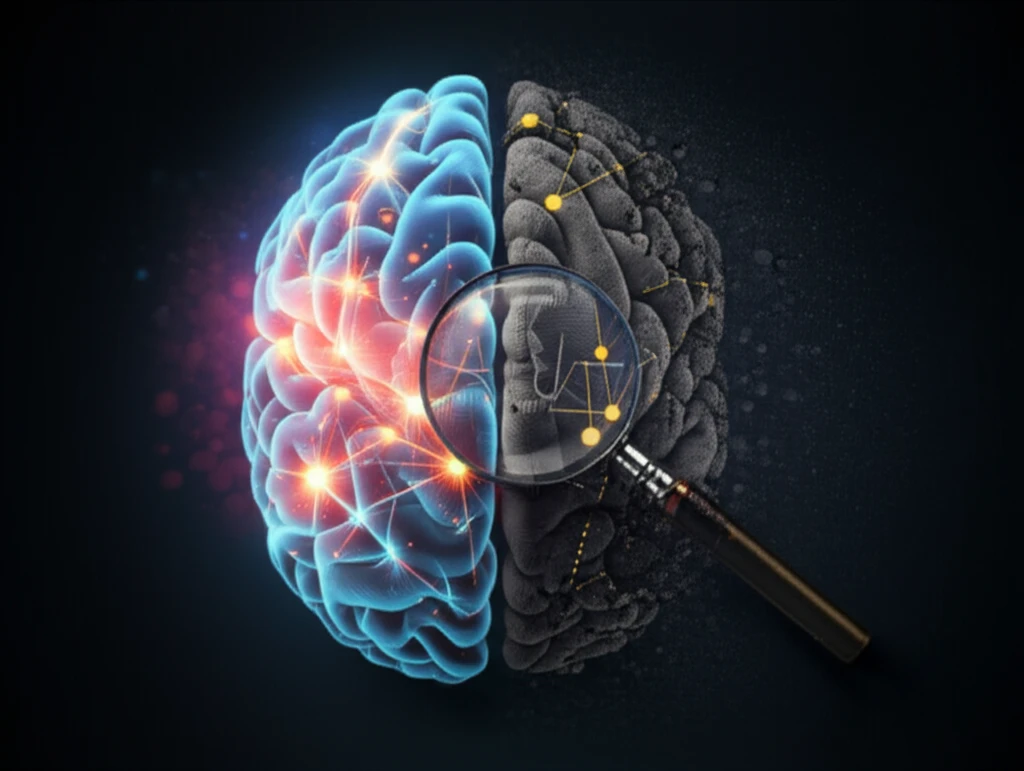
Unlocking the Alzheimer's Puzzle: How Brain Network Lateralization Holds a Key to Early Detection

"New research explores how changes in brain network lateralization, particularly in the default mode network (DMN), could be an early indicator of Alzheimer's disease, offering hope for earlier intervention."
For years, scientists have observed that as we age, the way our brains specialize tasks to one side—a phenomenon called lateralization—tends to shift. Similarly, Alzheimer's disease (AD) brings distinctive changes to brain function and structure. But what if these two processes are connected? Recent research is diving deep into how AD impacts the brain's resting-state lateralization, particularly within a critical network known as the default mode network (DMN).
The DMN is essentially your brain's 'at rest' network—active when you're not focused on specific tasks. It's been found to be vulnerable in aging and AD. Given that language and verbal memory often lean heavily on the left side of the brain, understanding how AD affects this balance could be a game-changer.
This article explores a study from the Alzheimer's Disease Neuroimaging Initiative, which investigates how amyloid pathology—a hallmark of AD—affects the lateralization of the DMN. By comparing groups with and without amyloid buildup, and varying stages of cognitive impairment, the research sheds light on potential new avenues for early diagnosis and intervention.
Decoding the Default Mode Network (DMN) and Alzheimer's Link
The default mode network (DMN) isn't just one homogenous blob of brain activity; it's more like a carefully orchestrated symphony with different sections playing unique roles. The anterior DMN (aDMN) and posterior DMN (pDMN) are two major components, each associated with distinct functions.
- Brain Regions Involved: The pDMN includes the posterior cingulate cortex, and parts of the temporal lobe, while the aDMN encompasses the medial prefrontal cortex.
- Connectivity Changes: AD can lead to enhanced connectivity in the aDMN and reduced connectivity in the pDMN.
- Age-Related Shifts: Functional lateralization in components of the DMN can shift as we age.
The Future of Alzheimer's Detection: A Call for More Research
This research underscores that exploring functional lateralization, alongside connectivity, is crucial to understanding the intricacies of AD. Further studies that incorporate diverse cognitive assessments, longitudinal designs, and advanced imaging techniques will refine our insights into the relationships between amyloid deposition, DMN lateralization, and cognitive decline. By focusing on these nuanced aspects, we can pave the way for early diagnostic tools and targeted interventions, ultimately improving outcomes for individuals at risk of or affected by Alzheimer's disease.