
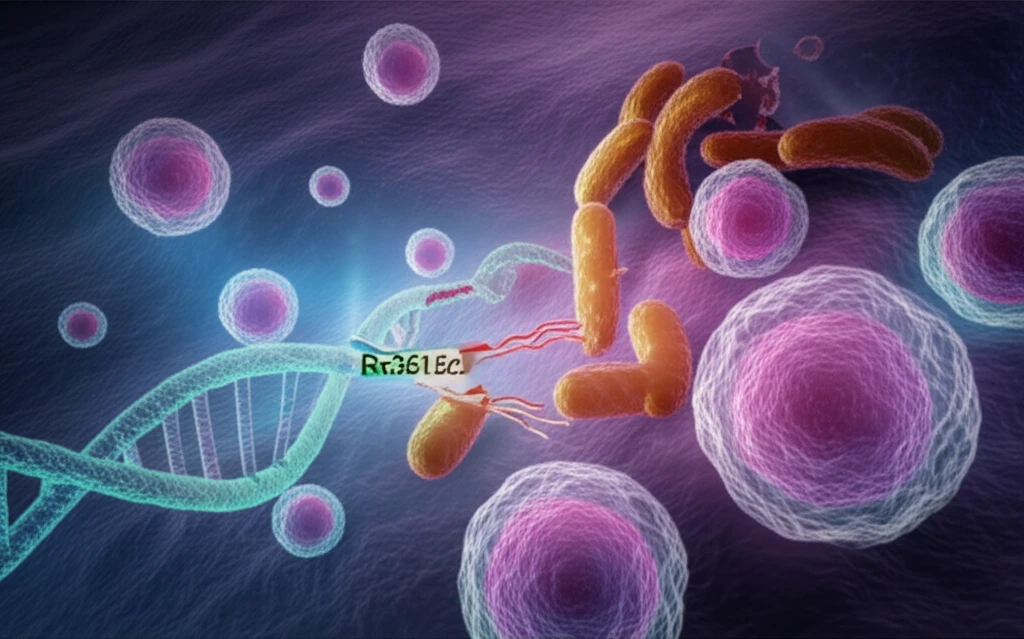
Microscopic view of Mycobacterium tuberculosis bacteria interacting with human immune cells.

Unlocking TB Detection: How a Novel Antigen Cocktail Could Revolutionize Diagnosis

"Discover how the inclusion of the Rv3615c antigen in a diagnostic cocktail significantly improves the sensitivity of tuberculosis detection, offering new hope for early and accurate diagnosis."


Tuberculosis (TB) remains a significant global health threat, with millions of new cases reported each year. Early and accurate diagnosis is crucial for effective treatment and control, but current methods often fall short, particularly in detecting latent infections or in immunocompromised individuals. The challenge lies in improving diagnostic sensitivity without sacrificing specificity, a balance that could transform TB management worldwide.

Traditional diagnostic approaches, such as sputum smear microscopy, have limitations in sensitivity, while others are affected by prior BCG vaccination or compromised immune responses. This has spurred the search for novel diagnostic markers and methods that can overcome these challenges and provide reliable results across diverse patient populations.

Recent research has focused on identifying new antigens that elicit strong T-cell responses, which play a pivotal role in the immune response to TB. Among these, the Rv3615c antigen has shown promise as a potent immuno-dominant target. A new study explores the potential of incorporating Rv3615c into a diagnostic cocktail to enhance TB detection, offering a beacon of hope for improved diagnostics.

Rv3615c: A Game-Changer in TB Diagnostics?

Microscopic view of Mycobacterium tuberculosis bacteria interacting with human immune cells.

The study, published in 'Tuberculosis,' investigates the effectiveness of a diagnostic cocktail comprising ESAT-6, CFP-10, and Rv3615c antigens for detecting Mycobacterium tuberculosis infection. Conducted across multiple centers, the randomized, double-blind study aimed to evaluate the clinical diagnostic performance of this three-antigen cocktail compared to existing methods.

The researchers identified Rv3615c as a robust CTL immunoantigen with broadly cross-HLA (human leukocyte antigen) allele-recognized peptides. This means the antigen can be recognized by a large portion of the population, making it a valuable tool for widespread diagnostic use. The key findings of the study include:

  • Enhanced Sensitivity: The three-antigen cocktail demonstrated a significantly improved sensitivity compared to using ESAT-6 and CFP-10 alone.
  • Broad Recognition: Rv3615c antigen contains multiple HLA restricted CTL epitopes.
  • Limitations in Immunocompromised Patients: The diagnostic performance was notably lower in patients concurrently suffering from cancer, indicating a restriction in diagnosing immunocompromised patients.
  • Clinical Significance: Inclusion of the Rv3615c antigen with multiple HLA restricted CTL epitopes would benefit the T-cell based diagnosis of MTB infection.
These results highlight the potential of Rv3615c as a valuable addition to TB diagnostic tools, particularly in improving sensitivity. However, the reduced efficacy in immunocompromised patients underscores the need for further research to address diagnostic challenges in these vulnerable populations.

The Future of TB Diagnostics

The integration of Rv3615c into TB diagnostic strategies represents a promising step forward in the fight against this global health challenge. While further research is needed to optimize its use in diverse clinical settings and patient populations, the enhanced sensitivity offered by the three-antigen cocktail holds significant potential for improving early detection and ultimately, TB control.

About this Article -

This article was crafted using a human-AI hybrid and collaborative approach. AI assisted our team with initial drafting, research insights, identifying key questions, and image generation. Our human editors guided topic selection, defined the angle, structured the content, ensured factual accuracy and relevance, refined the tone, and conducted thorough editing to deliver helpful, high-quality information.See our About page for more information.

Everything You Need To Know

1

What is the primary goal of incorporating the Rv3615c antigen into a diagnostic cocktail for tuberculosis (TB)?

The primary goal is to enhance the sensitivity of TB detection. This enhancement is achieved by including the Rv3615c antigen, along with ESAT-6 and CFP-10, in a diagnostic cocktail. This combination aims to improve the accuracy of identifying Mycobacterium tuberculosis infections, thereby enabling earlier diagnosis and treatment initiation. The study showed a significant improvement in sensitivity compared to using ESAT-6 and CFP-10 alone, which is crucial for effective TB control.

2

What role does the Rv3615c antigen play in TB diagnosis, and how does it differ from traditional methods?

The Rv3615c antigen is a key component of a new diagnostic approach, designed to improve the detection of Mycobacterium tuberculosis. Unlike traditional methods, which may have limitations in sensitivity, especially in cases of latent infections or compromised immune responses, the inclusion of Rv3615c aims to offer more reliable results. Rv3615c has been identified as a robust CTL immunoantigen, meaning it triggers a strong T-cell response. The diagnostic cocktail containing Rv3615c has shown enhanced sensitivity, suggesting that it can detect infections that might be missed by older methods. Traditional methods like sputum smear microscopy often lack the sensitivity required for early detection, highlighting the advantage of this novel approach.

3

What are the advantages of using a three-antigen cocktail composed of ESAT-6, CFP-10, and Rv3615c for TB diagnosis, as demonstrated in the study?

The three-antigen cocktail offers several advantages. Firstly, it enhances the sensitivity of detecting Mycobacterium tuberculosis, which is critical for early diagnosis. Secondly, Rv3615c antigen contains multiple HLA restricted CTL epitopes. This means that it can be recognized by a broad range of individuals, increasing the potential for widespread diagnostic use. The combination of ESAT-6, CFP-10, and Rv3615c provides a more comprehensive approach to TB detection, improving the chances of identifying the infection accurately across diverse patient populations.

4

Are there any limitations to the diagnostic performance of the three-antigen cocktail, and if so, what are they?

Yes, one notable limitation is the reduced efficacy in immunocompromised patients, particularly those concurrently suffering from cancer. The study found that the diagnostic performance of the cocktail was notably lower in this patient group. This underscores the need for further research to optimize diagnostic strategies for vulnerable populations and highlights that the enhanced sensitivity may not be as effective in all cases. This limitation emphasizes the importance of ongoing research to address diagnostic challenges across diverse patient populations and clinical settings.

5

How does the inclusion of Rv3615c in TB diagnostic strategies represent a step forward in combating tuberculosis globally?

The integration of Rv3615c into TB diagnostic strategies represents a significant advancement by improving early detection, which is crucial for effective TB control. The enhanced sensitivity offered by the three-antigen cocktail, including ESAT-6, CFP-10, and Rv3615c, allows for more accurate identification of Mycobacterium tuberculosis infections. This is particularly beneficial for detecting latent infections and improving diagnosis in various populations. Early detection enables timely treatment initiation, reducing the spread of the disease and improving patient outcomes, ultimately contributing to global efforts to combat TB.

Newsletter Subscribe

Subscribe to get the latest articles and insights directly in your inbox.