
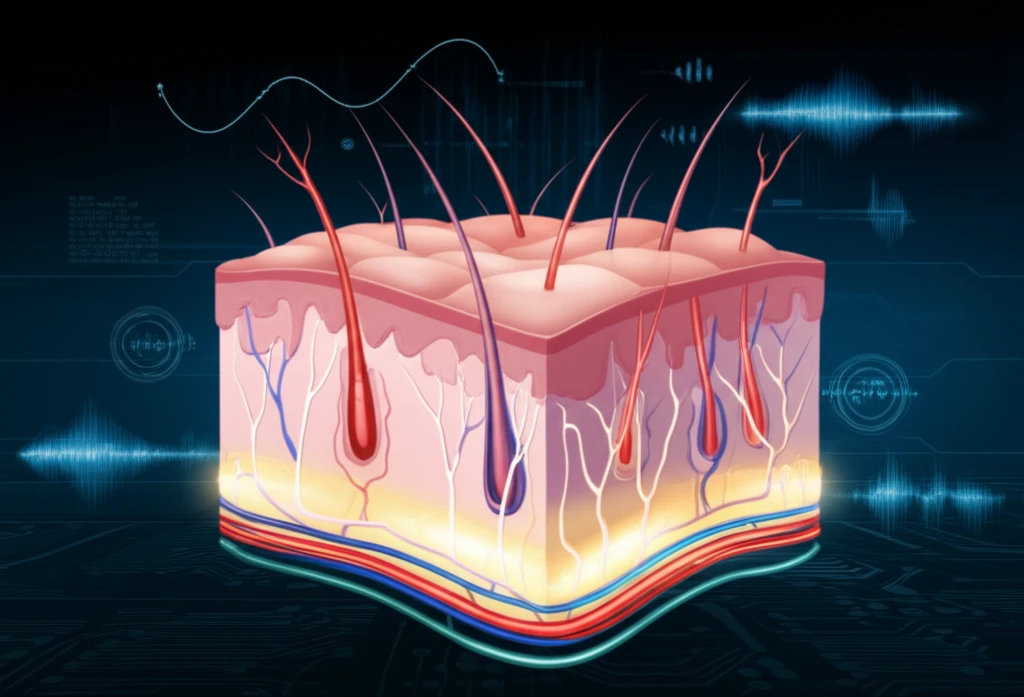
Unlocking Skin Secrets: How a New Technology is Revolutionizing Dermatology

"Motion correction in optoacoustic mesoscopy (RSOM) offers a new way to see beneath the skin, potentially changing how we diagnose and treat skin conditions."
For centuries, the beauty of skin has been admired, but its deeper mysteries remained hidden. Traditional methods of examining the skin, like visual inspection and biopsies, offer limited insights into the underlying structures and processes. However, a new technology is emerging that is changing the game: optoacoustic mesoscopy (RSOM). This innovative technique uses light and sound to create detailed images of the skin's internal landscape, opening up exciting new possibilities for dermatologists and patients alike.
RSOM, also known as photoacoustic mesoscopy, is a biomedical imaging technique that offers novel insights into the skin. It allows doctors to visualize tissue morphology and the biomarkers of inflammatory diseases non-invasively. While other imaging methods struggle to penetrate beyond a few millimeters, RSOM can achieve resolutions of just a few micrometers to depths of several millimeters. This makes it possible to see details previously hidden from view, such as the fine structures of blood vessels and the subtle changes associated with skin conditions.
This article delves into the science behind RSOM, exploring how it works and the significant impact it's making on dermatology. We'll explore how RSOM is being used to improve the diagnosis and treatment of skin conditions, as well as its potential for future advancements. From understanding the intricacies of psoriasis to detecting early signs of skin cancer, RSOM is poised to revolutionize the field of dermatology.
Decoding the Technology: How RSOM Works
At the heart of RSOM lies a fascinating interplay of light and sound. The process begins with short pulses of laser light, which are directed at the skin. This light is absorbed by different components of the skin, such as melanin (the pigment that gives skin its color) and blood vessels. When these structures absorb the light, they rapidly heat up, causing them to expand and generate ultrasonic waves. These waves, also known as photoacoustic waves, are then detected by highly sensitive ultrasound detectors.
- Laser Pulses: Short bursts of light are emitted onto the skin.
- Absorption and Expansion: Light is absorbed by skin components, causing them to heat up and expand.
- Ultrasound Wave Generation: This rapid expansion creates ultrasound waves.
- Detection: Ultrasound detectors capture these waves.
- Image Reconstruction: Computer algorithms transform the data into detailed 3D images.
The Future of Skin Care
Optoacoustic mesoscopy is more than just a new imaging technique; it's a window into the future of skin care. As the technology continues to develop, it holds immense promise for improving the diagnosis and treatment of skin diseases. With its ability to provide high-resolution, non-invasive images, RSOM is poised to revolutionize dermatology. The insights it provides are paving the way for more personalized and effective treatments, ultimately leading to healthier skin for all.