
Unlocking Skin Secrets: How a New Imaging Technique is Revolutionizing Dermatology

"Motion correction in optoacoustic mesoscopy is changing the way doctors diagnose and treat skin conditions."
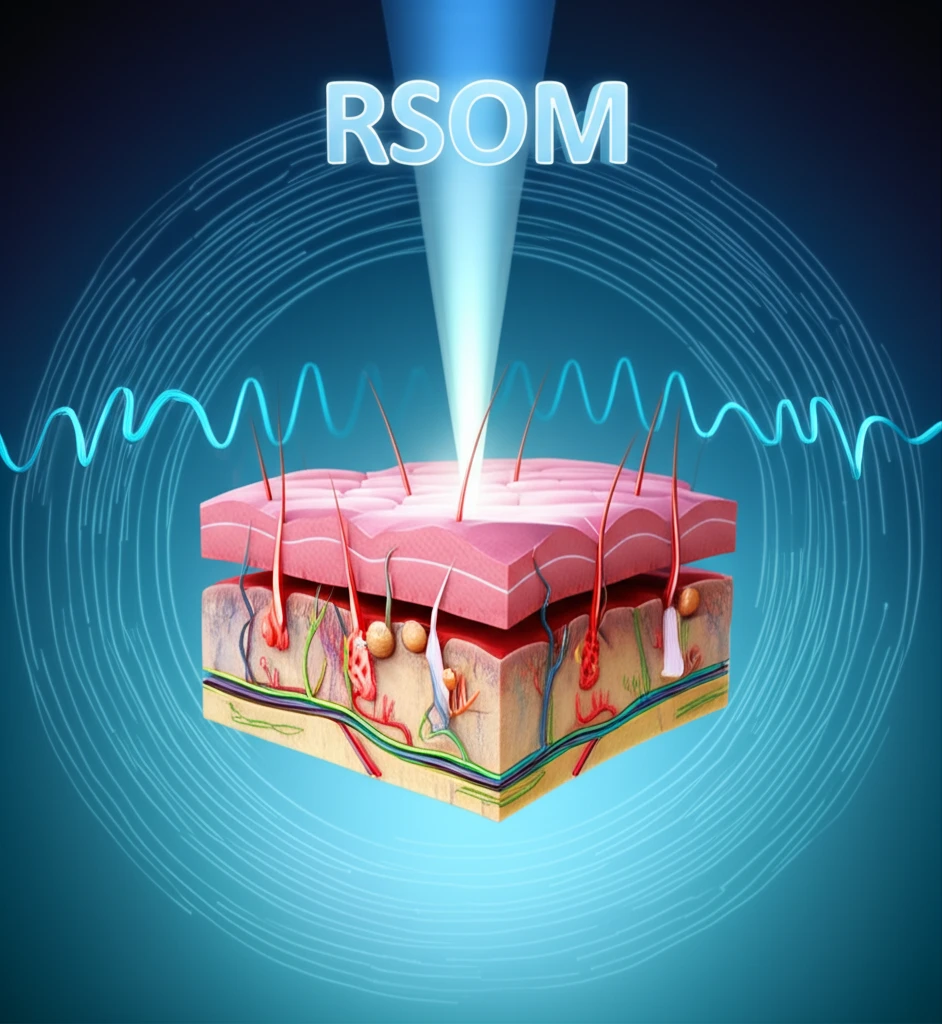
Imagine a world where doctors can peer beneath the surface of your skin, not just to see what's visible, but to understand the intricate processes happening within. This is the promise of optoacoustic mesoscopy (RSOM), a revolutionary imaging technique that's changing the face of dermatology. By combining light and sound, RSOM offers a non-invasive way to visualize the skin's structure and detect signs of disease at a level of detail previously unattainable.
RSOM, also known as photoacoustic mesoscopy, is offering novel insights into vascular morphology and pathophysiological biomarkers of skin inflammation in vivo at depths unattainable by other optical imaging methods. However, motion effects may deteriorate performance and reduce the effective resolution. Now, researchers have developed a motion correction algorithm for RSOM.
This article delves into the fascinating world of RSOM, exploring its capabilities, the challenges it faces, and the groundbreaking advancements that are making it a powerful tool for dermatologists. We'll examine how this technology works, the impact it's having on patient care, and what the future holds for this exciting field.
What is Optoacoustic Mesoscopy and How Does it Work?
At its core, optoacoustic mesoscopy is a sophisticated imaging technique that uses pulses of light to generate sound waves within the skin. The light is absorbed by different components of the skin, such as blood vessels and melanin, causing them to expand and emit sound waves. These sound waves are then detected by an ultrasound transducer, which creates detailed images of the skin's internal structures.
- Non-Invasive: RSOM is a non-invasive technique, meaning it doesn't require any incisions or injections.
- High Resolution: RSOM can achieve high-resolution images, allowing doctors to see details that are invisible to the naked eye.
- Deep Penetration: RSOM can penetrate deeper into the skin than many other imaging techniques, providing a more complete picture of the skin's health.
- Versatile: RSOM can be used to visualize a variety of skin conditions, from psoriasis to skin cancer.
The Future of Skin Imaging
The development of motion correction algorithms for RSOM is a significant step forward in the field of dermatology. As technology continues to advance, we can expect to see even more sophisticated imaging techniques that will enable doctors to diagnose and treat skin conditions with greater precision and effectiveness. With ongoing research, RSOM holds great promise for the future of skin health and well-being.