
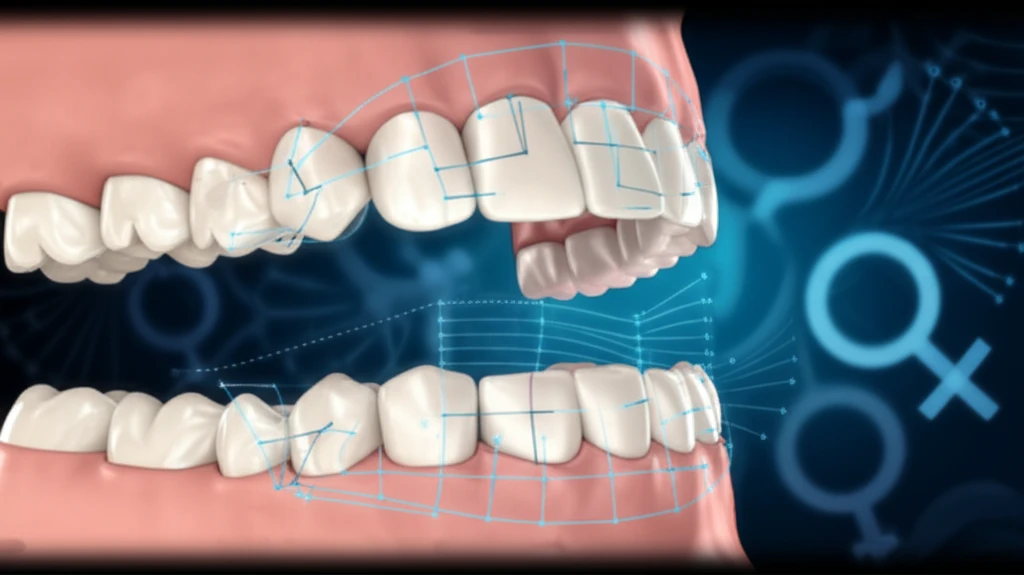
Unlocking Secrets with Bite Marks: A New AI Method to Determine Gender

"Forensic dentistry gets a high-tech update with computer-assisted bite mark analysis, promising faster and more reliable gender identification in criminal investigations."
In the high-stakes world of forensic science, where every detail matters, odontologic evidence—the study of teeth—stands as a critical tool for identifying individuals, often considered third in precision only to fingerprints and DNA analysis. The adage, "The criminal may lie through his teeth, though teeth themselves cannot lie," encapsulates the reliability that dental evidence brings to legal investigations. Any deviation from the norm in dental characteristics becomes a vital clue in establishing a suspect's identity.
Bite marks, defined as impressions made by teeth alone or in combination with other mouth parts, are a unique form of dental evidence. Forensic odontologists analyze these marks, examining their shape, size, and position to match them with a suspect's dentition. This process can reveal individual tooth marks, double-arched patterns, or even multiple overlying bruises, each providing critical information. However, bite marks can be altered by factors like skin elasticity, pressure applied during the bite, and the angle of the jaw, making accurate analysis challenging.
Recognizing these challenges, a team of researchers introduced a novel approach to bite mark analysis using computer-assisted methods. Their study aimed to evaluate bite marks in both males and females using an indirect, computer-assisted technique focusing on intercanine distance (ICD) and other angular measurements. The goal was to determine if this method could reliably differentiate between genders, thereby enhancing the accuracy and efficiency of forensic investigations.
Decoding Bite Marks: How the Computer-Assisted Method Works
The study, conducted in the Department of Oral Medicine and Radiology at Haldia Institute of Dental Sciences and Research in India, involved 60 participants—30 males and 30 females—aged 20 to 40 years. All participants had normal dental occlusion and presence of both maxillary canines. Exclusion criteria included occlusal disharmony, prior orthodontic treatment, restorative procedures on canines, developmental anomalies, trauma, and extreme age groups. Informed consent was obtained from each subject after explaining the study's importance.
- Bite Registrations: Participants gently bit into sheets of modeling wax to create bite registrations.
- Positive Replicas: Positive replicas of the bite marks were prepared using dental stone and barium powder to enhance radiodensity.
- Radiographic Analysis: Intraoral periapical radiographs were taken of the dental casts. These radiographs were then scanned and analyzed using specialized computer software (Sidexis Next Generation).
- Measurements: The software was used to measure several parameters: Intercanine distance (ICD), defined as the perpendicular distance between the mid-point of the central incisors to the intercanine line (line AB); Angles ABX and ABY, formed by lines drawn from the distal aspect of the central incisors to the midpoint of line AB.
The Future of Forensic Dentistry
The study introduces a novel computer-assisted method for bite mark analysis that is simple, reliable, economical, and less time-consuming, with assured confidentiality and minimal risk to participants. As forensic science continues to evolve, integrating advanced technologies like AI promises to enhance the precision and reliability of bite mark analysis, bringing justice closer with every investigation.