
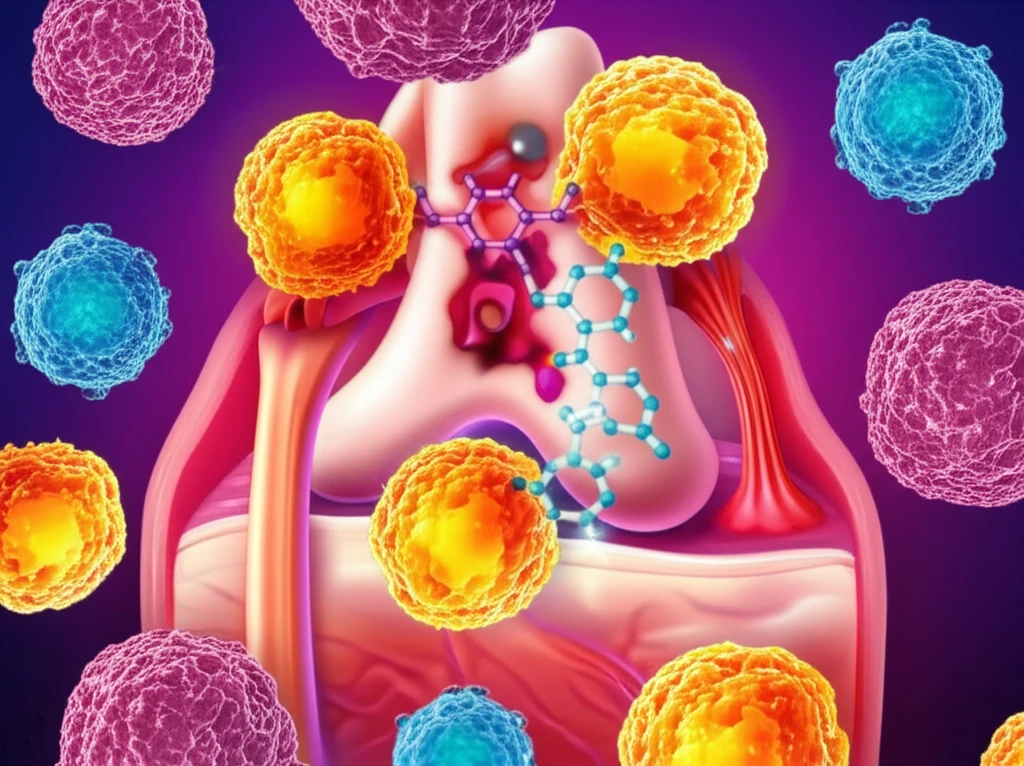
Illustration of a joint affected by rheumatoid arthritis, highlighting macrophages and the impact of Polyphyllin I.

Unlocking Relief: How a Natural Compound Fights Arthritis by Calming Your Immune System

"New research reveals how a compound found in traditional medicine could offer a promising path toward easing the painful symptoms of rheumatoid arthritis."


Rheumatoid arthritis (RA) is a chronic autoimmune disorder that affects millions worldwide, causing painful swelling, stiffness, and joint damage. For those living with RA, everyday activities can become a challenge, and finding effective treatments is crucial. Current treatments often involve medications with significant side effects, highlighting the need for new approaches.

Amidst the search for better solutions, researchers are turning to the wisdom of traditional medicine, specifically to a compound called Polyphyllin I (PPI). This natural substance, derived from the Rhizoma of Paris polyphylla, has shown intriguing properties in preliminary studies. This article delves into the latest findings on PPI, exploring its potential to alleviate RA symptoms by targeting the body's inflammatory responses.

This article aims to provide a clear and accessible overview of the latest research on Polyphyllin I, examining its mechanism of action and potential benefits for those living with rheumatoid arthritis. We'll explore how PPI interacts with key pathways in the immune system, potentially offering a new, natural avenue for managing this challenging condition.

The Science Behind Rheumatoid Arthritis: Understanding the Inflammation

Illustration of a joint affected by rheumatoid arthritis, highlighting macrophages and the impact of Polyphyllin I.

Rheumatoid arthritis is characterized by the immune system mistakenly attacking the lining of the joints, known as the synovium. This immune response leads to inflammation, which causes the familiar symptoms of pain, swelling, and stiffness. Over time, this chronic inflammation can damage cartilage and bone, leading to further pain and disability.

At the heart of this inflammatory process are immune cells, particularly macrophages. Macrophages are like the body's cleanup crew, but in RA, they become overactive and contribute to the ongoing inflammation. These macrophages release inflammatory cytokines such as TNF-alpha and IL-6, which fuel the inflammatory cascade, exacerbating the condition.

  • Immune System Dysfunction: The immune system attacks the joint lining.
  • Macrophage Activation: Overactive macrophages release inflammatory cytokines.
  • Cytokine Release: TNF-alpha and IL-6 worsen inflammation.
  • Joint Damage: Chronic inflammation damages cartilage and bone.
Therefore, any treatment that can effectively calm down the activity of macrophages and reduce the production of these inflammatory cytokines could offer significant relief to RA sufferers. This is where the potential of Polyphyllin I comes into play.

A Promising Future for RA Treatment

The research on Polyphyllin I offers a ray of hope for individuals with rheumatoid arthritis. By targeting the inflammatory pathways that drive the disease, PPI could potentially provide relief from pain and slow the progression of joint damage. While more research is needed, the initial findings are encouraging, suggesting that PPI could become a valuable addition to the arsenal of treatments for RA. As research continues, it is hoped that PPI will be proven effective for the treatment of RA and improve the quality of life of many people.

About this Article -

This article was crafted using a human-AI hybrid and collaborative approach. AI assisted our team with initial drafting, research insights, identifying key questions, and image generation. Our human editors guided topic selection, defined the angle, structured the content, ensured factual accuracy and relevance, refined the tone, and conducted thorough editing to deliver helpful, high-quality information.See our About page for more information.

This article is based on research published under:

DOI-LINK: 10.3389/fimmu.2018.02091, Alternate LINK

Title: Polyphyllin I Ameliorates Collagen-Induced Arthritis By Suppressing The Inflammation Response In Macrophages Through The Nf-Κb Pathway

Subject: Immunology

Journal: Frontiers in Immunology

Publisher: Frontiers Media SA

Authors: Qiong Wang, Xin Zhou, Yongjian Zhao, Jun Xiao, Yao Lu, Qi Shi, Yongjun Wang, Hongyan Wang, Qianqian Liang

Published: 2018-09-27

Everything You Need To Know

1

What is Rheumatoid Arthritis (RA) and how does it impact daily life?

Rheumatoid Arthritis (RA) is a chronic autoimmune disorder where the immune system mistakenly attacks the synovium, the lining of the joints. This leads to inflammation, causing pain, swelling, and stiffness. Over time, this chronic inflammation can damage cartilage and bone, leading to further pain and disability. For individuals with RA, everyday activities can become challenging due to the pain and reduced joint function.

2

How does Polyphyllin I (PPI) potentially alleviate the symptoms of Rheumatoid Arthritis?

Polyphyllin I (PPI) shows promise in alleviating Rheumatoid Arthritis symptoms by targeting the inflammatory pathways that drive the disease. Specifically, research suggests PPI can calm down the activity of macrophages and reduce the production of inflammatory cytokines like TNF-alpha and IL-6. By modulating these key components of the immune response, PPI could potentially reduce inflammation, providing relief from pain and slowing the progression of joint damage.

3

What role do macrophages and cytokines like TNF-alpha and IL-6 play in Rheumatoid Arthritis?

In Rheumatoid Arthritis, macrophages, which are normally part of the body's cleanup crew, become overactive and contribute to ongoing inflammation. These macrophages release inflammatory cytokines, such as TNF-alpha and IL-6, which fuel the inflammatory cascade and exacerbate the condition. TNF-alpha and IL-6 worsen the inflammation, leading to increased pain, swelling, and joint damage. Therefore, targeting macrophages and these cytokines is crucial in managing RA.

4

Where does Polyphyllin I (PPI) come from, and why is it being researched as a potential treatment for Rheumatoid Arthritis?

Polyphyllin I (PPI) is a natural substance derived from the Rhizoma of Paris polyphylla, a plant used in traditional medicine. Researchers are exploring PPI as a potential treatment for Rheumatoid Arthritis because preliminary studies have shown it has intriguing anti-inflammatory properties. It shows the potential to modulate the immune response and reduce inflammation in the joints. This offers a new avenue for managing the condition.

5

What are the current treatments for Rheumatoid Arthritis, and what are the limitations that make research into compounds like Polyphyllin I (PPI) important?

Current treatments for Rheumatoid Arthritis often involve medications that can have significant side effects. These medications aim to suppress the immune system or reduce inflammation, but they may not be effective for all patients, and the side effects can impact quality of life. This highlights the need for new approaches, such as exploring natural compounds like Polyphyllin I (PPI). PPI offers a potential alternative with a different mechanism of action, possibly leading to fewer side effects while still effectively managing the disease.

Newsletter Subscribe

Subscribe to get the latest articles and insights directly in your inbox.