
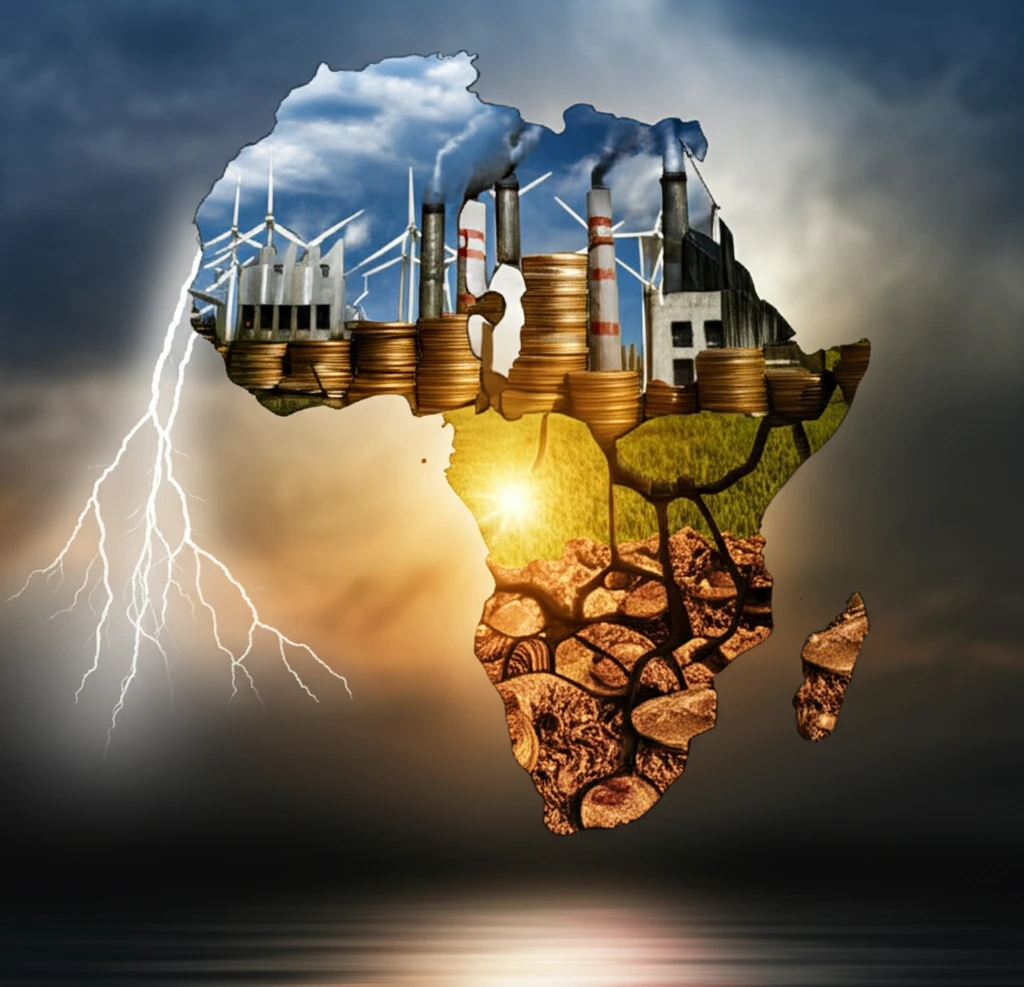
Unlocking Peace: How Economic Factors Drive Conflict in Africa

"A Deep Dive into the Economic Roots of Violent Conflict and Strategies for Sustainable Stability"
For the past half-century, Africa has faced significant challenges with high levels of violent conflict. Unlike historical patterns where wars led to state formation, African conflicts have often been destructive, leaving states weakened and vulnerable to further unrest. Despite a global decline in conflicts since the end of the Cold War, Africa has not followed this trend, with predictions suggesting that conflict levels will remain alarmingly high.
Understanding the drivers behind these conflicts is crucial. While many factors have been cited—historical grievances, geographic challenges, demographic pressures, and economic factors—it's essential to examine the root causes and dispel the notion of African exceptionalism. The key question remains: why has Africa experienced so much violent political conflict, and what can be done to foster lasting peace?
This article delves into the economics of violent conflict in Africa, exploring the complex interplay of historical, geographical, demographic, and economic factors. By examining these elements, we aim to provide insights into the underlying causes of conflict and potential strategies for building more stable and prosperous societies.
The Human and Economic Toll of Conflict
Violent conflict in Africa carries a devastating human toll. Over the last two decades, conflict has likely contributed to the deaths of as many as 5 million young children, 3 million of them infants, according to research that links conflict locations to health statistics on child deaths. The Council on Foreign Relations' Global Conflict Tracker documents active conflict across the continent, including in the Central African Republic, the Democratic Republic of Congo, Somalia, South Sudan, and the Sahel. One analysis calls violent conflict 'the biggest impediment to a more prosperous Africa,' and asks what concrete benefits the absence of war would deliver over time. Researchers have also studied how proximity to conflict shapes social attitudes, measuring exposure by counting incidents within a 30-kilometer radius of respondents' dwellings.
Studying the Climate-Conflict Link
A growing body of research treats climate change as a potential driver of violent conflict, often using an analytical framework that links climate change to conflict events based on desktop research and personal insights. Scholars caution, however, that violent conflict in Africa stems from many causes, including poor leadership, social exclusion, and conflicting goals, and that the climate-narrative is relatively new and examined largely in terms of correlation. The Horn of Africa, home to the largest concentration of pastoralists in Sub-Saharan Africa, is a focal case because it is both highly conflict-prone and vulnerable to climatic fluctuations. These desktop and correlational methods face inherent limitations in isolating climate as a distinct cause amid multiple interacting drivers.
Roots of Contemporary African Conflict
Contemporary violent conflict in Africa is best understood against its historical backdrop. African historians observe that there have been transformations in the nature and dimension of violent conflicts from what has been the history of violence on the continent, with Africa 'once again on the boil.' Scholarly masterclasses on crisis and crisis management in Africa lay historical and conceptual foundations for understanding today's conflicts. Horizontal inequalities are identified as root causes, supported by original surveys of more than 3,000 respondents in African cities and towns that expose clear discrepancies between objective inequalities and people's subjective perceptions. Emerging legal scholarship is also examining new areas of concern, such as the link between climate change and armed conflict in Africa's Horn.
Economic Factors Fueling Conflict
A key factor to consider is Africa’s historical experience with conflict. Unlike Europe, where warfare played a crucial role in state formation by incentivizing military innovation and taxation, African wars often hindered development. Colonial rule further complicated matters by disrupting traditional governance structures and creating opportunities for rent-seeking among local elites. These historical dynamics have left many African states with weak institutions and a legacy of instability.
- Resource Dependence: Reliance on primary commodities creates economic volatility.
- Weak Governance: Limited state capacity hinders conflict prevention.
- Historical Grievances: Past conflicts fuel ongoing tensions.
- Geographic Challenges: Difficult terrain aids rebel groups.
New Evidence on Poverty, Climate, and Conflict
Recent research increasingly links poverty dynamics to violent conflict. One researcher, whose work focuses on poverty dynamics, violent conflict, and intersecting crises alongside gender and education, asks how governments can tackle poverty when conflict persists. A study published by International Studies Review on 15 November 2023 demonstrates that climate change can escalate the risks of violent conflict through various pathways, with relevance for the Middle East and North Africa. These findings point to multiple, interacting pathways between environmental stress, economic hardship, and organized violence.
Gaps in African Conflict Management
African conflict management faces documented gaps, from the design of the African peace and security architecture and regional conflict management mechanisms to the challenges posed by cross-border criminal and terrorist networks in West Africa. Critics argue the shortfall is not a lack of understanding but of political will. President Paul Kagame has criticized African leaders for their lack of a sense of responsibility, noting that 'for so long we have discussed African conflicts, their historical roots, reasons for conflicts' and that 'we have quite a good idea as to what is needed in order for the conflicts to be resolved.' The recurring failure to translate diagnosis into action helps explain why conflict persists despite extensive analysis.
Fewer Wars, More Complex Political Violence
Conflict data sources show fewer armed conflicts in Africa, but analysts caution that political violence is rising and has become more complex, even as it is significantly less deadly than in previous decades. Violent conflict is not limited to Ethiopia and Sudan: many countries are caught in conflict traps, including South Sudan, Burundi, Cameroon, Chad, the Democratic Republic of Congo, Somalia, the Central African Republic, Burkina Faso, Libya, and Mali. In the Horn of Africa, protracted internal conflicts known as complex political emergencies have been prevalent since the 1970s, making conflict resolution and mediation a high priority for intergovernmental organizations as well as Western and African governments.
Towards a More Peaceful Future
Addressing the root causes of violent conflict in Africa requires a multifaceted approach that tackles economic, political, and social challenges. By promoting inclusive economic growth, strengthening governance structures, and fostering social cohesion, it is possible to build more stable and prosperous societies. While there is no one-size-fits-all solution, understanding the underlying drivers of conflict is the first step towards creating a more peaceful future for the continent.
On-the-Ground Assessment of Renewed Fighting
Expert analysis underscores how quickly Africa's conflict landscape can shift. In August 2026, Dr Jalale Getachew Birru, East Africa Senior Analyst at ACLED, commented on renewed TDF-government clashes and shifting alliances across Ethiopia. His assessment highlights that even conflicts widely believed to be resolved can flare again as political alliances realign. Such country-level expert commentary provides the granular, up-to-date context that aggregate statistics and modeling alone cannot capture.
Projecting Conflict to 2050
Forward-looking research projects the trajectory of intrastate conflict in Africa to 2050. One paper using the International Futures (IFs) model analyzes future trends and explores how multipolarity may impact stability, forecasting conflict patterns for West, Southern, Horn/East, and Central Africa. Earlier analyses described emerging trends since the end of the Cold War and identified seven key correlations associated with intrastate violence on the continent. The stakes are visible today: an analysis of Sudan confirms that violent conflict is the single most binding constraint on the country's development, directly undermining all dimensions of human development.
Conflict's Intersection with Governance, Food, and Climate
Violent conflict in Africa interacts with governance choices, food systems, and environmental stress. Researchers note a notable lack of evidence on whether exposure to violent conflict increases support for government surveillance in fragile settings, where the incidence of conflict is high, even though this question has been studied elsewhere. CGIAR has examined the gendered response to farmer-herder violent conflict in Nigeria as part of region-specific challenges to food, land, and water systems. The Horn of Africa is a stark example of how climate change and conflict converge to exacerbate displacement, with severe and recurrent impacts including prolonged droughts, devastating floods, desertification, and erratic weather patterns.
The Everyday Reality of Violence
Beyond statistics, conflict reshapes the daily lives of ordinary people. African conflicts are inseparable from the conflicts of the twentieth century, the most violent century in world history, and many postcolonial conflicts are rooted in colonial conflicts. Gender-specific effects are severe: research in Northern Uganda found that participants view their world as a dangerous place surrounded by multiple forms of violence, including verbal, emotional, physical, and sexual abuse. The majority of young people affected by conflict remain largely invisible, though initiatives such as International Alert's Kenya-based 'Powering peace through climate action' project allow young applicants to secure small grants for their own initiatives, in whatever format they choose.