
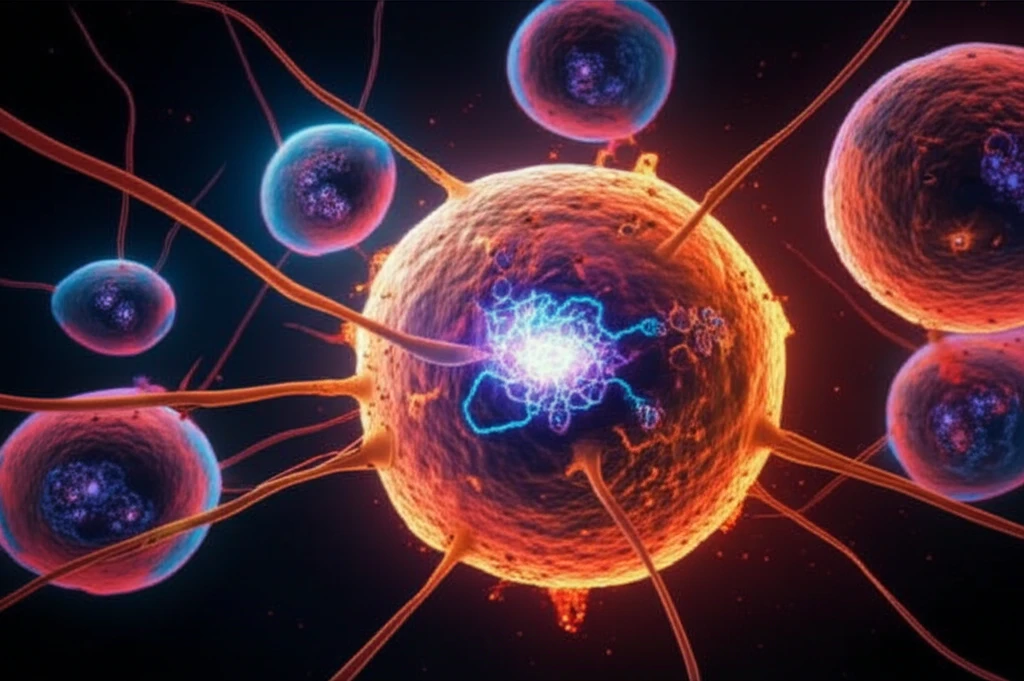
Unlocking Parasite Secrets: How an Enzyme Shapes Toxoplasma gondii

"Delving into the role of Active Serine Hydrolase 4 (ASH4) in parasite division and architecture."
Toxoplasma gondii, a common parasite, subtly influences the health of nearly a third of the global population. While most infections remain unnoticed, they pose significant risks to individuals with weakened immune systems and pregnant women. Understanding how this parasite replicates is critical to finding new treatments to halt disease.
Central to T. gondii's success is its replication cycle, relying on a class of enzymes known as serine hydrolases. These enzymes regulate diverse biological processes within the parasite, but their specific roles are just beginning to be understood. Recent studies spotlight Active Serine Hydrolase 4 (ASH4) as a key player, but its function has remained elusive until now.
New research has revealed that ASH4 is essential for parasite division and the maintenance of parasite architecture. This breakthrough not only clarifies ASH4’s function but also opens new doors for therapeutic interventions targeting T. gondii.
ASH4: More Than Just a Depalmitoylase
Previous studies hinted that ASH4 might function as a depalmitoylase, an enzyme that removes palmitate from proteins. However, new biochemical assays demonstrate that ASH4 prefers short acyl esters over palmitoyl thioesters. This suggests that ASH4 functions as an esterase, cleaving short-chain esters and impacting different metabolic pathways than initially thought.
- Division Defects: Mutant parasites show incomplete cell division, resulting in disorganized clusters.
- Multiple Residual Bodies: Unlike typical parasites, ASH4-deficient parasites form multiple residual bodies, which disrupt the typical rosette architecture.
- Dispersion Problems: After leaving host cells, mutant parasites fail to disperse effectively, hindering their ability to infect new cells.
New Directions in Parasite Control
This research highlights ASH4 as a potential target for therapeutic interventions. By understanding its role in parasite division and architecture, researchers can explore new ways to disrupt T. gondii's life cycle.
Future studies could focus on developing specific ASH4 inhibitors or compounds that restore normal vacuolar organization. These strategies may improve the effectiveness of existing treatments and prevent the spread of infection.
Unraveling the mysteries of parasite biology provides essential tools to combat infectious diseases and protect vulnerable populations. With each discovery, we move closer to a future where parasitic infections pose less of a threat to global health.