
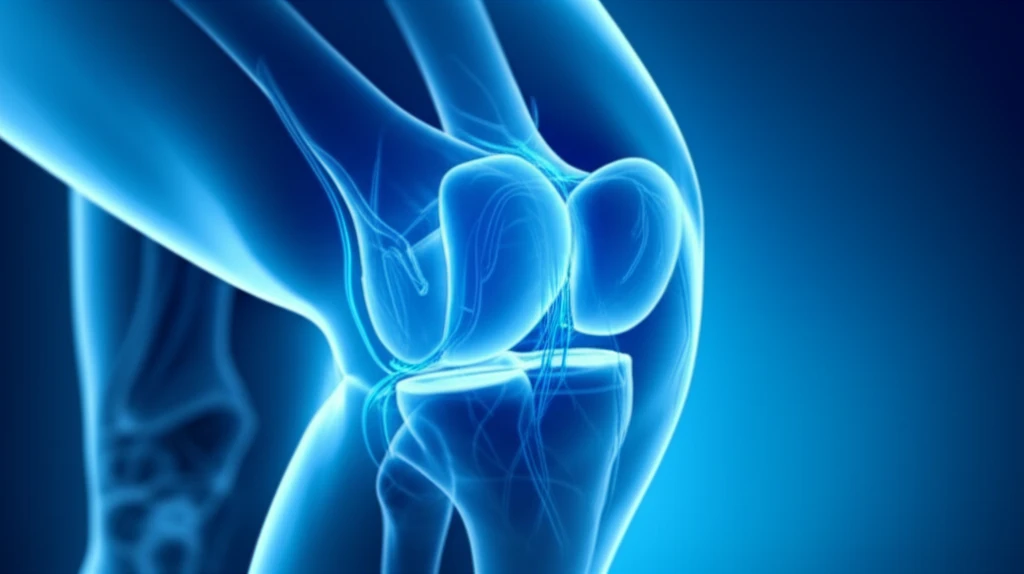
Illustration of a knee joint with glowing ion channels, symbolizing osteoarthritis pain relief.

Unlocking Pain Relief: How Targeting Ion Channels Could Revolutionize Osteoarthritis Treatment

"New research identifies a key mechanism behind osteoarthritis pain, offering hope for more effective and targeted therapies."


Osteoarthritis (OA) is a widespread and debilitating condition, impacting millions worldwide. It's characterized by chronic pain, reduced mobility, and a diminished quality of life. Current pain management strategies often fall short, highlighting the urgent need for more effective solutions.

A key feature of OA is mechanical allodynia, where normally painless stimuli, like joint movement, trigger intense pain. This occurs due to the sensitization of articular nociceptors – the pain receptors in your joints. These receptors become hyperactive, firing pain signals at the slightest touch.

Recent research has focused on high-threshold mechanosensitive ion channels (MSICs) within these nociceptors. These channels are responsible for converting mechanical forces into electrical signals that the brain interprets as pain. A groundbreaking study has uncovered how MSICs contribute to the development of mechanical allodynia in osteoarthritis, paving the way for targeted therapeutic interventions.

MSIC's Role in Osteoarthritis Pain: The Science Explained

Illustration of a knee joint with glowing ion channels, symbolizing osteoarthritis pain relief.

The study, published in Osteoarthritis and Cartilage, used a mouse model to investigate the role of MSICs in OA-related pain. Researchers induced osteoarthritis in mice and then examined the properties of MSICs in knee-innervating nociceptors. Electrophysiological recordings revealed that in OA mice, the activation threshold of MSICs was significantly reduced. This means that the channels opened more easily, firing pain signals at lower levels of mechanical stimulation.

Further experiments demonstrated that a selective MSIC inhibitor, GsMTx4, could reverse this effect. When injected into the arthritic joints of mice, GsMTx4 significantly reduced the activation of pain circuits in the spinal cord and alleviated primary mechanical allodynia. This finding suggests that MSICs are critical contributors to OA pain and that blocking these channels could be an effective therapeutic strategy.

What This Means for OA Pain:
  • MSICs in articular nociceptors become sensitized during osteoarthritis.
  • This sensitization lowers the threshold for pain activation, leading to mechanical allodynia.
  • Blocking MSICs with inhibitors like GsMTx4 can reduce pain and spinal cord activation in OA models.
To determine if MSIC activity was indeed tied to the sensation of pain, scientists tested whether blocking these channels would prevent pain signals from reaching the spinal cord. They found that blocking MSICs in the OA knee prevented pain signals from reaching the spinal cord, thus proving that MSICs were responsible for the sensation of pain in osteoarthritic mice. Additional research also proved that commonly used pain relief methods that worked on other channels had no effect on MSIC activity.

The Future of Osteoarthritis Pain Management

This research offers a promising new direction for osteoarthritis pain management. By targeting MSICs, scientists may be able to develop more effective and specific pain relief strategies with fewer side effects than current treatments.

While GsMTx4 shows promise, further research is needed to develop similar compounds suitable for human use. Future studies will also investigate how MSIC sensitization occurs in the first place, potentially uncovering additional therapeutic targets.

Ultimately, understanding the role of MSICs in osteoarthritis pain could revolutionize treatment approaches, providing much-needed relief for millions suffering from this debilitating condition. In the future, scientists hope to target TNF-α, interleukin-6, or interleukin-1β on MSIC activity, which may lead to the development of improved therapy for OA pain.

About this Article -

This article was crafted using a human-AI hybrid and collaborative approach. AI assisted our team with initial drafting, research insights, identifying key questions, and image generation. Our human editors guided topic selection, defined the angle, structured the content, ensured factual accuracy and relevance, refined the tone, and conducted thorough editing to deliver helpful, high-quality information.See our About page for more information.

This article is based on research published under:

DOI-LINK: 10.1016/j.joca.2017.08.012, Alternate LINK

Title: Mechanosensitive Ion Channels In Articular Nociceptors Drive Mechanical Allodynia In Osteoarthritis

Subject: Orthopedics and Sports Medicine

Journal: Osteoarthritis and Cartilage

Publisher: Elsevier BV

Authors: B.H. He, M. Christin, S. Mouchbahani-Constance, A. Davidova, R. Sharif-Naeini

Published: 2017-12-01

Everything You Need To Know

1

What is Osteoarthritis?

Osteoarthritis is a condition that causes chronic pain and reduced mobility. It is a widespread and debilitating condition that affects millions worldwide. It is characterized by the degeneration of joint cartilage, leading to pain, inflammation, and stiffness. The current pain management strategies often fall short, highlighting the urgent need for more effective solutions.

2

What is mechanical allodynia and how does it relate to Osteoarthritis?

Mechanical allodynia is a key feature of Osteoarthritis, where normally painless stimuli, like joint movement, trigger intense pain. This occurs due to the sensitization of articular nociceptors, which are the pain receptors in your joints. These receptors become hyperactive, firing pain signals at the slightest touch. This is different from other types of pain, as it is triggered by mechanical forces rather than inflammatory or neuropathic processes.

3

What are MSICs and what is their role in Osteoarthritis?

MSICs, or high-threshold mechanosensitive ion channels, are found within articular nociceptors and are responsible for converting mechanical forces into electrical signals that the brain interprets as pain. In Osteoarthritis, these MSICs become sensitized, meaning they open more easily and fire pain signals at lower levels of mechanical stimulation. This increased sensitivity contributes directly to the experience of mechanical allodynia.

4

How was the role of MSICs investigated in the study?

The study used a mouse model to investigate the role of MSICs in Osteoarthritis-related pain. Researchers induced Osteoarthritis in mice and then examined the properties of MSICs in knee-innervating nociceptors. Electrophysiological recordings revealed that in the Osteoarthritis mice, the activation threshold of MSICs was significantly reduced. They also used a selective MSIC inhibitor, GsMTx4, which, when injected into the arthritic joints of mice, significantly reduced the activation of pain circuits in the spinal cord and alleviated primary mechanical allodynia.

5

How can targeting MSICs help with Osteoarthritis pain management?

Targeting MSICs with inhibitors like GsMTx4 offers a promising new direction for Osteoarthritis pain management. By blocking these channels, scientists may be able to develop more effective and specific pain relief strategies with fewer side effects than current treatments. The research shows that blocking MSICs in the osteoarthritic knee prevented pain signals from reaching the spinal cord, thus proving that MSICs were responsible for the sensation of pain. This is significant because it offers a potential mechanism of action for new therapies that could specifically target the source of pain in Osteoarthritis.

Newsletter Subscribe

Subscribe to get the latest articles and insights directly in your inbox.